





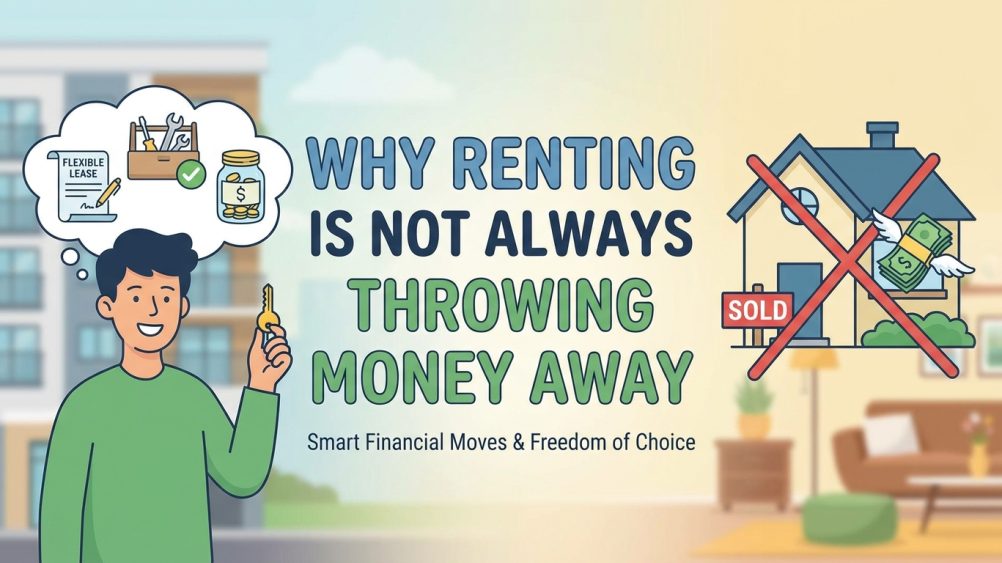
You have heard it before. “Renting is just throwing money away.” It is one of the most repeated pieces of financial advice. It is also one of the most misleading. The truth is far more layered than a single sentence can capture.
Renting and buying are two different financial tools. Neither is universally better. Your income, location, life plans, and market conditions all matter enormously. Dismissing renting as wasteful ignores real numbers that tell a very different story.
The Monthly Cost Gap Is Real
Let us start with the most basic comparison: what you actually pay each month.
SmartAsset’s 2025 study found that homeowners face median monthly costs of $2,641. Renters, by comparison, pay a median of $1,341 per month. That is nearly double the cost for owners. The gap alone demands attention before any other argument is made.
In large cities, the difference is even sharper. Buying in a major metro means higher property taxes, steeper insurance, and larger mortgage payments. Renting in those same cities often comes at a fraction of the cost. That freed-up cash is not disappearing. It can be saved, invested, or deployed elsewhere.
The monthly cost comparison is only the starting point. The real picture gets much heavier once hidden costs are added.
Hidden Costs of Owning Are Staggering
Most homebuying conversations focus on the mortgage. That is a mistake.
A 2025 analysis by Zillow and Thumbtack found that insurance, maintenance, and property taxes cost the average homeowner $15,979 per year. That works out to an additional $1,325 every single month, on top of the mortgage payment. The breakdown is telling: $10,946 goes toward maintenance alone. Another $2,003 covers homeowner’s insurance. The remaining $3,030 goes to property taxes.
Insurance premiums have surged 48% over the past five years. Household incomes, by contrast, grew just 3.8% in the past year. These hidden costs grew 4.7% in the same period. The numbers are moving in the wrong direction for buyers.
In expensive coastal metros, the situation is worse. Hidden costs exceed $24,000 annually in New York City and $22,000 in San Francisco. These are not edge cases. These are major employment hubs where millions of people live.
Renters sidestep almost all of this. A broken boiler, a leaking roof, a failing HVAC system none of that lands on a renter’s budget. That financial insulation has genuine value, even if it does not show up in a mortgage brochure.
The Opportunity Cost Argument Is Powerful
Here is where the conversation shifts from costs to capital.
Buying a home requires a significant down payment. In 2025, that often means putting down $60,000 to $100,000 or more on a median-priced home. That money is locked into a single illiquid asset. It cannot be quickly accessed. It earns returns only when the property appreciates.
Now consider what happens if that same capital is invested instead. Historical data cited by NYU Stern School of Business shows that real estate typically delivers lower average returns than stocks. The S&P 500 returned 24.88% in 2024 alone, while real estate returned just 4.24% that same year.
This is not an argument that stocks always win. Markets fluctuate, and real estate can perform well in specific locations and time periods. But it is a serious challenge to the assumption that buying always beats renting financially. A renter who invests their down payment savings and the monthly cost difference can, in the right conditions, build substantial wealth over time.
Rent buys housing and flexibility. Ownership costs: interest, insurance, maintenance: vanish just as silently.
Flexibility Has Real Financial Value
Life does not follow a fixed plan. Careers shift. Relationships change. Cities grow and shrink in different directions. Renting lets you respond to those shifts without enormous friction.
Selling a home takes time, money, and the right market conditions. Transaction costs, agent fees, and closing costs can easily total 8% to 10% of a home’s sale price. If you need to move before five years are up, buying almost certainly costs more than renting would have.
For people in their twenties and thirties, career mobility is often more valuable than property ownership. A job opportunity in another city is far easier to act on as a renter. For remote workers navigating an uncertain job market, locking capital into a single location carries real financial risk.
This flexibility is not emotional. It is economical. The ability to respond to changing circumstances without losing tens of thousands of dollars in transaction costs is a genuine financial advantage.
The Narrative Has Always Favoured Buyers
Part of why renting is treated as failure comes down to culture, not economics. Homeownership has been marketed as the cornerstone of financial success for decades. Real estate agents, mortgage lenders, and popular personal finance advice all push in the same direction.
But the math does not always agree with the narrative Bankrate’s 2025 Hidden Costs of Homeownership Study found that hidden homeownership costs now make buying a $21,400-per-year proposition in the United States beyond the mortgage. Nearly 42% of homeowners with regrets cited maintenance and hidden costs as more expensive than they expected. That is not a fringe experience. It is the majority of people who have second thoughts.
This is not an argument against ever buying a home. Homeownership builds equity over time. It provides stability. It can be a powerful long-term wealth-building tool in the right market, at the right price, held for long enough.
The argument is simpler: the belief that renting is always a financial mistake is wrong. It is not based on evidence. It is based on a cultural script that was written when housing prices were lower, mortgage rates were friendlier, and hidden costs were far less significant.
When Renting Makes Clear Financial Sense
There are specific conditions where renting is the more rational financial choice. You are in a high-cost city where the price-to-rent ratio is very high. You plan to stay in a location for fewer than five years. You have high-return investment opportunities for your capital. You value career or geographic flexibility. You are not in a position to absorb unexpected large expenses.
In all of these situations, renting is not a consolation prize. It is a deliberate and defensible financial decision.
The Bottom Line
The phrase “throwing money away” has always been a rhetorical shortcut, not a financial analysis. Rent pays for shelter, flexibility, and freedom from maintenance liability. A mortgage payment, especially in its early years, pays mostly for interest, insurance, and taxes rather than equity.
Neither path is pure waste. Neither is universally superior. The question is which one fits your actual financial situation, your goals, and the specific market you live in.
Renting deserves to be evaluated on its actual merits. In 2025, those merits are considerable.
Post Disclaimer
The information provided on Financepdia.com is for educational and informational purposes only and should not be considered financial, investment, or trading advice. Cryptocurrency and financial markets are highly volatile and involve significant risk. Readers should conduct their own research (DYOR) and consult with a qualified financial advisor before making any investment decisions. Financepdia.com and its authors are not responsible for any financial losses resulting from actions taken based on the information provided on this website.