
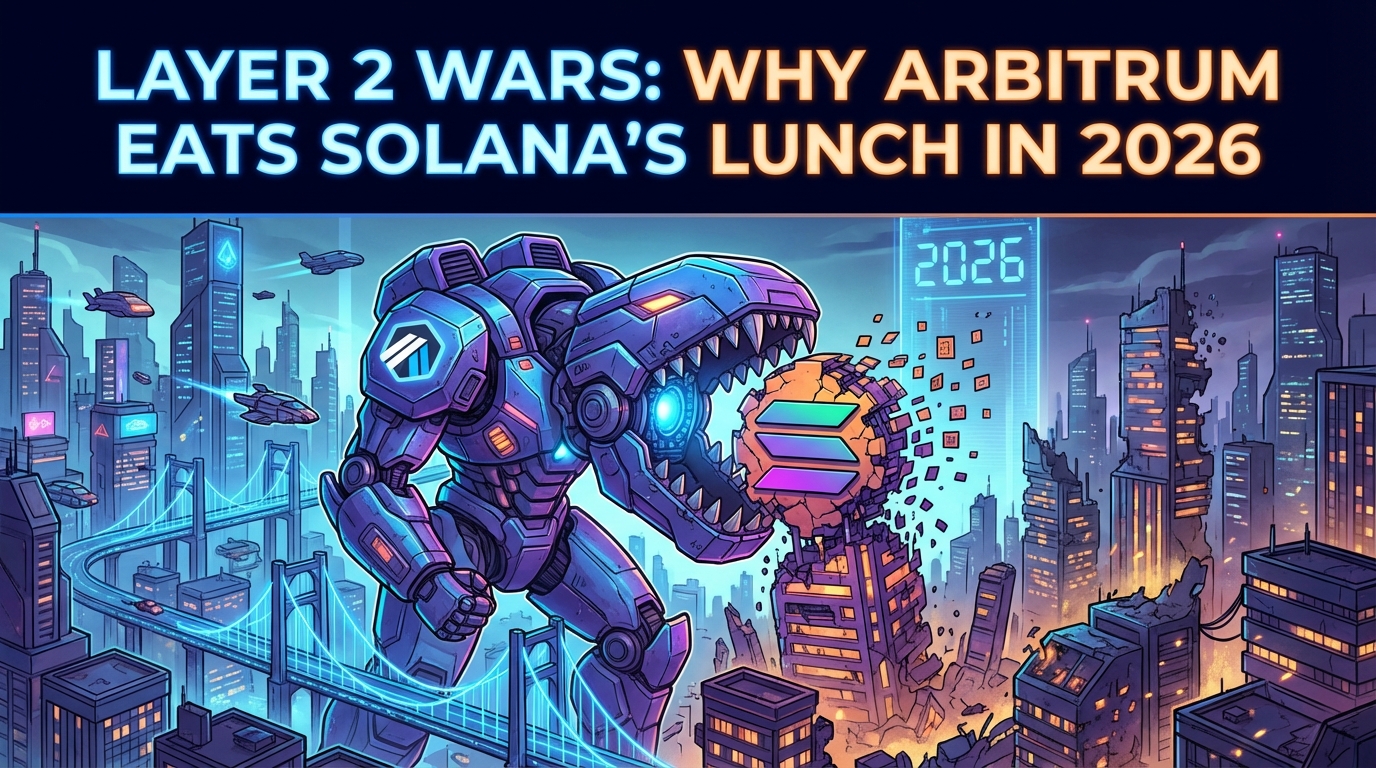

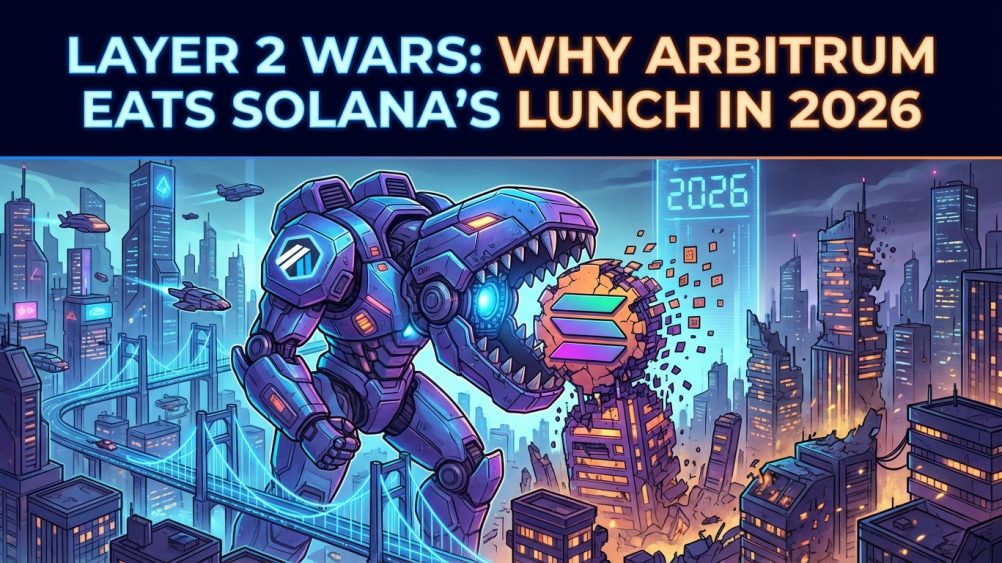
The old crypto script said Solana would beat Ethereum on speed and cost. In 2026, that script looks weaker. Arbitrum is not trying to beat Solana at its own game. It is doing something more important. It is taking the best parts of Ethereum and making them “cheaper, faster, and easier” to use at scale. As a result, the real fight is no longer Ethereum vs Solana. It is Arbitrum vs Solana, and Arbitrum One is starting to win where it matters.
That claim sounds aggressive, but the numbers back it up. Arbitrum One now holds about $16.6 billion in total value secured, making it one of the largest and most trusted networks in crypto. It also runs at Stage 1 on L2BEAT, which matters because it points to stronger security progress inside the Ethereum Layer 2 model. Solana still posts huge activity, with about $15.6 billion in stablecoin market cap, 150 million daily transactions, and 4.2 million active addresses on DefiLlama. However, raw activity is not the whole story. The market is starting to care more about durable capital, trust, and settlement quality than headline throughput.
Why Arbitrum Looks Stronger in 2026
The first reason is security inheritance. Arbitrum sits inside the Ethereum ecosystem. That gives it a stronger base for users who care about settlement, bridge safety, and deep liquidity. Solana is a fast monolithic chain, and that has real appeal. Still, many large users prefer a system tied to Ethereum because Ethereum remains the core home for stablecoins, tokenized assets, and institutional DeFi. So, Arbitrum does not need to replace Ethereum. It grows by staying close to it.
The second reason is capital depth. On Arbitrum, the asset mix is not thin or speculative. L2BEAT shows over $6.0 billion in USDC on the network, plus large amounts of ETH, BTC derivatives, and tokenized treasury products. That matters because serious users follow deep collateral, not just fast meme flows. Meanwhile, Solana still has major stablecoin strength and very strong payment momentum, including a reported $650 billion in stablecoin transaction volume in February 2026. But payment flow and sticky DeFi capital are not the same thing. Arbitrum looks stronger on locked capital quality.
The third reason is fee behavior under stress. Offchain Labs said Arbitrum kept median fees at peak demand around 2.12 gwei, even while handling higher load. That is a big point in the Arbitrum vs Solana debate. Solana is famous for cheap transactions, but fee stability during heavy bursts is what apps need in practice. In contrast, Arbitrum now offers low costs without asking users to leave Ethereum’s security orbit. That is a hard value case for Solana to beat.
Quick Comparison of Arbitrum vs Solana
| Metric | Arbitrum One | Solana | Why it matters |
| Network model | Ethereum Layer 2 rollup | Monolithic Layer 1 | Arbitrum gets Ethereum-linked settlement, Solana keeps one-chain speed |
| Value secured / TVL signal | $16.57B to $16.59B value secured | $15.57B stablecoin market cap | Arbitrum shows deep secured capital, Solana shows strong money movement |
| Daily activity | 38 to 46 UOPS | 91.47M daily transactions | Solana wins on raw activity |
| Security stage | Stage 1 | Not an L2 stage model | Arbitrum shows formal rollup progress |
| Fee story | Low single-digit gwei at peak demand | Very low fees, high throughput | Arbitrum closes the old cost gap |
| Core strength in 2026 | DeFi depth, Ethereum alignment, capital quality | Payments, stablecoins, retail flow | Different users value different things |
Why Solana Still Matters, But Why That is Not Enough
Solana is not weak. That would be the wrong read. It has scale, speed, and strong consumer energy. It also has a large DEX volume, about $2.339 billion in 24 hours, and over $1.023 billion in 24-hour perps volume on DefiLlama. Those are serious numbers. Even so, the question is not whether Solana has users. The question is whether it can keep winning as crypto becomes more financial and more institutional.
That is where Arbitrum One starts to look better. The next phase of crypto is likely to favor chains that handle
-
- DeFi TVL,
- tokenized real-world assets,
- deep stablecoin pools,
- and cross-chain settlement with less trust risk.
Arbitrum is already there. It is not just a fast chain.
“It is a financial layer plugged into Ethereum.”
Therefore, it can serve traders, funds, DAOs, and builders that want lower fees without leaving the biggest settlement network in the market.
The Real Reason Arbitrum Eats Solana’s Lunch
The strongest point is simple. Arbitrum does not need to beat Solana on every speed chart. It only needs to be fast enough while offering better capital gravity. In 2026, that trade looks smarter.
- Solana still wins attention.
- Arbitrum wins trust from the parts of the market that move larger amounts of money and build longer.
So, the lunch Arbitrum is eating is not only transaction flow. It is mindshare around what serious on-chain finance should look like.
That is why this Layer 2 war story matters. For years, Solana sold the idea that Ethereum Layer 2 chains were patched systems. Now, Arbitrum is flipping that argument. It offers low fees, growing performance, deep liquidity, and Ethereum-linked settlement in one package. That is not a patch. It is a stronger product fit for the 2026 market.
Final Verdict: Arbitrum Is Winning the Smarter Fight
The loudest chain does not always win. In 2026, Arbitrum vs Solana is less about speed and more about where sticky capital wants to live. Solana still owns a big part of payments, trading bursts, and retail flow.
However, Arbitrum is taking the higher-value lane. It is pulling in capital depth, stronger settlement trust, and a tighter link to the wider Ethereum ecosystem. That is why the claim lands: Arbitrum eats Solana’s lunch in 2026 not by being louder, but by being harder to replace.
Post Disclaimer
The information provided on Financepdia.com is for educational and informational purposes only and should not be considered financial, investment, or trading advice. Cryptocurrency and financial markets are highly volatile and involve significant risk. Readers should conduct their own research (DYOR) and consult with a qualified financial advisor before making any investment decisions. Financepdia.com and its authors are not responsible for any financial losses resulting from actions taken based on the information provided on this website.