





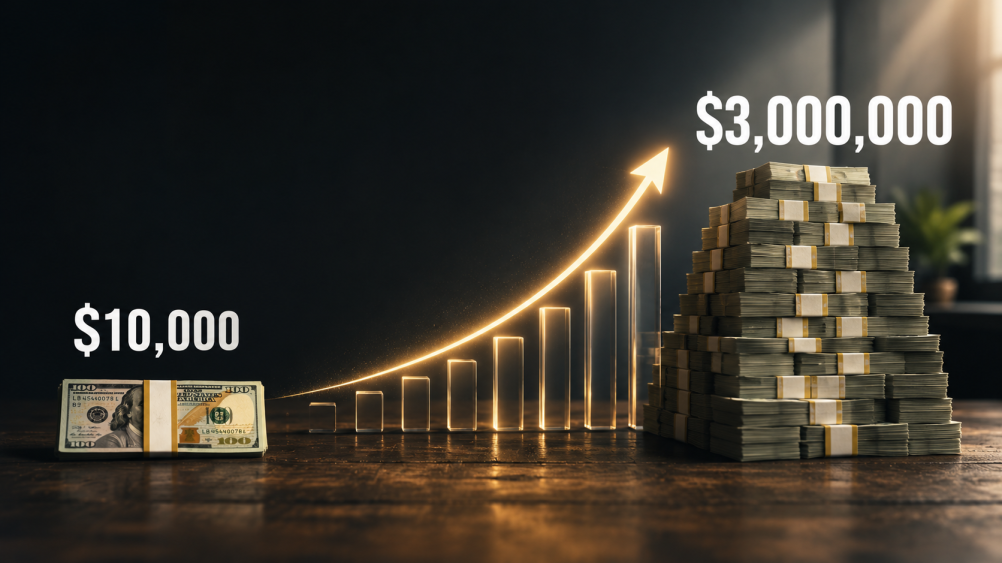
What if one patient investor could turn $10,000 into $3 million without guessing the market?
That question sounds unreal, especially when every dip feels urgent. Most people wait for the “perfect price.” They study charts, chase tips, and fear buying too soon. Then the stock moves, and doubt wins again.
But one investor took a different path.
They put $10,000 into one growing company and stayed with it. At the time, the company did not look like a sure thing. It looked risky, early, and easy to ignore.
There was no magic signal. There was no perfect bottom. There was only a simple idea: “own the business, not the noise.”
The real work came after buying. They had to sit through bad months, scary drops, and loud opinions. Still, they held because the business kept getting better.
That is how patience turned a small stake into life-changing wealth.
The Stock Was Not Obvious Until It Was
Great long-term winners rarely arrive wearing a clear label. They often look small, strange, or too risky. That is why most people miss them early.
NVIDIA began with graphics, gaming, and computing hardware. Its own history points back to 3D graphics and the GPU. Years later, those same roots supported AI workloads at scale.
Apple also had doubters. For years, people questioned iPhone growth and product limits. Then the ecosystem became the real machine. iPhone, Mac, iPad, Watch, iCloud, Music, and services tied users together.
Monster Beverage looked even less serious to many investors. It was an energy drink company on a crowded shelf. Yet its brand family kept expanding across Monster Energy, Reign, NOS, Bang, and others.
Each case carried risk. These growth stocks became long-term stock winners because the businesses had a long runway. None came with a note saying, “This will make you rich.”
The investor needed more than numbers. They needed patience, curiosity, and a view of what could come next. That was the edge.
Not certainty. Not perfect timing. Just the courage to hold a strong idea before everyone respected it.
No Market Timing, Just a Long View on a Big Shift
Market timers ask, “Is this the bottom?” Long-term investors ask a better question: “Can this business look much larger in 20 years?” That question changes the whole decision.
The investor did not need one perfect buying day. They needed a clear reason to stay. The investor built wealth without timing the market because they focused on business fundamentals, not daily price moves. With NVIDIA, that reason was the rising demand for computing power, AI, gaming, and advanced chips.
With Apple, the reason was daily customer use. Its products became part of work, entertainment, payments, photos, and communication. Once people joined the ecosystem, leaving became harder.
With Monster, the reason was brand reach. It started as an energy drink name on a shelf. Over time, it became a global drinks business with loyal customers.
None of this required perfect market timing. The investor still faced crashes, weak quarters, and painful drops. Many people would have sold and called it smart.
But they did not need to win every year. They needed the business to keep growing across decades. This is why time in the market mattered more than the perfect entry price. That is where $10,000 starts becoming life-changing.
The company expands. The investor stays. Compounding gets more room to work. The result looks unreal later, but the method stays simple: own the right business, then avoid interrupting it.
The Hardest Part Was Holding After the First Big Gain
Buying sounds hard, but holding often hurts more.
Turning $10,000 into $30,000 already feels like a victory. This is where buying and holding investing becomes difficult. Stock market volatility tests every investor’s patience. Many people would sell there. They would say, “profit is profit.”
Then comes the harder test. If the same stake reaches $100,000, fear gets louder. The investor starts thinking about bills, safety, and regret.
| Stage | What many investors feel | What the patient investor does |
| $10,000 to $30,000 | Take the profit. | Check the business first. |
| $30,000 to $100,000 | This may fall. | Holds if growth remains real. |
| $100,000 to $3 million | This is too much risk. | Let compounding keep working. |
The path from $10,000 to $3 million was not smooth. Price swings only looked easy years later, not while they were happening. It had ugly drops, weak quarters, and many reasons to leave.
NVIDIA kept reporting business growth across AI and data-center demand. Apple kept building around products and services. Monster kept expanding its drinks business through its investor updates.
That gave the investor something stronger than price movement. They had a business case.
The stock price could fall in a bad year. The business still had to answer one question: “Is the long-term story still alive?” Holding after the first big gain took discipline. Holding after the second took conviction.
Compounding Did Not Explode Until Most People Would Have Quit
Early compounding rarely feels exciting. Compound growth does not look powerful at first, but stock market compounding can change everything later. It feels slow, even when it works. That is why many investors leave too soon.
A stock moving from $10,000 to $100,000 already feels huge. Most people would call that enough. They would protect the profit and move on.
But the larger money often comes after that point. Once $100,000 keeps growing, each move carries more weight. That is how wealth building through stocks often works. The same percentage return now adds far more dollars.
This is why the last few years can matter more. NVIDIA later reported $215.9 billion in fiscal 2026 revenue. Apple reported $111.2 billion for its March 2026 quarter.
The lesson is simple:
- Little money needs time.
- Large amounts of money need patience.
- Compounding needs both.
The investor did not earn the reward through constant action. They earned it through endurance. They allowed the business to grow without cutting the process short.
Long-term investing can look boring for years. Then one decade can change everything. That is why selling too early can cost more than buying late.
Final Take: Speculate on the Future, But Do It Like an Investor
The investor took a risk, but not a blind risk. They did not buy noise, hype, or a random story. They looked for a business with a large market, strong demand, pricing power, and real growth. Then they gave it time.
That is the difference between guessing and investing. The real lesson of long-term investing is simple. Patient investing works best when the business keeps improving. They accepted uncertainty, but avoided constant trading. They seized the position so fear would not force a bad sale. They stayed focused on the business, not the daily price.
The lesson is simple: you do not need perfect timing to build serious wealth. You need strong ideas, time, and investment discipline to turn ordinary money into real wealth creation.
Disclaimer: This article is for general information only. It is not personal financial advice. Consider speaking with a qualified financial adviser before making investment decisions.
Post Disclaimer
The information provided on Financepdia.com is for educational and informational purposes only and should not be considered financial, investment, or trading advice. Cryptocurrency and financial markets are highly volatile and involve significant risk. Readers should conduct their own research (DYOR) and consult with a qualified financial advisor before making any investment decisions. Financepdia.com and its authors are not responsible for any financial losses resulting from actions taken based on the information provided on this website.