







Leverage in Forex: How to Use It Without Blowing Your Account

Leverage in Forex: How to Use It Without Blowing Your Account

March 31, 2026; Have you ever watched your forex account drop to zero? You are not alone. Most traders lose money with leverage.

Right now, in March 2026, forex markets are wild. Oil prices topped $100 a barrel this month. The Iran conflict shook currencies worldwide. The Fed held rates at 3.50% to 3.75%. Central banks are stuck. Traders are scared.

In this chaos, leverage becomes extra dangerous. A 1% move can wipe out a full account. Yet millions of new traders still use high leverage.

The forex market moves $9.6 trillion every single day. That number comes from the BIS 2025 Triennial Survey. It is the biggest market on Earth. Leverage is the tool that lets small traders join. But that same tool destroys most of them.

Between 74% and 89% of retail trading accounts lose money. That is not a guess. ESMA, Europe’s top market regulator, requires every broker to show this number. It is printed on every trading ad in Europe.

This guide will show you how leverage works. More importantly, it will show you how to survive it.

Key Takeaways

  • Most retail traders lose money. ESMA data shows 74% to 89% of retail accounts lose. Leverage misuse is often the cause.
  • Leverage limits vary by country. The U.S. caps it at 50:1 for major pairs. The EU and UK cap it at 30:1. Offshore brokers offer up to 1000:1 or more.
  • Small accounts take the biggest risks. Small-deposit traders are 4 times more likely to max out leverage (Gitnux 2026).
  • The 2% rule saves accounts. Risking more than 2% per trade leads to the highest bankruptcy rate.
  • Current volatility makes leverage riskier. March 2026 saw oil swing $15 in a single day. Currencies followed.

What Is Forex Leverage ?

Leverage is borrowed money from your broker. It lets you control a bigger trade. You put up a small deposit called margin.

Say you have $1,000. With 50:1 leverage, you control $50,000. That sounds great until the trade goes wrong. A 2% drop means you lose $1,000. Your full account is gone.

The margin is your safety deposit. When your losses eat through it, the broker closes your trade. This is called a margin call. It happens fast and without warning.

Higher leverage means less room for error. At 100:1, even a 1% move can end you. At 500:1, a tiny 0.2% swing does the job.

Why Leverage Feels Like a Superpower.

Now flip the story. What if the trade goes right?

You have $500. You use 50:1 leverage. You now control $25,000 worth of EUR/USD.

The price rose 1%. That is $250 profit. A 50% return on your $500. In maybe a few hours.

Price rises 2%? That is a $500 profit. You just doubled your money. Your account jumps to $1,000.

Without leverage? That same 1% move on $500 earns you $5. Five dollars. Barely worth the screen time.

That is why leverage is addictive. The wins feel huge. Fast. Easy. Almost magical.

Here is what that math looks like side by side.

Price Move Profit Without Leverage ($500) Profit With 50:1 Leverage ($500)
+0.5% $2.50 $125
+1.0% $5.00 $250
+2.0% $10.00 $500

Now read that table again. Replace every “+” with a “-” sign. That $500 profit? It’s a $500 loss. Account wiped

A 2% drop without leverage costs you $10. Annoying but fine. A 2% drop with 50:1 leverage costs $500. Your entire account. Gone.

The temptation is the trap. One good trade makes you feel like a genius. So you go bigger. Bolder. Then the market turns. The same math that doubled your money now wipes it out.

This is why 74% to 89% of retail accounts lose. Winning early with high leverage teaches terrible habits. It rewards reckless risk until the one bad trade ends it all.

Why March 2026 Is a Wake-Up Call

This month reminded traders why leverage is risky. The Iran conflict sent oil above $112 per barrel. Currency pairs moved sharply.

On March 17, WTI crude swung over $15 in one session. The dollar reversed hard. AUD, NZD, and EUR all moved fast.

The Korean won fell to its lowest since March 2009. USD/JPY pushed past 159.50. These are not normal moves.

Traders using high leverage during these swings faced brutal margin calls. Stop-loss orders could not fill in time. Slippage was severe.

This is exactly the kind of market that blows accounts. Central banks are all on hold. Nobody knows what comes next.

The Swiss Franc Crash: A Real Leverage Disaster

On January 15, 2015, the Swiss National Bank dropped its EUR/CHF peg. No warning was given. The Swiss franc jumped 20% to 30% in minutes.

Traders lost hundreds of millions of dollars. FXCM, one of the biggest retail brokers, reported $225 million in client losses. It needed an emergency $300 million loan to survive. Alpari UK went bankrupt the same day.

Retail investors lost over $400 million on Swiss currency bets, as reported by Fortune. Many traders owed more than they had deposited.

Stop-loss orders were skipped. There was no one to take the other side. Leverage turned a bad day into total ruin.

After that crash, ESMA tightened leverage rules across Europe. Negative balance protection became standard.

Leverage Limits Around the World

Different countries set different rules. Here is a quick look.

Region Regulator Max Leverage (Major Pairs)
United States CFTC / NFA 50:1
European Union ESMA 30:1
United Kingdom FCA 30:1
Australia ASIC 30:1
Canada CIRO 50:1
UAE (DIFC) DFSA 30:1
Offshore (Seychelles, etc.) Various 500:1 to 3000:1

Source: LiquidityFinder 2026 leverage comparison

Offshore brokers tempt traders with extreme leverage. But weaker regulation means less protection. If something goes wrong, your money has fewer legal safeguards.

Five Rules to Survive Leverage

These rules are simple but hard to follow.

  1. Never risk more than 1% to 2% per trade. If you have $5,000, risk $50 to $100 max. This keeps you alive through losing streaks.
  2. Always use a stop-loss order. Set your exit before you enter. Accept the loss before it happens.
  3. Lower your leverage as volatility rises. In wild markets like March 2026, cut your size. Let others blow up.
  4. Pick a regulated broker with negative balance protection. This means you can never owe more than you deposit.
  5. Know your margin level at all times. Check it before, during, and after every trade. Do not guess.

Who Should Avoid High Leverage?

Beginners should stay away from anything above 10:1. Even 50:1 is aggressive for new traders.

Small deposits plus high leverage is the deadliest mix. Many blow their account within three months.

Have you backtested over 1,000 trades? If not, you likely have no edge. Without an edge, leverage just speeds up losses.

Professional traders at banks earn 8% to 15% per year. They use moderate leverage and strict rules. Retail traders who copy this approach do better over time.

Frequently Asked Questions

Is leverage the same as margin?

No. They are related but different. Leverage is the ratio of your buying power to your deposit. Margin is the actual money held as collateral. A 50:1 leverage ratio means a 2% margin requirement. You need $2,000 in margin to control $100,000. If your equity drops below the margin level, your broker may close your positions.

Can I trade forex without leverage?

Yes. Some brokers offer 1:1 accounts. Without leverage, a $1,000 account controls only $1,000 worth of currency. Moves will be small. But you cannot lose more than your deposit. This is the safest way for beginners to learn how real markets feel.

How does leverage in forex compare to stocks?

In the U.S., stock margin gives about 2:1 leverage. Day traders get up to 4:1. Forex offers up to 50:1 in the U.S. and more offshore. This means forex carries far higher risk per dollar. Stock regulators have always capped leverage lower because of lessons learned during past crashes.

Disclaimer: This article is for informational purposes only. It is not financial advice. Always do your own research.


Post Disclaimer

The information provided on Financepdia.com is for educational and informational purposes only and should not be considered financial, investment, or trading advice. Cryptocurrency and financial markets are highly volatile and involve significant risk. Readers should conduct their own research (DYOR) and consult with a qualified financial advisor before making any investment decisions. Financepdia.com and its authors are not responsible for any financial losses resulting from actions taken based on the information provided on this website.
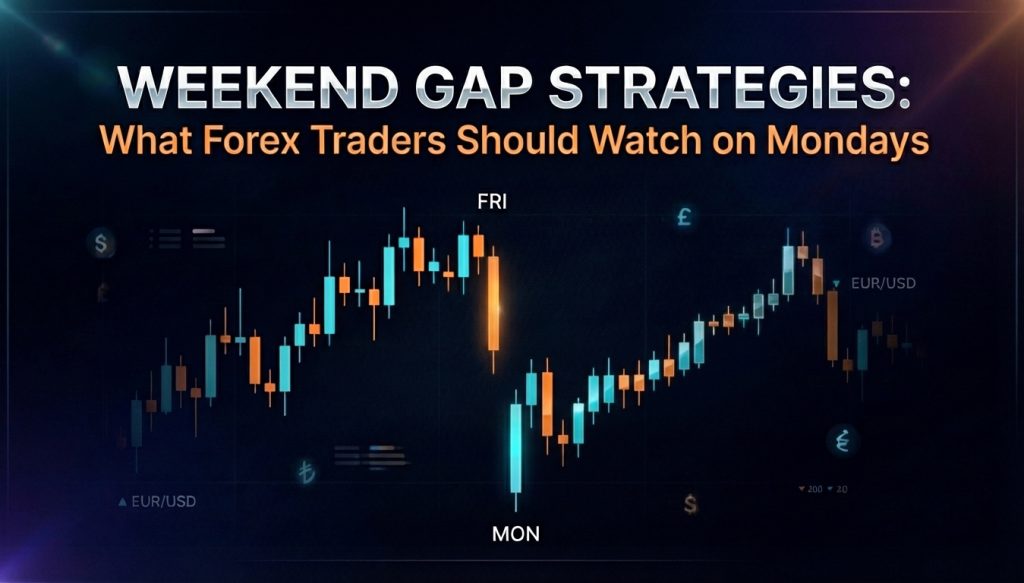

Weekend Gap Strategies: What Forex Traders Should Watch on Mondays

Weekend Gap Strategies: What Forex Traders Should Watch on Mondays

Can a calm weekend in crypto hide the kind of Monday move that catches a forex trader off guard? 

That question matters more than many new traders think. A quiet chart on Friday can turn into a sharp jump by the Monday open when fresh orders hit the market. For a crypto focused reader, the lesson feels familiar. News never really stops, and price can react fast when liquidity comes back.

In forex gap trading, the main weekly gap appears between the Friday close and the Monday open because retail trading pauses over the weekend while global events keep moving. A gap can open higher or lower than Friday’s last traded price. Also, that move can trigger fear, fast entries, or bad exits if the trader has no plan.

What a Weekend Gap Really Says

A weekend gap is not random noise. It often reflects new information that hit the market while forex trading was closed. That can include political news, central bank talk, election results, conflict headlines, or a sudden shift in market mood. So, the first job on Monday is not to chase price. The first job is to read what the gap is saying.

A small gap in a quiet pair may mean little. A large gap in EUR/USD, GBP/USD, or USD/JPY can point to strong order flow at the open. However, size alone is not enough. The trader still needs to check whether price starts to pull back toward Friday’s close or keeps moving in the gap direction.

That difference matters. Some Monday gaps move back toward the prior close, which traders often call a gap fill. Meanwhile, other gaps keep running because the weekend event changed sentiment in a real way.

Why Monday Needs a Different Mindset

Monday is not just another session. Early trading can have wider spreads, thinner liquidity, and quick fake moves before London volume comes in. As a result, traders who jump in during the first few minutes often pay a high price for poor timing.

For crypto readers, this is a familiar setup. Weekend emotion can build a strong story before real liquidity returns. In forex, that story gets tested when the market opens, and bigger players start showing their hand. So, patience often beats speed on Monday morning.

A smart trader watches the first reaction, not just the first print. If price gaps up and then stalls under a key level, buyers may be weak. However, if the price gaps down and then cannot push lower, sellers may lose control.

Monday Gap Signals Traders Should Track

The table below shows what matters most during the Monday open.


What to Watch What It Can Mean What a Trader Should Do
Gap size A bigger gap can signal stronger news or stronger emotion Compare the gap with recent Monday opens
Pair selection Major pairs often react cleaner than thin pairs Focus on EUR/USD, GBP/USD, and USD/JPY first
Spread at open A wide spread can ruin entry quality Wait for the spread to calm before acting
Friday close level This is the key line for a possible gap fill Mark it before the market opens
First 30 to 60 minutes Early candles show whether the move is accepted or rejected Let price show direction first
Weekend news flow News often explains whether the move may continue Check the economic calendar and headlines
Risk per trade Gaps can skip normal exits Cut position size and keep a hard risk limit


A Simple Monday Plan That Makes Sense

A trader can start by marking three prices before the open. The first is the Friday close. The second is the Monday open. The third is the nearest support or resistance level on the four-hour chart. Also, that quick map helps remove guesswork.

Next, the trader should check the weekend news and the economic calendar. If the gap came after major news, a full reversal is less likely. If there were no strong driver, the chance of a gap fill may be higher.

Then comes the key question. 

Is the price accepting the new level, or rejecting it? 

If candles hold above the gap area after a gap up, continuation may be the stronger idea. However, if the price quickly drops back into Friday’s range, the market may be trying to close the gap.

Risk control matters more than the entry. A trader should keep position size small, especially during the first hour. Stop placement also needs space because Monday volatility can be messy. A tight stop loss placed in panic often gets hit before the real move starts.

When the Best Trade Is No Trade

Not every weekend gap deserves action. Some are too small to matter after the spread cost. Others are so large that the reward-to-risk picture looks poor from the start. So, skipping weak setups is part of the strategy, not a failure.

This is where many newer traders slip. They see a dramatic price action move and think a trade must be taken at once. In reality, a clean no-trade decision can protect the account far better than a forced entry.

Another warning sign is conflict between time frames. If the daily chart is in a strong uptrend, fading a small gap up can be risky. Meanwhile, trading with the bigger trend often gives the price more room to work.

Monday Gaps Reward the Prepared Trader

The real edge in weekend gap strategies does not come from guessing. It comes from reading context, waiting for structure, and respecting risk. A trader who marks the Friday close, watches the Monday open, checks the news, and waits for spreads to settle already stands in a better spot than the crowd.

For a crypto audience, the lesson is clear. Weekend emotion can shape Monday action across markets. In forex, that action becomes sharp and visible at the open. So, the trader who stays calm, keeps size under control, and reacts to proof instead of fear has the better chance over time.

Disclaimer: This article is for educational purposes only and does not give financial advice. Trading forex and crypto carries risk, and losses can exceed expectations.


Post Disclaimer

The information provided on Financepdia.com is for educational and informational purposes only and should not be considered financial, investment, or trading advice. Cryptocurrency and financial markets are highly volatile and involve significant risk. Readers should conduct their own research (DYOR) and consult with a qualified financial advisor before making any investment decisions. Financepdia.com and its authors are not responsible for any financial losses resulting from actions taken based on the information provided on this website.

Best Passive Income Ideas That Can Generate Monthly Cash Flow

Best Passive Income Ideas That Can Generate Monthly Cash Flow

Can crypto still help build a monthly cash flow without watching charts all day or chasing the next hype coin?

That is the question many beginners and careful investors keep asking. They want passive income ideas that feel real, simple, and worth the risk. They also want income that can grow over time, not just one lucky trade.

For a crypto audience, the answer is yes, but only with the right plan. Crypto passive income is no longer just about buying a token and hoping it pumps. Today, it is more about picking systems that pay rewards for holding, staking, lending, or adding liquidity. However, not every option is safe, and not every yield lasts.

This article breaks down the best passive income ideas that can generate monthly cash flow for crypto-focused readers. It keeps the focus on methods that match the article title, reader intent, and current market behavior. As a result, readers can see which choices fit a beginner, which fit a higher-risk investor, and what to avoid.

Why Crypto Passive Income Still Gets Attention

Many investors want income without daily trading stress. That is why terms like crypto passive income, staking rewards, DeFi lending, yield farming, and monthly cash flow keep showing up in beginner searches and crypto guides. Recent educational pages from Coinbase on staking, Coinbase on crypto rewards, and Lido’s liquid staking page show that staking and reward-based models remain central to this space.

At the same time, regulators still warn that crypto yield products can carry serious risk. The U.S. investor bulletin on crypto interest-bearing accounts and the broader crypto asset securities alert both stress that losses can happen and investor protections may be limited. So, the smart path is not chasing the highest APY. It is choosing a method that fits the investor’s risk level.

Best Passive Income Ideas for Monthly Cash Flow in Crypto

1. Staking Blue-Chip Proof-of-Stake Coins

For many readers, staking is the cleanest starting point. A holder locks or delegates coins such as ETH, SOL, ADA, or ATOM and earns rewards for helping the network run. Coinbase explains staking as a way to earn rewards by putting crypto to work on a blockchain, and Lido shows how liquid staking lets ETH holders earn while keeping a usable token like stETH.

This method works best for investors who already plan to hold major proof-of-stake assets. In addition, it feels easier to understand than more advanced DeFi plays.

Why it works for monthly cash flow: rewards often build daily or over time, and they can be withdrawn or tracked as a recurring income stream.

2. Liquid Staking for More Flexibility

Traditional staking can lock funds. That is where liquid staking stands out. Lido states that users can stake ETH and receive stETH, which stays usable in the wider market while still reflecting staking rewards. Therefore, this can suit investors who want yield but also want room to move capital later.

Still, this option adds smart contract risk and token price tracking risk. So it is better for readers who understand basic DeFi wallets and on-chain tools.

3. DeFi Lending

Another strong option is DeFi lending. In simple terms, an investor deposits crypto into a lending market and earns interest when borrowers use that pool. This is one of the main models behind earn interest on crypto content across the market, and Coinbase’s rewards guide lists lending as one of the common reward paths in crypto.

This can work well with stable assets or large-cap crypto. Even so, readers should remember that lending has platform risk, token risk, and market stress risk.

4. Yield Farming and Liquidity Pools

Yield farming can create stronger returns, but it is not beginner-friendly. Investors add token pairs to liquidity pools and earn trading fees plus possible token rewards. Webopedia’s current guide notes that yield farming income often comes from transaction fees and incentive tokens, while also warning about impermanent loss.

This is a real passive income idea, but it should sit lower on a beginner’s list. For that reason, it fits readers who already know how DeFi pairs, pool ratios, and fee income work.

Quick Comparison Table


Passive income idea Best for Income style Main risk
Staking Beginners and long-term holders Steady reward flow Token price drops
Liquid staking Investors who want flexibility Staking rewards plus token mobility Smart contract risk
DeFi lending Moderate-risk investors Interest from borrowed funds Platform and borrower risk
Yield farming Advanced DeFi users Fees plus token rewards Impermanent loss and volatility


What Makes One Option Better Than Another

The best passive income idea is not the one with the loudest APY. It is the one that can still make sense after fees, taxes, price swings, and risk. A careful investor often starts with staking rewards on quality assets before moving into DeFi lending or yield farming.

Likewise, monthly cash flow in crypto should not be judged by payout speed alone. A method may pay often, but if the asset drops hard, the income does not help much. That is why simple, repeatable systems often beat flashy ones.

The Smart Way to Think About Monthly Cash Flow

A crypto investor who wants a monthly income should think in layers. One layer can be staking on major proof-of-stake coins. Another layer can be a smaller share in liquid staking or DeFi lending. Higher-risk methods, such as yield farming, should stay small unless the investor already knows the mechanics well.

Most importantly, passive income in crypto is still tied to market risk. It is income, but it is not fixed salary income. That mindset helps readers avoid poor choices.

Final Thoughts: Build Cash Flow Without Chasing Hype

The best passive income ideas that can generate monthly cash flow in crypto are the ones built on clear use, simple logic, and controlled risk. For most readers, that means starting with staking, learning how liquid staking works, and only then looking at DeFi lending or yield farming.

That path may look slower. Yet, slower often wins in crypto. A reader does not need ten income streams. A reader needs one or two solid systems that can be understood, tracked, and improved over time.

Disclaimer: This article is for educational purposes only and does not give financial, legal, or tax advice. Crypto assets are risky, volatile, and can lead to loss of capital. Readers should do their own research before making any decision.


Post Disclaimer

The information provided on Financepdia.com is for educational and informational purposes only and should not be considered financial, investment, or trading advice. Cryptocurrency and financial markets are highly volatile and involve significant risk. Readers should conduct their own research (DYOR) and consult with a qualified financial advisor before making any investment decisions. Financepdia.com and its authors are not responsible for any financial losses resulting from actions taken based on the information provided on this website.