




Can crypto finally become more than a trading story in 2026?
That is the question many investors keep asking after years of hype, sharp drops, and slow real-world use. Many still worry that crypto feels fast, but not always useful. They want to know whether digital assets can do more than move prices on a screen.
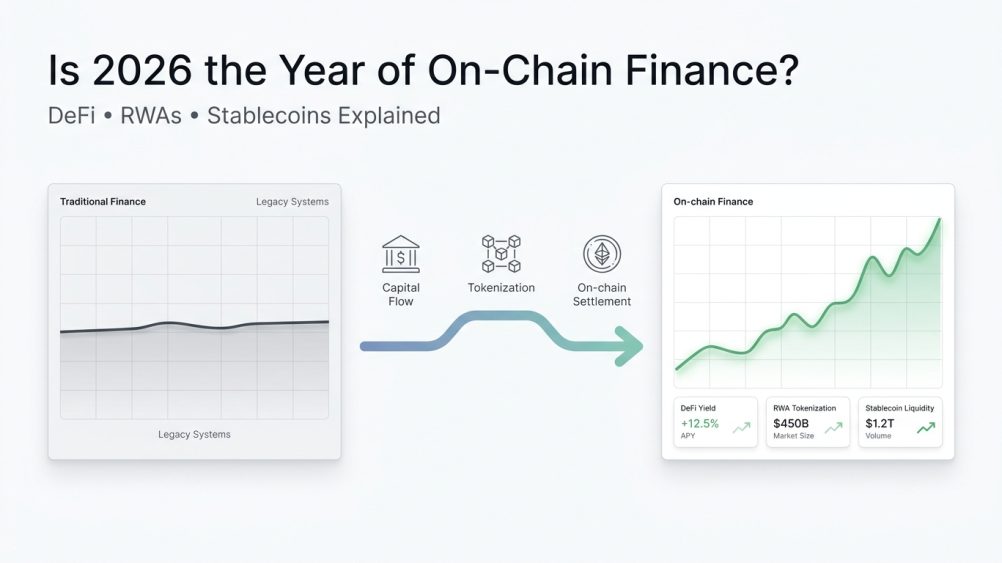
In 2026, that question looks more serious than before. On-chain finance is no longer just about meme coins or yield chasing. It now includes DeFi, stablecoins, and real-world assets, also called RWAs, moving into a shared lane.
As a result, the market is starting to look less like a side experiment and more like a new financial rail. Recent data points support that shift, with DeFi TVL near $94.5 billion, stablecoin market cap above $317 billion, and tokenized real-world asset value on RWA.xyz at $26.7 billion distributed value. DefiLlama, DefiLlama stablecoins data, and RWA.xyz data all show that this part of crypto is growing into a bigger market structure, not just a passing theme.
What On-Chain Finanace Means in 2026
On-chain finance means financial activity that happens on blockchain networks. That includes borrowing, lending, payments, trading, settlement, and ownership records. In simple terms, value moves on public or shared digital rails instead of old closed systems.
The IMF now describes tokenized finance as a deeper change in financial architecture, not a small efficiency update. It says tokenization can support atomic settlement, continuous liquidity management, and embedded compliance inside regulated finance. In turn, that matters because it shows that blockchain is being discussed as infrastructure, not only as speculation.
Why 2026 Feels Different
The biggest change is that the three key parts of on-chain finance are now starting to support each other.
- DeFi gives the market open lending, swaps, and programmable trading.
- Stablecoins give the market a dollar-linked unit for payments and settlement.
- RWAs bring assets like Treasuries, private credit, fund shares, and gold on-chain.
That mix is important. Stablecoins bring usable money. RWAs bring assets with known value. DeFi brings around-the-clock access and code-based execution. Meanwhile, tokenized U.S. Treasuries alone are now about $10 billion on RWA.xyz, which shows where early institutional interest is landing first.
A Quick View of the Market
| Pillar | What it does | Why it matters in 2026 |
| DeFi | Lending, borrowing, trading, staking | Keeps markets open 24/7 and cuts waiting time |
| Stablecoins | Dollar-linked payments and settlement | Makes crypto easier to use for transfers and pricing |
| RWAs | Puts off-chain assets on-chain | Connects blockchain with bonds, funds, credit, and more |
This table matters because 2026 is not about one trend alone. It is about how these three parts connect into one financial stack.
Stablecoins Are Now the Base Layer in 2026
Among all crypto use cases, stablecoins look the most mature. They are already used for exchange settlement, cross-border transfers, treasury movement, and trading liquidity. Visa says growing market cap, stronger infrastructure, and better policy clarity are setting the stage for firms to launch stablecoin-based products in 2026. An IMF paper from March 2026 also found that markets expect stablecoins to matter in payments, with pro-stablecoin legislation linked to an estimated 18% drop, or about $300 billion, in the market value of listed payment incumbents. That signals real competitive pressure.
At the same time, stablecoins are not risk-free. Chainalysis noted that stablecoins made up 84% of illicit virtual asset transaction volume in 2025, which is why compliance, wallet screening, and secondary market monitoring now matter more. So, growth is real, but trust and controls still decide how far the sector can go.
RWAs May be the Bridge that Crypto Needed
If stablecoins are the money rail, RWAs may be the bridge between crypto and traditional finance. Investors have talked for years about putting bonds, funds, and credit products on-chain. In 2026, that idea looks less theoretical.
According to RWA.xyz, the market now shows $26.71 billion in distributed real-world asset value, while tokenized U.S. Treasuries stand near $10 billion. That matters because Treasuries are familiar, yield-bearing, and easier for institutions to understand than many crypto-native tokens. Meanwhile, McKinsey still sees tokenized financial assets reaching about $2 trillion by 2030, excluding cryptocurrencies and stablecoins. So the current market is still early if that path keeps building.
DeFi Still Matters, But its Role is Changing
For years, DeFi was mostly judged by speculation and high yields. In 2026, the role is changing. It is becoming the execution layer for a broader market. That means lending against tokenized assets, swapping stable assets, and settling value faster.
DefiLlama currently shows DeFi TVL around $94.5 billion. That figure is still below the last cycle peak, but it remains large enough to matter. More important, the quality of activity is changing. When stablecoins and RWAs enter DeFi, the market gets assets that are easier to price and easier to explain. As a result, on-chain finance starts to look more usable for payments, treasury flows, and collateral management, not just speculation.
So, Is 2026 the Breakout Year?
The honest answer is that 2026 could be the year on-chain finance starts to look normal. That does not mean every token will win. It also does not mean risk disappears. The IMF has warned that tokenized finance can also increase speed, concentration, fragmentation, and cross-border stress if policy and legal rules stay weak.
Still, the upside case is clearer now. Stablecoins are becoming payment tools. RWAs are bringing known assets on-chain. DeFi is turning into the open engine that connects both. When those three pieces grow together, crypto starts to look less like a closed trading loop and more like a new market structure.
The Big Takeaway for Crypto Watchers
The strongest signal in 2026 is not one coin or one headline. It is the steady build of on-chain finance as a working system. DeFi, stablecoins, and RWAs are now forming a chain of money, assets, and execution. That shift may not grab attention like a meme rally. However, it may matter far more over time.
If this path continues, 2026 may be remembered as the year crypto moved closer to finance that people can actually use.
Disclaimer: This article is for informational purposes only and is not financial, legal, or investment advice. Crypto markets remain volatile, and readers should do their own research before making any decision.
Post Disclaimer
The information provided on Financepdia.com is for educational and informational purposes only and should not be considered financial, investment, or trading advice. Cryptocurrency and financial markets are highly volatile and involve significant risk. Readers should conduct their own research (DYOR) and consult with a qualified financial advisor before making any investment decisions. Financepdia.com and its authors are not responsible for any financial losses resulting from actions taken based on the information provided on this website.