





What if you could build real wealth starting with just $5 a week? That sounds almost too simple. But for decades, that kind of thinking kept ordinary people out of investing. In 1980, buying into early Apple stock required a stockbroker, a minimum investment, and the right connections.
Retail investors rarely got access. Institutions got rich first. Everyone else waited.
That gap has closed. Today, apps like Robinhood and Fidelity let you buy fractional shares of any stock for as little as $1. You no longer need to be wealthy to start investing. You just need to start.
This guide shows you exactly how to do that, step by step.
Key Takeaways
- You can start with $1. Many platforms now offer fractional share investing with no minimum deposit.
- Compound interest is your best friend. A $50/month investment at 8% grows to over $74,000 in 30 years.
- Index funds beat most active portfolios. Over 15 years, more than 90% of actively managed funds underperformed their benchmarks.
- Consistency matters more than timing. Investing small amounts regularly outperforms waiting for the “right moment.”
- Fees can quietly destroy returns. A 1% annual fee can reduce your final balance by up to 28% over 30 years.
Why Starting Small Is Smarter Than Waiting
Most people delay investing because they’re waiting to have “enough.” That wait costs more than they realize.
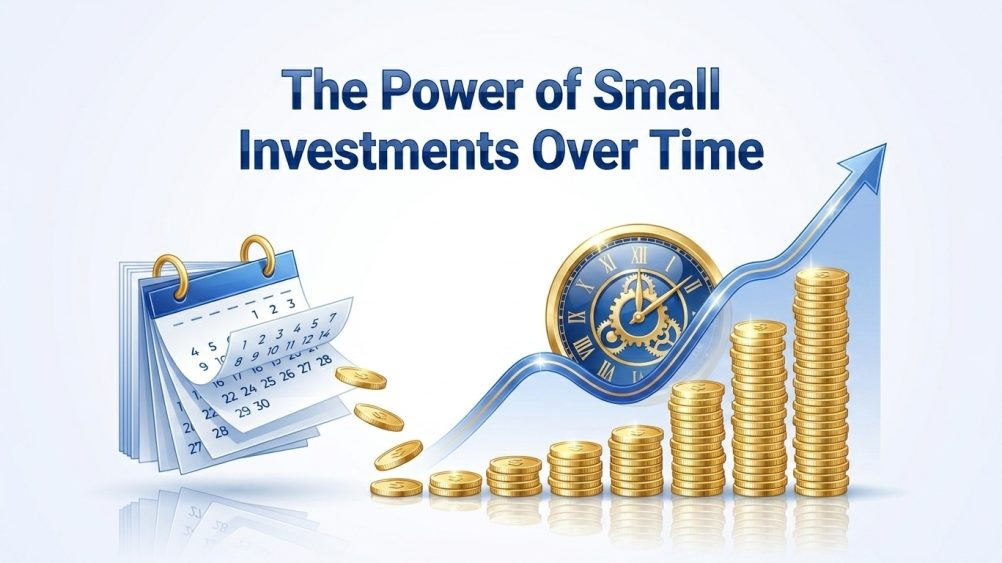
Consider this: if you invest $100 a month starting at age 25, and your portfolio earns 7% annually, you’d have roughly $263,000 by age 65. Start at 35 instead? You’d end up with around $122,000. Same monthly amount. Half the result. Time does the heavy lifting.
This is the power of compound interest. Your returns generate their own returns. The earlier you start, the more that snowball grows.
The good news is you don’t need $100 to begin. You need $5 and a smartphone.
How to Choose the Right Account for Beginners
Before you invest a single dollar, you need the right account. This is simpler than it sounds.
For most beginners in the U.S., a Roth IRA is the best starting point. You invest after-tax money, and your gains grow completely tax-free. In 2024, you can contribute up to $7,000 per year to a Roth IRA.
If your employer offers a 401(k) with matching contributions, use that first. Matching is essentially free money. Never leave it on the table.
For general investing outside retirement accounts, a standard brokerage account works fine. Platforms like Fidelity, Vanguard, and Charles Schwab charge zero commissions on most trades.
The Investment Options That Make Sense for Small Budgets
Not all investments are created equal. Some are designed for Wall Street. Others are perfect for a $25 weekly budget.
Here’s a side-by-side comparison of the most common beginner options:
| Investment Type | Minimum to Start | Risk Level | Best For | Average Annual Return* |
| Index Funds (S&P 500) | $1 (fractional) | Low–Medium | Long-term growth | ~10% (historical) |
| ETFs | $1 (fractional) | Low–Medium | Diversification | ~8–10% |
| Individual Stocks | $1 (fractional) | Medium–High | Growth with research | Varies widely |
| High-Yield Savings | $0 | Very Low | Emergency fund | ~4–5% (2024 rates) |
| Robo-Advisors | $0–$500 | Low–Medium | Hands-off investing | ~6–8% |
| REITs | $1 (fractional) | Medium | Passive income | ~8–12% |
*Historical averages. Past performance does not guarantee future results.
For most beginners, a simple S&P 500 index fund is the smartest first move. It spreads your money across 500 of the largest U.S. companies. Low fees. Built-in diversification. No stock-picking required.
The Habit That Builds Real Wealth: Dollar-Cost Averaging
Trying to time the market is a losing game, even for professionals.
Dollar-cost averaging (DCA) is a much smarter strategy. You invest a fixed amount on a regular schedule, regardless of market conditions. When prices are high, you buy fewer shares. When prices drop, you buy more. Over time, your average cost per share tends to be lower than the market’s average price.
This strategy removes emotion from investing. You stop trying to predict crashes or peaks. You just invest consistently, month after month, and let the market do its work.
Set up automatic transfers on your platform of choice. Even $20 a week adds up to over $1,000 a year before any returns.
The Fees You Must Watch Out For
Fees are the silent wealth killer most beginners ignore.
Every investment product charges a fee called an expense ratio. For index funds, this can be as low as 0.03% annually (Vanguard’s VOO, for example). For actively managed mutual funds, it can be 1% or more.
That gap sounds small. It’s not. On a $10,000 portfolio over 20 years, a 1% annual fee can cost you over $30,000 in lost returns compared to a 0.1% fund.
Always check the expense ratio before investing. Stick to low-cost index funds and ETFs whenever possible.
Six Smart Rules for Consistent Growth
- Build your emergency fund first. Keep three to six months of expenses in a high-yield savings account before investing.
- Pay off high-interest debt first. Credit card interest at 20%+ beats any market return you’ll realistically earn.
- Automate your investments. Remove the decision from your hands. Set it and let it compound.
- Reinvest dividends automatically. Dividend reinvestment accelerates compound growth significantly over time.
- Diversify across asset classes. Never put all your money in one stock, sector, or country.
- Review your portfolio annually, not daily. Obsessing over short-term movement leads to emotional decisions and poor returns.
Frequently Asked Questions
Is investing with $10 or $20 actually worth it?
Yes, absolutely. The amount matters less than the habit. Investing $20 weekly from age 22 to 62 at a 7% average return produces roughly $218,000. The real value of starting small is building the routine early. Most millionaires didn’t start with large sums. They started consistently. Micro-investing apps like Acorns and Stash make this effortless by rounding up everyday purchases and investing the difference.
How is a robo-advisor different from picking my own stocks?
A robo-advisor is an automated platform (like Betterment or Wealthfront) that builds and manages a diversified portfolio for you based on your risk tolerance and goals. Picking individual stocks requires research, time, and tolerance for higher volatility. Robo-advisors are ideal for hands-off beginners with small budgets. Self-directed stock picking is better suited for investors who want more control and understand the risks involved.
Should I invest or save during a market downturn?
Both, if possible. A market downturn is actually a great time to invest because asset prices are lower. History shows that markets recover. The S&P 500 has never had a negative return over any rolling 20-year period on record. That said, never invest money you might need within the next one to three years. Keep short-term needs in savings, and keep your long-term investment schedule running through the dip.
Sources
- U.S. Securities and Exchange Commission: Mutual Fund Cost Calculator
- S&P Global (SPIVA): Active vs Passive Fund Performance Report
Disclaimer: This article is for informational purposes only. It is not financial advice. Always do your own research before making any investment decisions.
Post Disclaimer
The information provided on Financepdia.com is for educational and informational purposes only and should not be considered financial, investment, or trading advice. Cryptocurrency and financial markets are highly volatile and involve significant risk. Readers should conduct their own research (DYOR) and consult with a qualified financial advisor before making any investment decisions. Financepdia.com and its authors are not responsible for any financial losses resulting from actions taken based on the information provided on this website.