





Most people trade time for money. You show up, you work, you get paid. Stop working and the money stops too. That is the problem passive income solves.
Passive income flips that equation. You put in the effort or capital once. Then the returns keep coming, largely on their own. It is not magic. It is mechanics.
According to the US Census Bureau, 20% of US households already earn passive income, with a median of $4,200 per year. That will not replace a full salary overnight. But as a starting point, it is a meaningful shift in how your money behaves.
The Real Problem: One Income Stream Is a Risk
Here is something most people never think about until it is too late.
A single income source for your job is the most fragile financial position you can be in. One layoff, one health setback, one industry disruption, and the whole thing collapses. Building passive income is not about getting rich quick. It is about building resilience.
A recent survey found that 77% of American adults say they are not completely financially secure. Passive income is one of the most direct ways to change that number for yourself. You do not need to be wealthy to start. You need a plan.
What Passive Income Actually Means
Let us be honest about one thing first. Almost no income stream is truly zero effort. Most require upfront work, capital, or both. The difference is that the ongoing effort shrinks significantly over time. You build once. You earn repeatedly.
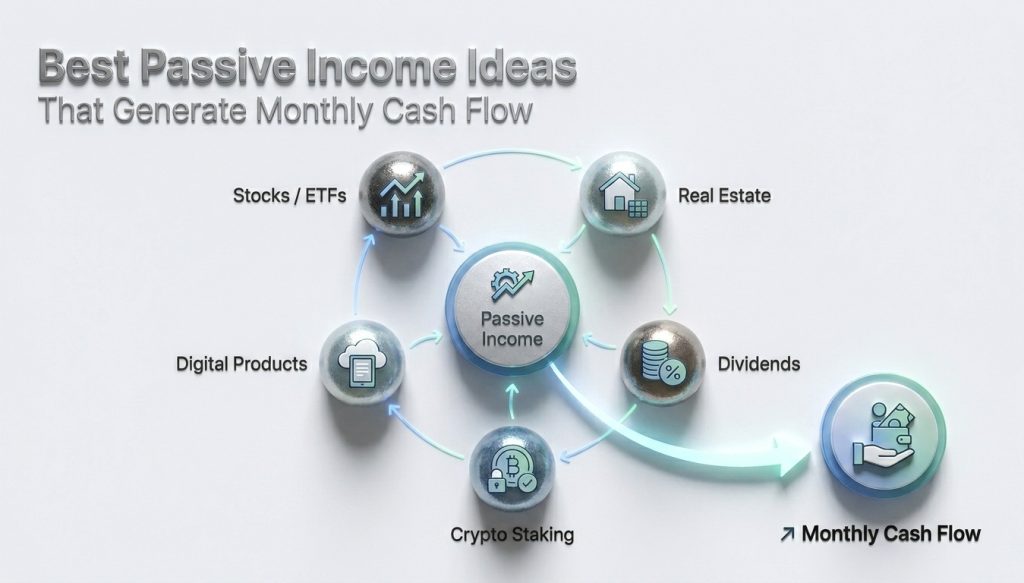
The best beginner strategies fall into two categories: capital-based and content-based. Capital-based means you invest money and it earns returns. Content-based means you create something once and it keeps generating income.
Here are four legitimate entry points for beginners.
1. High-Yield Savings Accounts
This is the easiest starting point. It requires no skill. No research. No risk beyond the standard. You simply move your existing savings into an account that pays more.
High-yield savings accounts currently offer above 4% annual percentage yield (APY) at many institutions. Traditional bank savings accounts pay a fraction of that. The money sits in the same place. It just earns far more. This is not going to make you wealthy on its own. But it is passive income from money you already have. Start here while you build toward bigger strategies.
2. Dividend Stocks and ETFs
When you buy shares in a company that pays dividends, you receive a portion of their profits at regular intervals. No extra work needed after the initial investment.
The S&P 500 Dividend Aristocrats Index includes companies that have increased their annual dividend for at least 25 consecutive years. These are not speculative bets. These are established businesses with decades of consistent payouts. Dividend ETFs give beginners access to a diversified basket of these companies through a single purchase. You do not need to pick individual stocks. You buy the ETF, collect the dividends, and reinvest them over time. Compounding does the heavy lifting.
A $10,000 investment in a stock yielding 4% generates $400 per year. That grows significantly as the investment grows and dividends are reinvested.
3. REITs – Real Estate Without the Landlord Headaches
Real estate is one of the oldest wealth-building tools in history. The problem for most beginners is the barrier to entry: down payments, mortgages, maintenance, tenants.
REITs remove all of that. A Real Estate Investment Trust is a company that owns income-producing real estate. You buy shares the way you would buy a stock. The REIT is legally required to distribute at least 90% of its taxable income to shareholders as dividends.
Some well-established REITs have paid dividends for decades, with compound annual total returns over 13% since listing. You get exposure to real estate income without owning a single property. You can start with a small amount and scale over time.
4. Digital Products
This one requires time upfront, not capital. Create something once an ebook, a template, a printable, a short course and sell it repeatedly with no additional effort per sale.
Platforms like Gumroad, Etsy, and Shopify handle the delivery and payments automatically. A well-made budgeting template or niche guide can sell for years with minimal updates. The upfront investment is your time and skills. The ongoing return is nearly passive once the product is live and discoverable.
Tips to Get Started Without Overwhelm
Start with one stream. Trying to build five passive income sources at once is a reliable path to building none. Pick the one that matches your current resources, capital or time and focus there first.
Automate everything you can. Set up automatic dividend reinvestment. Schedule recurring transfers to your high-yield savings account. Passive income works best when it runs in the background without requiring your attention.
Do not chase high yields blindly. A 20% return promise is almost always a warning sign. Sustainable passive income is built on boring, consistent, repeatable systems.
Think in years, not weeks. Passive income compounds. The returns in year three look very different from year one. The people who benefit most are the ones who start early and stay consistent.
The Bottom Line
You do not need to be wealthy to start earning passive income. You need to understand your options and begin with what you have. High-yield savings, dividend investments, REITs, and digital products are all accessible starting points for beginners. The goal is not to replace your income overnight. The goal is to build a second engine that runs quietly in the background while your life moves forward.
Money that works while you sleep is not a fantasy. It is a strategy. Start small. Be consistent. Let time do what it does best.
Post Disclaimer
The information provided on Financepdia.com is for educational and informational purposes only and should not be considered financial, investment, or trading advice. Cryptocurrency and financial markets are highly volatile and involve significant risk. Readers should conduct their own research (DYOR) and consult with a qualified financial advisor before making any investment decisions. Financepdia.com and its authors are not responsible for any financial losses resulting from actions taken based on the information provided on this website.