





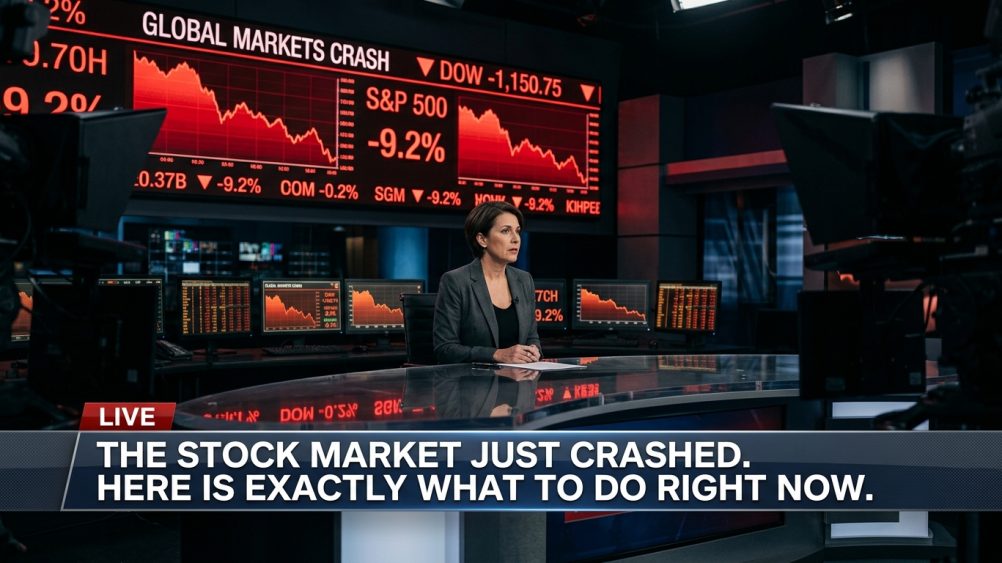
Your portfolio is down. Your phone is full of notifications. Every headline is worse than the last. Take a breath. Here is what actually matters right now.
First, Do Not Touch Anything Yet
This is the hardest part. The instinct when markets drop is to do something. Sell. Move to cash. Get out before it gets worse.
That instinct is also the most expensive mistake most investors make.
Panic selling locks in losses permanently. Staying put keeps the loss on paper. Those are two very different outcomes. One gives the market a chance to recover. The other does not.
Since 1950, the S&P 500 has experienced 13 crashes with an average decline of around 33%. The average recovery time afterward is approximately two years and two months. That is not a guarantee. But it is what history actually shows, across wars, recessions, pandemics, and political chaos.
The market has recovered from every single one.
Understand What Kind of Drop This Is
Not every red day is a crash. Not every crash is permanent. Before making any decision, understand what you are actually looking at.
A drop of 5 to 10 percent is a pullback. They happen several times a year. The average recovery time from a 5 to 10 percent downturn is around three months. A 10 to 20 percent correction takes around eight months on average to recover. Invesco
A drop over 20 percent is a bear market. Those take longer. But they also end.
Knowing the size of the drop tells you how to respond. A 7 percent drop and a 35 percent crash are not the same problem and they do not require the same response.
Check These Four Things Right Now
Before you make any move, run through this list.
1. Do you need this money in the next two years?
If the answer is no, you almost certainly do not need to act. Long-term investors who stay put through downturns consistently outperform those who move to cash and try to time re-entry. In 7 out of 11 historical drops, the S&P 500 recovered to its previous all-time high within one year. Four Pillar Freedom
If you genuinely need the money within two years, that money probably should not have been in stocks. That is a portfolio construction issue, not a crash issue.
2. Are you divers€ified?
If one sector is dragging your whole portfolio down, the problem is concentration, not the crash itself. A crash reveals portfolio problems that were already there.
3. Do you have an emergency fund separate from your investments?
Your emergency fund should never be in the market. Three to six months of expenses in cash or a high-yield savings account means a market crash does not become a personal financial crisis.
4. Are you still earning income?
If yes, a crash is not a disaster. It is actually a buying opportunity. Every contribution you make while prices are low buys more shares than it would have a month ago.
What You Can Actually Do Right Now
Do not sell in panic. If your financial situation has not changed, your investment strategy should not change because of one bad week.
Do rebalance if you are significantly off target. If your allocation has drifted way beyond your risk tolerance, a crash is a reasonable time to rebalance. Do it deliberately, not reactively.
Do look at what you own. Perhaps the most useful thing investors can do during a downturn is check that they are only holding quality stocks with healthy underlying fundamentals. A crash is a good time to ask whether each position still makes sense long term, not whether it is up or down today.
Do consider contributing more if you can. Buying during a downturn is uncomfortable. It is also how long-term wealth gets built. You are buying the same assets at a lower price.
Do turn off the financial news for a few days. Seriously. Real-time market coverage is designed to create urgency. Most of it is not actionable. Data shows that the S&P 500 ended higher one year after every market correction since 1955, averaging a 14.7 percent return over the following 12 months. That context rarely makes the headlines.
The One Question That Actually Matters
Ask yourself this: has anything changed about your actual financial goals, your income, or your timeline?
If the answer is no, then a falling market is not a reason to change your strategy. It is noise. Expensive, stressful, uncomfortable noise. But noise.
The investors who build real wealth over time are not the ones who predicted every crash. They are the ones who stayed invested through all of them.
A Note on Timing the Market
Everyone thinks they will buy back in at the bottom. Almost nobody does. The bottom only becomes visible in hindsight. By the time it feels safe to invest again, the recovery has usually already started.
Missing just the ten best trading days in any given decade has historically cut long-term returns nearly in half. Most of those best days happen during bear markets, right when selling feels most logical.
What to Actually Do in the Next 24 Hours
- Do not make any trade based on today’s headlines
- Check your emergency fund is intact and separate
- Review your asset allocation calmly, not reactively
- If you have cash on the sidelines, consider a small planned contribution
- Talk to a financial advisor if you are genuinely uncertain about your specific situation
A market crash feels like a crisis. For long-term investors who stay calm, it rarely turns out to be one.
Disclaimer: This article is for informational purposes only and does not constitute financial advice. Consult a licensed financial advisor before making investment decisions.
Post Disclaimer
The information provided on Financepdia.com is for educational and informational purposes only and should not be considered financial, investment, or trading advice. Cryptocurrency and financial markets are highly volatile and involve significant risk. Readers should conduct their own research (DYOR) and consult with a qualified financial advisor before making any investment decisions. Financepdia.com and its authors are not responsible for any financial losses resulting from actions taken based on the information provided on this website.