


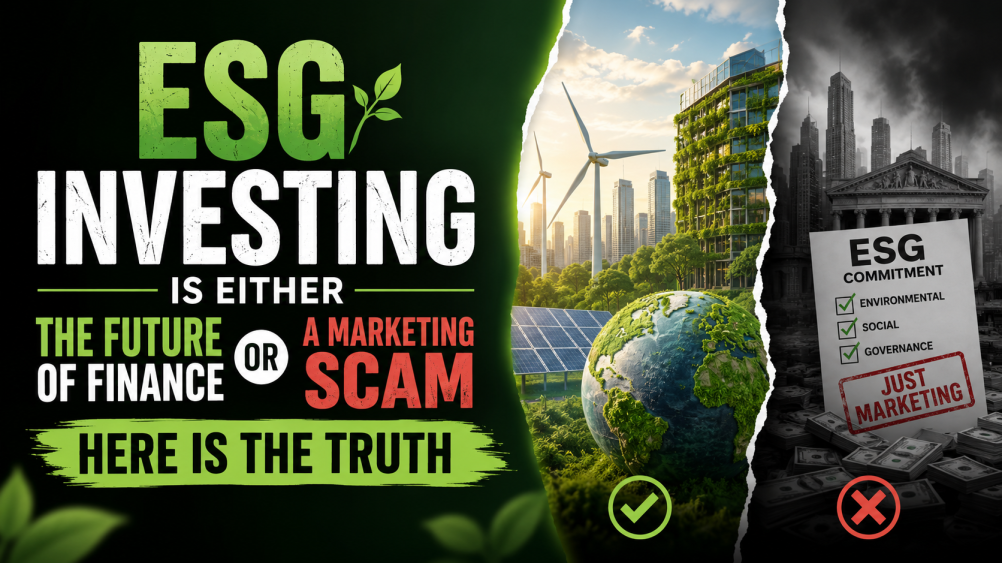
Is ESG investing really changing finance, or just selling guilt with a ticker symbol?
You want your money to grow. You also want it used responsibly. But ESG makes that choice harder. Funds promise cleaner portfolios, better governance, and lower long-term risk. Critics see something else: Wall Street selling good intentions at premium prices. That idea matters. ESG grew because climate risk, social pressure, and boardroom failures became harder to ignore. Supporters call it smarter finance. They say ESG helps spot weak companies before losses arrive. Skeptics call it moral packaging. They argue that many ESG funds sell labels, not proof.
The truth sits in the middle. ESG is not automatically the future of finance. But calling it a total marketing scam also misses the point.
The real question is simple: Does ESG protect capital, create impact, or just rebrand ordinary investing?
Why ESG Could Still Matter to Investors
ESG still has a real use, even when the label feels overused.
A balance sheet can show revenue, debt, and margins. It rarely shows a toxic workplace before lawsuits arrive. It rarely shows weak board control before scandals damage value. That is where ESG can help.
At its best, ESG asks a hard question: can this company survive pressure? That pressure can come from regulators, workers, customers, courts, or climate rules. ESG reviews how a company handles environmental, social, and governance issues. It also helps investors check risks and opportunities that basic numbers may miss.
This does not make ESG moral magic. It makes it another screen. Poor labor practices can lead to strikes or lawsuits. Pollution issues can bring fines. A weak board can miss obvious risks.
So yes, ESG can matter. But only when investors use it as risk analysis, not as a clean label.
Where ESG Starts Looking Like a Marketing Tool
Here is where ESG starts to lose people.
Many funds sell the label before they prove the method. That should bother any serious investor. Some ESG funds hold the same big companies found in ordinary index funds. Then they charge investors for a cleaner story.
The problem is not owning large companies. The problem is selling a moral upgrade without clear proof. That matters because weak companies can borrow virtue from ESG language. They can talk about responsibility while the business picture worsens.
Regulators see the risk too. The SEC expanded its fund-name rule to cover ESG-style terms. The rule links a fund’s name to its actual investments. Europe also tightened rules for funds using sustainable labels. Reuters reported that such funds must keep at least 80% of assets aligned with those terms.
This is the scam argument at its strongest. ESG becomes suspect when it sells comfort, not results. If a fund claims impact, it should show the receipts.
The Problem With ESG Scores and Fund Labels
ESG scores look precise. They are not always that clean.
Different ESG rating agencies look at different things. One may care more about carbon risk. Another may care more about workers, leadership, or company reports. That is why scores often do not match.
That creates a messy result. A company can look responsible in one model, then risky in another. The score can depend on the scorekeeper.
Tesla shows the problem clearly:
- It sells electric vehicles, which supports a lower-carbon story.
- Tesla says its customers avoided nearly 32 million metric tons of CO₂e in 2024.
- Yet S&P removed Tesla from its ESG index in 2022.
- The reasons included discrimination claims, working conditions, and Autopilot concerns.
First Solar shows another side:
- Its reports highlight recycling and lower-carbon solar modules.
- Its process recovers more than 90% of module materials.
- But strong sustainability claims do not erase business pressure.
- First Solar posted $5.2 billion in net sales for 2025, up from $4.2 billion in 2024.
- It also reported $14.21 diluted EPS for 2025.
- Still, its 2026 sales forecast came in below Wall Street estimates. Reuters said the stock fell almost 14% after that forecast.
So, fund labels need caution. An ESG label should start questions, not end them.
Investors should ask what the label measures. They should also ask what it ignores.
Can ESG Deliver Returns and Real Impact?
This is the complex question in the ESG debate.
Can ESG funds deliver returns and real impact? The answer stays mixed.
Some research supports ESG as risk control. It can help investors avoid weak oversight, legal trouble, or climate exposure. ESG reviews companies beyond basic financial results. It looks at risks linked to the environment, workers, leadership, and company behavior. That gives ESG a real place in analysis.
But returns do not prove real-world change. A fund can beat its benchmark and change almost nothing. It can also claim impact while holding companies that barely improve.
Harvard Business Review raised this issue clearly. It argued that highly rated sustainability funds did not beat low-rated funds. It also questioned whether ESG portfolios improved labor or environmental behavior.
That does not make every ESG fund useless. It means investors need proof before buying the story. They should check the holdings, method, fees, and engagement record. They should ask whether the fund pushes companies to change.
Morningstar data also shows uneven demand across regions and fund types. That makes broad claims risky.
ESG can support better investing. But returns, labels, and impact are three different things.
The Truth: Useful Framework or Overpriced Story?
So, is ESG the future of finance or a marketing scam? The answer depends on how investors use it.
ESG works when it stays honest. It can help test risk, governance, labor issues, and climate exposure. It can show problems that earnings reports may miss.
But ESG fails when funds sell virtue without evidence. A clean label does not prove a clean impact. A high ESG score does not always mean better returns.
That is where the scam argument becomes fair. Some ESG products sell comfort at a higher price.
The better view is simple. ESG is useful as a framework, not as a promise.
ESG may have a future. But only with honest labels, fair fees, and measurable results.
Disclaimer: This article is for informational purposes only and is not financial, legal, or credit advice. Always read lender terms carefully and consult a qualified advisor before applying.
Post Disclaimer
The information provided on Financepdia.com is for educational and informational purposes only and should not be considered financial, investment, or trading advice. Cryptocurrency and financial markets are highly volatile and involve significant risk. Readers should conduct their own research (DYOR) and consult with a qualified financial advisor before making any investment decisions. Financepdia.com and its authors are not responsible for any financial losses resulting from actions taken based on the information provided on this website.