






The Complete Money Guide for Freelancers Who Have No Idea What They Are Doing Financially

The Complete Money Guide for Freelancers Who Have No Idea What They Are Doing Financially

Nobody teaches you this part. You got the clients. You got the work. Then the invoice cleared and you thought, now what? No payslip. No pension. No HR department. Just you, your bank account, and a creeping feeling you are doing this wrong.

You are not alone. Millions of freelancers feel this exact way. The good news is that managing money as a freelancer is not complicated. It just needs a system. This guide gives you one.

Why Freelance Finance Feels Harder Than It Is

Freelance work can be precarious and unpredictable. One month, you may have more work than you can handle. Next, it dries up completely.

That is the core problem. Salaried workers get a fixed amount every month. Freelancers do not. So the tools built for salaried workers, monthly budgets, automatic savings, employer pensions, simply do not fit.

You need tools built around irregular income. This guide covers exactly that.

Step 1: Separate Your Money Immediately

This is the first rule. No exceptions.

Separating your freelancing finances from your personal finances is key. By having separate accounts, you can more easily track your income and expenses, and have cleaner records to show what business expenses you can deduct on your tax return.

Open a dedicated business account today.

Every client payment goes in there. Every business expense comes out of there. Your personal account stays personal.

This one habit saves you hours at tax time and protects you from overspending during good months.

Step 2: Build Your Financial Safety Net

Freelance income goes up and down. Your expenses do not.

Many financial experts in 2026 now recommend aiming closer to six months of living expenses in an emergency fund, because of inflation and uncertain job markets.

Start small. Even one month saved creates breathing room. Add to it during good months. Do not touch it unless something genuinely breaks.

Consider diversifying your income by taking on multiple clients or projects. This can help stabilize your income and reduce reliance on a single source.

Step 3: Understand Your Taxes Before They Surprise You

This is where most new freelancers get hurt. Nobody withholds tax from your invoice. That becomes your job.

Many freelancers use a simple rule of thumb: set aside 25 to 30 percent of their net income for taxes. This covers your self-employment tax and federal income tax. If you are in a high-tax state, budget closer to 35 percent.

The self-employment tax rate for 2026 is 15.3 percent, made up of 12.4 percent for Social Security and 2.9 percent for Medicare. This means a freelancer earning $100,000 faces approximately $14,130 in self-employment tax before any deductions or credits.

The practical move: every time a payment lands, move 25 to 30 percent straight into a separate tax savings account. Treat it as gone. Pay quarterly. No April surprises.

2026 Quarterly Tax Deadlines (IRS via SelfEmployed.com):

  • Q1: April 15, 2026
  • Q2: June 16, 2026
  • Q3: September 15, 2026
  • Q4: January 15, 2027

Step 4: Budget Around Your Lowest Month

Most budgets fail freelancers because they are built on average income. Average is a lie when some months pay double and others pay nothing.

Since no two months result in the same income for a freelancer, base your budget on an average monthly income. One bad month does not define your business, but neither does one successful month.

A better approach: budget on your lowest earning month of the past six. Anything above that is surplus. Split the surplus between savings, taxes, and investment. This keeps you stable in slow months and smart in good ones.

Step 5: Plan for Retirement. Yes, Now.

Nobody is doing this for you.

You do not get an employer-sponsored 401(k) with a match when you freelance. Research retirement accounts like an IRA, a SEP 401(k), or a Solo 401(k) to decide what works best for you. Your contributions can fluctuate with your income as needed.

Even small, consistent contributions compound significantly over time. Start with whatever you can. Automate it so it moves before you spend it.

The Tools That Make This Easier

Tool Best For Cost
QuickBooks Self-Employed Income tracking, tax estimates From $15/month
Wave Free invoicing and bookkeeping Free
FreshBooks Client invoicing, expense tracking From $19/month
YNAB Budget management, goal tracking $14.99/month
Stripe / PayPal Getting paid by clients globally Per transaction fee
IRS EFTPS Paying quarterly taxes online Free
Solo 401(k) / SEP-IRA Retirement savings vehicle Varies by provider

Sources: Impact Wealth, Meriwest Credit Union

Your Freelance Finance Checklist

  • Open a separate business bank account
  • Set aside 25 to 30 percent of every payment for taxes
  • Build an emergency fund covering at least three months of expenses
  • Track every business expense for tax deductions
  • Pay quarterly taxes on time to avoid IRS penalties
  • Set up a retirement account and automate contributions
  • Review your rates annually and build business costs into what you charge
  • Do a financial check-in every quarter

Your Future Self Will Thank You For This.

You did not go freelance to become an accountant. But a few simple habits protect everything you are building.

When you understand how to manage finances as a freelancer, accounting for the costs of being self-employed, you can build the foundation of a long and lucrative freelance career.

Start with one thing today. Open that separate account. Move this month’s tax cut into savings. Small moves made consistently change everything.

Frequently Asked Questions

Can I deduct my home office as a freelancer? 

Yes, if you use a dedicated space exclusively for work. The IRS allows a home office deduction based on the square footage of your workspace relative to your home. Keep records and photos. It is one of the most missed deductions for freelancers. See the IRS home office deduction guidelines for full criteria.

What happens if I miss a quarterly tax payment? 

If you miss a quarterly estimated tax payment, the IRS charges interest and penalties on the amount owed. The penalty is typically a percentage of the unpaid tax. Filing and paying late costs more than filing on time, even if you cannot pay the full amount.

Do I need a business licence to freelance legally? 

It depends on your location and the type of work you do. Most freelancers operating as sole proprietors do not require a formal licence to begin. However, registering as an LLC provides liability protection and can simplify tax filing. Check your local state or city requirements before assuming you are covered.

Disclaimer: This article is for educational purposes only. It is not financial or legal advice. Tax rules vary by location and individual circumstances. Always consult a licensed tax professional for your specific situation.


Post Disclaimer

The information provided on Financepdia.com is for educational and informational purposes only and should not be considered financial, investment, or trading advice. Cryptocurrency and financial markets are highly volatile and involve significant risk. Readers should conduct their own research (DYOR) and consult with a qualified financial advisor before making any investment decisions. Financepdia.com and its authors are not responsible for any financial losses resulting from actions taken based on the information provided on this website.

Weekend Gap Strategies: What Forex Traders Should Watch on Mondays

Weekend Gap Strategies: What Forex Traders Should Watch on Mondays

Can a calm weekend in crypto hide the kind of Monday move that catches a forex trader off guard? 

That question matters more than many new traders think. A quiet chart on Friday can turn into a sharp jump by the Monday open when fresh orders hit the market. For a crypto focused reader, the lesson feels familiar. News never really stops, and price can react fast when liquidity comes back.

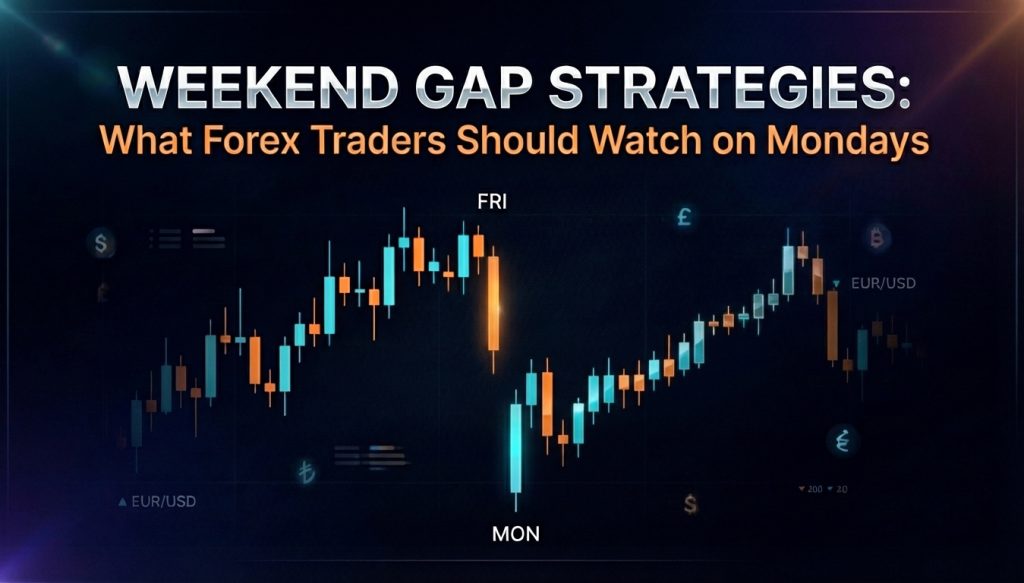
In forex gap trading, the main weekly gap appears between the Friday close and the Monday open because retail trading pauses over the weekend while global events keep moving. A gap can open higher or lower than Friday’s last traded price. Also, that move can trigger fear, fast entries, or bad exits if the trader has no plan.

What a Weekend Gap Really Says

A weekend gap is not random noise. It often reflects new information that hit the market while forex trading was closed. That can include political news, central bank talk, election results, conflict headlines, or a sudden shift in market mood. So, the first job on Monday is not to chase price. The first job is to read what the gap is saying.

A small gap in a quiet pair may mean little. A large gap in EUR/USD, GBP/USD, or USD/JPY can point to strong order flow at the open. However, size alone is not enough. The trader still needs to check whether price starts to pull back toward Friday’s close or keeps moving in the gap direction.

That difference matters. Some Monday gaps move back toward the prior close, which traders often call a gap fill. Meanwhile, other gaps keep running because the weekend event changed sentiment in a real way.

Why Monday Needs a Different Mindset

Monday is not just another session. Early trading can have wider spreads, thinner liquidity, and quick fake moves before London volume comes in. As a result, traders who jump in during the first few minutes often pay a high price for poor timing.

For crypto readers, this is a familiar setup. Weekend emotion can build a strong story before real liquidity returns. In forex, that story gets tested when the market opens, and bigger players start showing their hand. So, patience often beats speed on Monday morning.

A smart trader watches the first reaction, not just the first print. If price gaps up and then stalls under a key level, buyers may be weak. However, if the price gaps down and then cannot push lower, sellers may lose control.

Monday Gap Signals Traders Should Track

The table below shows what matters most during the Monday open.


What to Watch What It Can Mean What a Trader Should Do
Gap size A bigger gap can signal stronger news or stronger emotion Compare the gap with recent Monday opens
Pair selection Major pairs often react cleaner than thin pairs Focus on EUR/USD, GBP/USD, and USD/JPY first
Spread at open A wide spread can ruin entry quality Wait for the spread to calm before acting
Friday close level This is the key line for a possible gap fill Mark it before the market opens
First 30 to 60 minutes Early candles show whether the move is accepted or rejected Let price show direction first
Weekend news flow News often explains whether the move may continue Check the economic calendar and headlines
Risk per trade Gaps can skip normal exits Cut position size and keep a hard risk limit


A Simple Monday Plan That Makes Sense

A trader can start by marking three prices before the open. The first is the Friday close. The second is the Monday open. The third is the nearest support or resistance level on the four-hour chart. Also, that quick map helps remove guesswork.

Next, the trader should check the weekend news and the economic calendar. If the gap came after major news, a full reversal is less likely. If there were no strong driver, the chance of a gap fill may be higher.

Then comes the key question. 

Is the price accepting the new level, or rejecting it? 

If candles hold above the gap area after a gap up, continuation may be the stronger idea. However, if the price quickly drops back into Friday’s range, the market may be trying to close the gap.

Risk control matters more than the entry. A trader should keep position size small, especially during the first hour. Stop placement also needs space because Monday volatility can be messy. A tight stop loss placed in panic often gets hit before the real move starts.

When the Best Trade Is No Trade

Not every weekend gap deserves action. Some are too small to matter after the spread cost. Others are so large that the reward-to-risk picture looks poor from the start. So, skipping weak setups is part of the strategy, not a failure.

This is where many newer traders slip. They see a dramatic price action move and think a trade must be taken at once. In reality, a clean no-trade decision can protect the account far better than a forced entry.

Another warning sign is conflict between time frames. If the daily chart is in a strong uptrend, fading a small gap up can be risky. Meanwhile, trading with the bigger trend often gives the price more room to work.

Monday Gaps Reward the Prepared Trader

The real edge in weekend gap strategies does not come from guessing. It comes from reading context, waiting for structure, and respecting risk. A trader who marks the Friday close, watches the Monday open, checks the news, and waits for spreads to settle already stands in a better spot than the crowd.

For a crypto audience, the lesson is clear. Weekend emotion can shape Monday action across markets. In forex, that action becomes sharp and visible at the open. So, the trader who stays calm, keeps size under control, and reacts to proof instead of fear has the better chance over time.

Disclaimer: This article is for educational purposes only and does not give financial advice. Trading forex and crypto carries risk, and losses can exceed expectations.


Post Disclaimer

The information provided on Financepdia.com is for educational and informational purposes only and should not be considered financial, investment, or trading advice. Cryptocurrency and financial markets are highly volatile and involve significant risk. Readers should conduct their own research (DYOR) and consult with a qualified financial advisor before making any investment decisions. Financepdia.com and its authors are not responsible for any financial losses resulting from actions taken based on the information provided on this website.

Best Passive Income Ideas That Can Generate Monthly Cash Flow

Best Passive Income Ideas That Can Generate Monthly Cash Flow

Can crypto still help build a monthly cash flow without watching charts all day or chasing the next hype coin?

That is the question many beginners and careful investors keep asking. They want passive income ideas that feel real, simple, and worth the risk. They also want income that can grow over time, not just one lucky trade.

For a crypto audience, the answer is yes, but only with the right plan. Crypto passive income is no longer just about buying a token and hoping it pumps. Today, it is more about picking systems that pay rewards for holding, staking, lending, or adding liquidity. However, not every option is safe, and not every yield lasts.

This article breaks down the best passive income ideas that can generate monthly cash flow for crypto-focused readers. It keeps the focus on methods that match the article title, reader intent, and current market behavior. As a result, readers can see which choices fit a beginner, which fit a higher-risk investor, and what to avoid.

Why Crypto Passive Income Still Gets Attention

Many investors want income without daily trading stress. That is why terms like crypto passive income, staking rewards, DeFi lending, yield farming, and monthly cash flow keep showing up in beginner searches and crypto guides. Recent educational pages from Coinbase on staking, Coinbase on crypto rewards, and Lido’s liquid staking page show that staking and reward-based models remain central to this space.

At the same time, regulators still warn that crypto yield products can carry serious risk. The U.S. investor bulletin on crypto interest-bearing accounts and the broader crypto asset securities alert both stress that losses can happen and investor protections may be limited. So, the smart path is not chasing the highest APY. It is choosing a method that fits the investor’s risk level.

Best Passive Income Ideas for Monthly Cash Flow in Crypto

1. Staking Blue-Chip Proof-of-Stake Coins

For many readers, staking is the cleanest starting point. A holder locks or delegates coins such as ETH, SOL, ADA, or ATOM and earns rewards for helping the network run. Coinbase explains staking as a way to earn rewards by putting crypto to work on a blockchain, and Lido shows how liquid staking lets ETH holders earn while keeping a usable token like stETH.

This method works best for investors who already plan to hold major proof-of-stake assets. In addition, it feels easier to understand than more advanced DeFi plays.

Why it works for monthly cash flow: rewards often build daily or over time, and they can be withdrawn or tracked as a recurring income stream.

2. Liquid Staking for More Flexibility

Traditional staking can lock funds. That is where liquid staking stands out. Lido states that users can stake ETH and receive stETH, which stays usable in the wider market while still reflecting staking rewards. Therefore, this can suit investors who want yield but also want room to move capital later.

Still, this option adds smart contract risk and token price tracking risk. So it is better for readers who understand basic DeFi wallets and on-chain tools.

3. DeFi Lending

Another strong option is DeFi lending. In simple terms, an investor deposits crypto into a lending market and earns interest when borrowers use that pool. This is one of the main models behind earn interest on crypto content across the market, and Coinbase’s rewards guide lists lending as one of the common reward paths in crypto.

This can work well with stable assets or large-cap crypto. Even so, readers should remember that lending has platform risk, token risk, and market stress risk.

4. Yield Farming and Liquidity Pools

Yield farming can create stronger returns, but it is not beginner-friendly. Investors add token pairs to liquidity pools and earn trading fees plus possible token rewards. Webopedia’s current guide notes that yield farming income often comes from transaction fees and incentive tokens, while also warning about impermanent loss.

This is a real passive income idea, but it should sit lower on a beginner’s list. For that reason, it fits readers who already know how DeFi pairs, pool ratios, and fee income work.

Quick Comparison Table


Passive income idea Best for Income style Main risk
Staking Beginners and long-term holders Steady reward flow Token price drops
Liquid staking Investors who want flexibility Staking rewards plus token mobility Smart contract risk
DeFi lending Moderate-risk investors Interest from borrowed funds Platform and borrower risk
Yield farming Advanced DeFi users Fees plus token rewards Impermanent loss and volatility


What Makes One Option Better Than Another

The best passive income idea is not the one with the loudest APY. It is the one that can still make sense after fees, taxes, price swings, and risk. A careful investor often starts with staking rewards on quality assets before moving into DeFi lending or yield farming.

Likewise, monthly cash flow in crypto should not be judged by payout speed alone. A method may pay often, but if the asset drops hard, the income does not help much. That is why simple, repeatable systems often beat flashy ones.

The Smart Way to Think About Monthly Cash Flow

A crypto investor who wants a monthly income should think in layers. One layer can be staking on major proof-of-stake coins. Another layer can be a smaller share in liquid staking or DeFi lending. Higher-risk methods, such as yield farming, should stay small unless the investor already knows the mechanics well.

Most importantly, passive income in crypto is still tied to market risk. It is income, but it is not fixed salary income. That mindset helps readers avoid poor choices.

Final Thoughts: Build Cash Flow Without Chasing Hype

The best passive income ideas that can generate monthly cash flow in crypto are the ones built on clear use, simple logic, and controlled risk. For most readers, that means starting with staking, learning how liquid staking works, and only then looking at DeFi lending or yield farming.

That path may look slower. Yet, slower often wins in crypto. A reader does not need ten income streams. A reader needs one or two solid systems that can be understood, tracked, and improved over time.

Disclaimer: This article is for educational purposes only and does not give financial, legal, or tax advice. Crypto assets are risky, volatile, and can lead to loss of capital. Readers should do their own research before making any decision.


Post Disclaimer

The information provided on Financepdia.com is for educational and informational purposes only and should not be considered financial, investment, or trading advice. Cryptocurrency and financial markets are highly volatile and involve significant risk. Readers should conduct their own research (DYOR) and consult with a qualified financial advisor before making any investment decisions. Financepdia.com and its authors are not responsible for any financial losses resulting from actions taken based on the information provided on this website.