





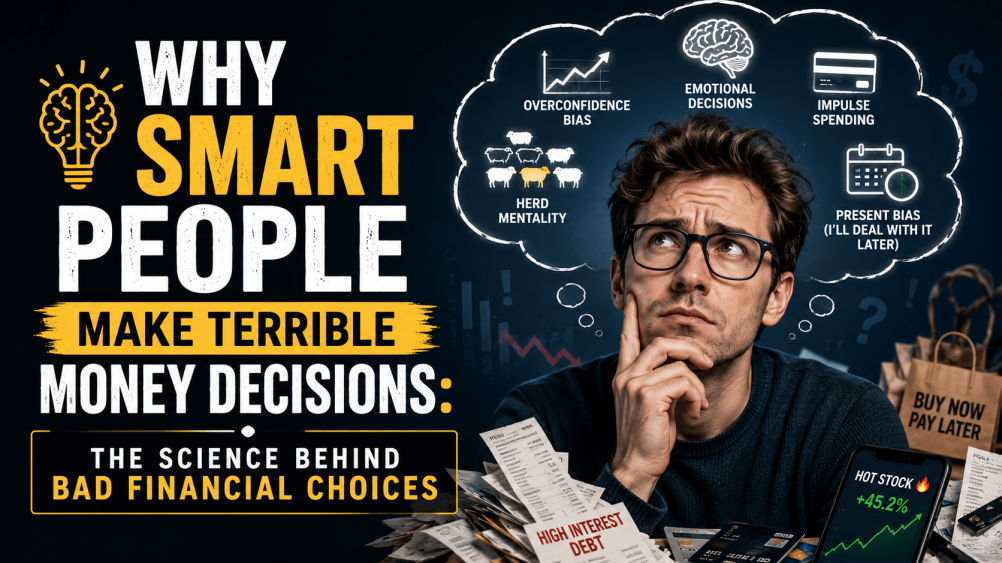
Doctors go broke. Engineers lose their savings in bad investments. Lawyers miss basic tax deductions. Intelligence does not protect you from financial mistakes. In fact, sometimes it makes things worse.
This is not about education or IQ. It is about how the human brain is wired, and why that wiring fails us when money is involved.
Your Brain Was Not Built for Finance
The human brain evolved to survive, not to invest. It craves instant rewards. It fears losses more than it loves gains. It follows the crowd. These instincts kept our ancestors alive. Today, they quietly destroy portfolios.
Behavioral finance is the science that studies why people make irrational money decisions. It sits at the crossroads of psychology and economics. And its findings are uncomfortable, because they apply to everyone, no matter how smart.
The Bias You Cannot See
Here is the first problem. Smart people are especially prone to a trap called overconfidence bias. The more someone knows about a topic, the more certain they feel, even when that certainty is not justified.
A study published in research on investor behavior found that overconfident investors trade more frequently, and that frequent trading leads to lower returns. The confidence feels real. The results are not.
This is why the person who reads every financial report still buys high and sells low. They believe their analysis is better than it is. The market does not care.
Loss Aversion: Why Losing Hurts More Than Winning Feels Good
Imagine gaining $100. Now imagine losing $100. The loss feels about twice as painful as the gain feels good.
This is called loss aversion, first identified by psychologists Daniel Kahneman and Amos Tversky in their foundational work on prospect theory. It is one of the most replicated findings in all of behavioral science.
Loss aversion causes people to:
- Hold on to losing investments too long, hoping to “break even”
- Sell winning investments too early, locking in gains out of fear
- Avoid any financial risk, even when the math clearly favors it
None of these behaviors are stupid. They are deeply human. But they are expensive.
The Herd Problem
In 2021, millions of retail investors poured money into meme stocks. Many of them were highly educated people. They were not acting on research. They were following the crowd.
This is herd behavior, and it is hardwired into us. Social belonging once meant survival. Being left out of the group was dangerous. Today, that instinct pushes people into bubbles, crypto pumps, and “too good to miss” investment trends.
Smart people are not immune. They simply build smarter-sounding reasons for following the herd.
Anchoring: The First Number Wins
Here is a simple test. You see a jacket originally priced at $500, now on sale for $300. It feels like a deal. But would you have paid $300 for that same jacket in a store without the “original price” shown? Probably not.
Anchoring bias means the first number you see shapes every judgment that follows. In finance, this shows up when investors refuse to sell a stock below the price they paid for it, even when holding it makes no logical sense. The purchase price becomes the anchor. The anchor becomes the trap.
Present Bias: Why Tomorrow Never Comes
Retirement feels abstract. The coffee feels real right now. This gap is called present bias, the tendency to overvalue immediate rewards and undervalue future ones.
It explains why even high earners undersave. It is not that they do not understand compound interest. Many can calculate it in their heads. But understanding a concept and feeling its urgency are two different things.
Research in behavioral economics consistently shows that people discount future rewards steeply, meaning a dollar today feels worth far more than a dollar in ten years, even when the math says otherwise.
Confirmation Bias: Seeing What You Want to See
Once someone believes something, they look for evidence that confirms it. They ignore evidence that challenges it. This is confirmation bias, and it is especially dangerous in investing.
A person who believes a stock will rise reads positive news about it hungrily. Negative reports feel wrong, biased, or irrelevant. Over time, they build an air-tight case inside their head, using only the information that agrees with them.
Smart people are particularly at risk here. They are better at constructing arguments. That makes them better at convincing themselves they are right, even when they are not.
What You Can Actually Do About It
Knowing these biases exist is step one. It is not enough on its own, but it matters.
Here are practical steps that behavioral science actually supports:
Automate your finances. Remove the decision from yourself entirely. Set automatic contributions to retirement accounts. Automation removes emotion from the equation.
Use rules, not feelings. Set a rule: “I will rebalance my portfolio every six months.” Follow it regardless of how the market feels. Rules protect you from yourself.
Slow down big decisions. Impose a 48-hour waiting period before any major financial move. Urgency is almost always manufactured. Real opportunities do not disappear in a day.
Seek opposing views. Actively look for reasons you might be wrong about a financial decision. Assign someone to argue against your plan before you commit.
Work with a fiduciary advisor. A fee-only financial advisor who is legally required to act in your interest adds a layer of objectivity that self-analysis cannot.
Intelligence Is Not the Problem. Awareness Is.
The smartest people in the room are not automatically the best with money. What separates good financial decision-makers is not IQ. It is self-awareness, structured thinking, and the humility to question their own instincts.
Your brain will try to protect you. It will feel certain. It will follow the crowd. It will cling to losses and celebrate small wins too soon. Knowing that these patterns exist inside you is the beginning of doing something about it.
Frequently Asked Questions
Can behavioral finance biases be completely eliminated?
No. These biases are neurological. They cannot be fully removed. But they can be managed with systems, rules, and awareness. The goal is not perfection. It is protection against the most costly errors.
Is loss aversion always a bad thing?
Not always. It can prevent reckless risk-taking. The problem is when it stops you from taking risks that are mathematically sound, like investing in diversified index funds over the long term.
Why do intelligent people fall for financial scams?
Scammers are skilled at targeting confidence and creating urgency. Smart people can be more susceptible because they trust their own judgment and may dismiss warning signs as “obvious” to someone like them. Overconfidence becomes the entry point.
How does stress affect financial decision-making?
Significantly. Stress activates the brain’s threat-response system, which narrows thinking and pushes toward short-term choices. Financial decisions made under stress are consistently worse than those made in calm, structured environments.
Post Disclaimer
The information provided on Financepdia.com is for educational and informational purposes only and should not be considered financial, investment, or trading advice. Cryptocurrency and financial markets are highly volatile and involve significant risk. Readers should conduct their own research (DYOR) and consult with a qualified financial advisor before making any investment decisions. Financepdia.com and its authors are not responsible for any financial losses resulting from actions taken based on the information provided on this website.