





Most investors glance at fund fees and think a 1% difference is too small to matter. Yet over decades, that seemingly tiny number quietly erodes wealth. Imagine investing consistently for 30 years. That extra 1% taken each year doesn’t just reduce your returns once. It compounds, shrinking your ending balance in ways many don’t expect.
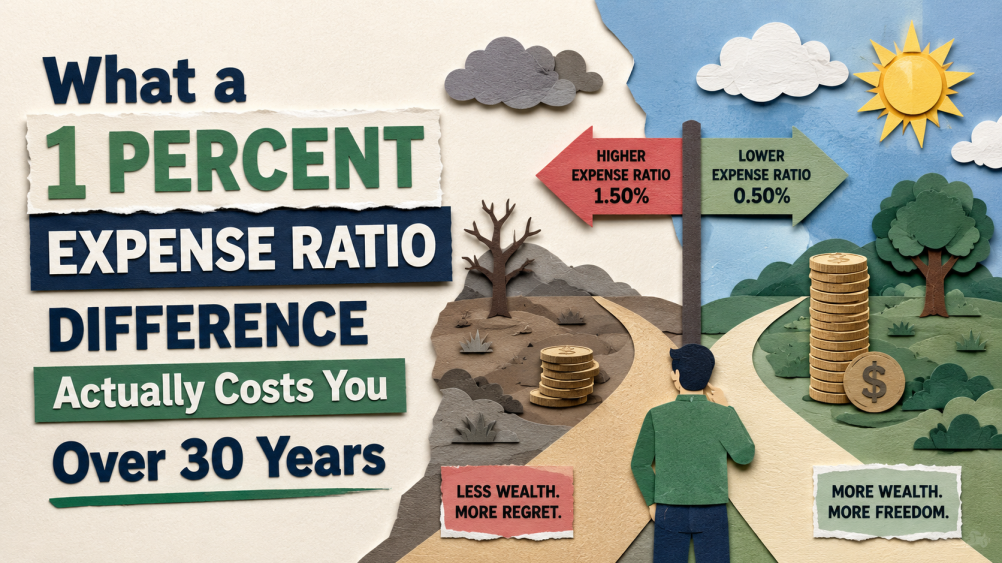
If two investors put the same amount into similar funds, one paying 0.5% and the other 1.5%, the outcome differs greatly. If held for 30 years, that small fee difference can turn tens of thousands into hundreds of thousands lost in potential growth.
So the question is simple but critical: “What does a 1 percent higher expense ratio really cost you over three decades?” Understanding the expense ratio impact is not abstract math. It’s a real effect on your long-term financial future. Being aware now can change how you invest today.
Expense Ratios: What They Take and How
An expense ratio is the annual fee a fund charges to manage your money. It is expressed as a percentage of your investment assets. While it may seem tiny, 0.5% or 1%, it is deducted from your portfolio every year, quietly reducing your returns before you even see them.
These fees cover fund operations like management, administration, marketing, and legal costs. Most of the time, investors don’t see these amounts on statements because they are automatically subtracted from the fund’s value. That’s why a small number often feels “safe.”
But here’s the math: even a 1% difference may not look like much in a single year, but over decades, it compounds against you. A $100,000 investment at a 7% annual return with a 0.5% expense ratio grows far more than the same investment with a 1.5% fee. The difference isn’t linear; it grows larger as the portfolio compounds over time.
Understanding how expense ratios eat into long-term wealth is crucial. Even a seemingly minor percentage can cost tens or hundreds of thousands of dollars over 30 years, making this one of the most important numbers for any long-term investor.
How Compounding Amplifies Fee Differences
Compounding is one of the most powerful forces in investing. It means your returns earn returns over time. But here’s the catch: the expense ratio impact reduces your annual return before compounding even starts. That small 1% difference isn’t just subtracted once; it affects every year of growth.
Let’s see the math. Imagine a $100,000 investment earning an average 7% annual return. With a 0.10% expense ratio, your portfolio grows steadily over 30 years. But with a 1.00% expense ratio, that extra 0.90% fee is deducted every year before compounding. By the end of 30 years, the difference in your ending balance can exceed $165,000.
This is more than a linear cost. The drag on compounding accelerates as your portfolio grows, because each year’s fee is taken from a larger base. Early years matter, but the real impact explodes in the final decade when your portfolio has compounded significantly.
In other words, the higher fee doesn’t just cost 1% more per year; it quietly erodes exponential growth. Investors who ignore small differences in expense ratios may see hundreds of thousands in potential wealth lost over decades. Understanding this is crucial: even minor fee differences have major long-term consequences.
Real Numbers: What a 1% Expense Ratio Costs You
Let’s put the math into perspective. Imagine you invest $100,000 in a fund expected to earn 7% annually over 30 years. How much you keep depends heavily on the expense ratio.
Here’s a clear comparison:
| Expense Ratio | Ending Balance (30 years) | Wealth Lost vs 0.1% Fee |
| 0.10% | $761,225 | Nil |
| 0.50% | $709,134 | $52,091 |
| 1.00% | $596,539 | $164,686 |
- With a 0.10% expense ratio, your $100K grows to $761,225.
- With 0.50%, you end up with $709,134, losing $52,091 compared to the low-cost option.
- With 1.00%, your ending balance drops to $596,539, a loss of $164,686.
Notice how the wealth gap grows largest in the final decade. The earlier years matter. But as your portfolio compounds, the same percentage fee takes more dollars each year, accelerating the drag on growth.
Even though 1% sounds small. Over 30 years, it can shrink your potential wealth by 20–30% compared to a low-cost fund with similar returns.
When choosing funds, small differences in fees can lead to massive differences in long-term outcomes. Checking the expense ratio impact is not optional. It’s one of the most important decisions for long-term investors.
Practical Takeaways for Investors
Not all funds are created equal. Index funds are usually the cheapest, with expense ratios around 0.03% to 0.20%, while actively managed funds often charge 0.75% to 1.50% or more. That difference may seem small, but over decades it can cost tens or hundreds of thousands of dollars.
Over time, the average mutual fund fee has dropped, but many high-cost funds still exist. Even if a fund looks reasonable, remember that expense ratios don’t capture the full cost. Trading fees, portfolio turnover, and hidden charges can further reduce returns.
To protect long-term growth, follow this simple checklist:
- Compare index vs active funds before investing.
- Review annual fee disclosures to understand exactly what is charged.
- Consider long-term cost impact on your portfolio, not just short-term returns.
The point is clear: small fee differences compound dramatically over decades. Choosing funds carefully and keeping costs low can significantly increase your ending balance. Every decimal point matters when your money is compounding for 30 years.
Conclusion: Your Future Wealth Depends on Tiny Percentages
A 1% expense ratio difference doesn’t just cost 1%. Over decades, it can erode hundreds of thousands of dollars from your portfolio. Each year, fees are subtracted from a growing balance, and the compounding drag accelerates over time.
Even small fee differences matter more than most investors realize. Choosing low-cost index funds or ETFs, reviewing total fees, and avoiding high-cost active funds can protect long-term growth.
Always check expense ratios and total costs. Tiny differences may seem minor now, but over 30 years, they can shift your wealth trajectory. They reveal the real expense ratio impact and determine how much your investments can truly grow.
Disclaimer: This article is for general information only. It is not personal financial advice. Consider speaking with a qualified financial adviser before making investment decisions.
Post Disclaimer
The information provided on Financepdia.com is for educational and informational purposes only and should not be considered financial, investment, or trading advice. Cryptocurrency and financial markets are highly volatile and involve significant risk. Readers should conduct their own research (DYOR) and consult with a qualified financial advisor before making any investment decisions. Financepdia.com and its authors are not responsible for any financial losses resulting from actions taken based on the information provided on this website.