



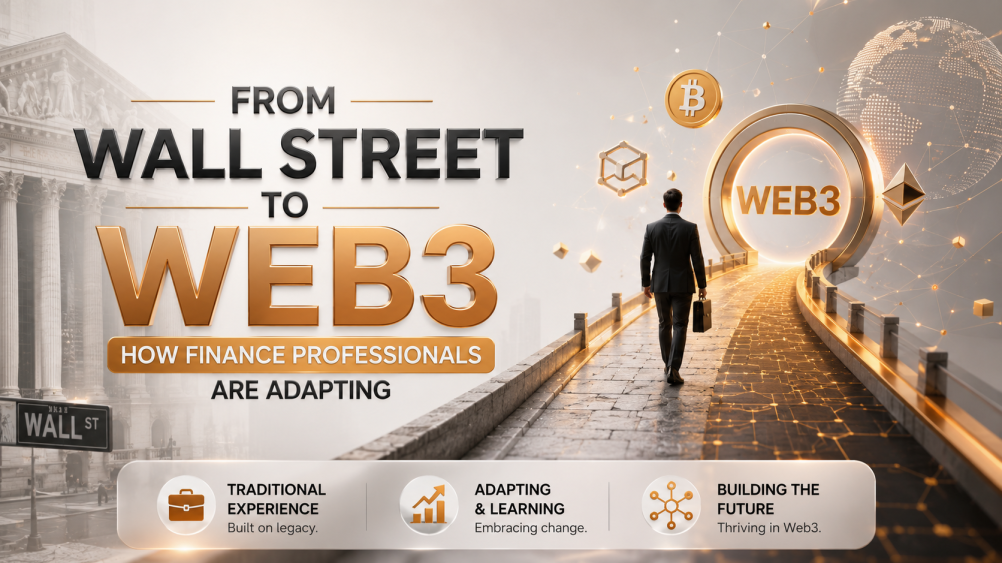
Can a worried investor trust crypto when the same finance experts who once avoided it are now building careers around it?
That question is becoming more common as Wall Street and Web3 finance move closer.
For years, many bankers, analysts, traders, and wealth managers viewed digital assets as too risky. Today, the picture is different. The approval of spot Bitcoin exchange-traded products in January 2024 gave traditional investors a regulated way to gain Bitcoin exposure through familiar market products.
As a result, finance professionals in crypto are no longer rare. They are joining exchanges, blockchain funds, tokenization firms, custody platforms, and compliance teams. However, this shift is not just about chasing higher returns. It is about learning how old financial skills fit into a faster, more transparent, and more technical market.
Why Wall Street Talent Is Moving Toward Web3
The biggest reason is simple. Institutional crypto adoption is growing. State Street’s 2025 digital assets research found that many institutional investors expect their digital asset exposure to double within three years, while over half expect 10% to 24% of investments to be tokenized by 2030.
Because of this, banks and asset managers need people who understand both capital markets and blockchain in finance. A risk analyst who once tracked bond exposure may now study wallet flows, custody risk, and smart contract audits. A portfolio manager may compare Bitcoin, tokenized treasuries, and stablecoin yield products.
Moreover, Web3 firms need credibility. They need professionals who know regulation, market structure, fund accounting, investor reporting, and anti-money laundering rules. These skills are already strong on Wall Street.
The Skills Finance Professionals Are Rebuilding
The move from traditional finance to Web3 is not a total reset. Many core skills still matter. Yet, the tools and market behavior are different.
| Wall Street Skill | Web3 Version | Why It Matters |
| Risk management | Wallet risk, protocol risk, custody risk | Crypto losses can happen through hacks, bad contracts, or weak controls |
| Asset valuation | Token economics, liquidity, and on-chain activity | Tokens need more than price charts |
| Compliance | Crypto compliance, KYC, AML, sanctions screening | Regulation is now central to Web3 growth |
| Trading | 24/7 crypto markets, DEX liquidity, exchange depth | Digital assets trade without a market close |
| Fund operations | Tokenized funds, on-chain settlement, digital custody | Back-office work is changing fast |
In addition, finance professionals are learning new terms such as DeFi, smart contracts, stablecoins, real-world assets, and tokenization. These are not buzzwords for them anymore. They are becoming part of daily work.
Tokenization Is Creating a New Career Path
One of the most important shifts is tokenization. This means recording ownership of assets such as funds, bonds, treasuries, or private assets on a blockchain. CFA Institute research has reviewed tokenized use cases across gold, equities, mutual funds, private market funds, and repurchase agreements.
BlackRock’s BUIDL fund is a clear example. In 2024, BlackRock launched its first tokenized fund on the Ethereum network, giving qualified investors access to a blockchain-based institutional liquidity fund.
Meanwhile, McKinsey has stated that tokenized financial assets could reach around $2 trillion by 2030 in its base case, excluding cryptocurrencies and stablecoins.
Therefore, finance professionals who understand fund structure, custody, settlement, and investor protection are in demand. They can help connect old market rules with new digital rails.
Compliance Is Becoming a High-Value Web3 Role
Crypto is not only about trading coins. The real growth depends on trust. That is why crypto compliance is one of the strongest career bridges from Wall Street to Web3.
The SEC says its Crypto Task Force works on policy measures linked to crypto asset markets, investor protection, and innovation. Deloitte also notes that digital assets bring accounting and reporting issues, including tax, lending, borrowing, and recognition questions.
For this reason, compliance officers, auditors, accountants, and legal finance teams are finding new roles in crypto companies. They review transaction monitoring, proof of reserves, custody controls, and financial reporting.
What Crypto Beginners Can Learn From This Shift
Crypto beginners should not see Wall Street’s move into Web3 as a signal to buy blindly. Instead, it shows that the market is maturing. More professionals are testing, measuring, and structuring crypto products with clearer rules.
Also, the rise of Bitcoin ETFs, tokenized funds, and regulated custody does not remove risk. Prices can still fall. Protocols can fail. Scams still exist. So, readers should look for projects with clear teams, real use cases, transparent data, and strong security practices.
The Next Chapter Belongs to Hybrid Talent
The finance professional of the future may not sit only in a bank or only in a crypto startup. The strongest talent will understand both. They will read balance sheets and blockchain data. They will know market risk and wallet risk. They will speak to regulators and developers.
In the end, the shift from Wall Street to Web3 is not a rejection of traditional finance. It is a change in how finance works. Professionals who adapt early may help shape safer, smarter, and more trusted digital asset markets.
Disclaimer: This article is for general information only. It is not financial advice. Readers should do their own research before investing in crypto or digital assets.
Post Disclaimer
The information provided on Financepdia.com is for educational and informational purposes only and should not be considered financial, investment, or trading advice. Cryptocurrency and financial markets are highly volatile and involve significant risk. Readers should conduct their own research (DYOR) and consult with a qualified financial advisor before making any investment decisions. Financepdia.com and its authors are not responsible for any financial losses resulting from actions taken based on the information provided on this website.