







Why Governments Are Pushing for Clear Crypto Regulations in 2026

ChatGPT Image Apr 30, 2026, 01_36_26 PM

Meta Title: Why Governments Are Pushing for Clear Crypto Regulations in 2026

Meta Description: Governments worldwide are writing clear crypto rules in 2026. Here is what the EU’s MiCA, the US GENIUS Act, and UK regulations mean for everyday investors right now.

Are your crypto investments actually protected? That is the question millions of everyday investors are asking right now.

Think about it this way. In 2019, Uber went public. Early investors made fortunes. Regular people joined too late. The private market kept the biggest gains locked behind closed doors.

Crypto promised to change that. Open markets. No gatekeepers. Anyone with a phone could participate.

But without clear rules, the door swung both ways. Scams grew. Exchanges collapsed. Billions in retail savings disappeared overnight. Governments watched. Then they moved.

In 2026, that movement became action.

Key Takeaways

  • MiCA is fully live in the EU: The EU’s Markets in Crypto-Assets Regulation reached full implementation on December 30, 2024, completing a two-stage rollout.
  • The US passed its first major crypto law: The GENIUS Act, signed into law on July 18, 2025, sets up a regulatory framework for USD-backed payment stablecoins. State Street
  • The UK is finalizing its own rules: The UK Financial Conduct Authority has moved toward finalized requirements scheduled for rollout in late 2026, emphasizing licensing for exchanges and custodians. 
  • Institutional money is moving in: Over half of traditional hedge funds now have some form of exposure to digital assets, the highest proportion ever recorded. 
  • 2026 is about enforcement, not just drafting: Companies and practitioners should expect 2026 to focus less on crafting new regulations and more on refining and operationalizing the ones already in place. Bloomberg Law

What Changed and Why Governments Could No Longer Wait

Crypto was unregulated for over a decade. That was both its appeal and its problem.

Anyone could launch a token. Anyone could run an exchange. No audits required. No reserves needed. No rules at all.

The result was predictable. Billions were lost to collapsed platforms. Retail investors paid the price while founders disappeared.

U.S. regulators shifted almost overnight, moving from an enforcement-heavy crypto-skepticism that effectively limited traditional financial institutions, to a determined focus on flexibility for market participants engaging with digital assets. Cleary Gottlieb

That shift did not happen because governments suddenly liked crypto. It happened because crypto became too big to ignore.

The British government cited that 12% of all UK adults now own some form of digital assets as the reason clear regulation is urgently needed. investing

When one in eight people hold an asset, that asset becomes a policy issue.


How Three Major Regions Are Writing the New Rules

Every major economy is approaching this differently. Here is what each one is actually doing.

1. The European Union: MiCA Sets the Global Standard

The EU moved first and moved comprehensively.

MiCA organized the chaotic token landscape into three categories: asset-referenced tokens backed by currencies or commodities, e-money tokens designed for payments, and a remaining category covering governance tokens and platform-access coins. 

The biggest change for investors is licensing. Crypto asset service providers must now hold a full license, allowing them to register services across all 27 EU member states. 

That means the exchange you use in Paris must meet the same standards as the one in Warsaw. For retail investors, that is meaningful protection.

MiCA regulations are reshaping the crypto industry by raising regulatory and operational standards, which could reduce the number of lightly regulated platforms operating across Europe. CoinDesk

Fewer platforms, but safer ones. That is the tradeoff MiCA is making.

2. The United States: GENIUS Act Targets Stablecoins First

The US took a narrower but historic first step.

The GENIUS Act requires stablecoins to be backed one-for-one by US dollars or other low-risk assets. Wikipedia No more algorithmic stablecoins with nothing behind them.

On March 17, 2026, the SEC and CFTC jointly issued a comprehensive interpretation clarifying how federal securities laws apply to crypto assets and transactions. Latham & Watkins That is the first coordinated statement from both agencies working together.

For everyday investors, this matters. It means the rules are no longer ambiguous. It means regulators are talking to each other. And it means more institutional money can enter legally.

3. The United Kingdom: Building an Innovation-Friendly Framework

The UK is taking a middle path.

The UK has chosen to mirror much of MiCA while offering more regulatory sandboxes for experimental DeFi projects, positioning itself as an innovation hub compared to the EU’s focus on safety and consumer protection.

In December 2025, the FCA released a consulting paper on rules for trading platforms, intermediaries, lending, borrowing, staking, and decentralized finance, with new guidance expected in 2026. Sumsub

The UK wants the business. It is building rules designed to attract it.

Why Governments Are Pushing for Clear Crypto Regulations in 2026

Global Crypto Regulation Timeline: Where Each Region Stands

Region Key Regulation Status in 2026 Main Focus
European Union MiCA Fully implemented Licensing, stablecoins, consumer protection
United States GENIUS Act Active, enforcement ongoing Payment stablecoins, reserve requirements
United Kingdom FCA Framework Finalizing rules, late 2026 Exchanges, custodians, DeFi sandboxes
Hong Kong / Singapore Institutional frameworks Active Institutional-only access

What Clear Regulation Actually Means for Retail Investors

Rules sound boring. The impact is not.

Here is what crypto regulation directly changes for everyday investors:

  • Safer exchanges: Licensed platforms must meet reserve and audit requirements. Your funds have real backing.
  • Clearer tax obligations: Every provider must now report transaction data to tax authorities, ending the era of tax-hopping within the EU. The Blockverse
  • More institutional money: When banks can legally hold crypto, more capital enters the market. That benefits early retail holders.
  • Scam reduction: Unlicensed operators get forced out. The noise drops. Quality projects become easier to identify.
  • Consumer rights: MiCA includes withdrawal rights and market abuse protections. Retail investors are no longer last in line.

Why Institutional Money Is Finally Moving In

Rules create permission. Permission brings capital.

Stricter regulations have increased compliance challenges for crypto service providers, yet they are also fostering greater market trust and driving growing institutional adoption of digital assets.

That is the paradox of regulation. Tighter rules feel restrictive. But they are what make serious money comfortable enough to enter.

Banks and regulated financial firms are increasingly permitted to offer custody, payments, and supervised stablecoin issuance, subject to defined controls. Blockchain Council

JPMorgan. BlackRock. Fidelity. These institutions do not move without legal clarity. In 2026, they finally have enough of it to act.

For retail investors who got in early, institutional entry is not a threat. It is a tailwind.

Frequently Asked Questions

Does crypto regulation mean governments can freeze my wallet?

Not under current frameworks. MiCA and the GENIUS Act focus on regulating service providers and issuers, not individual wallet holders. Self-custody wallets remain outside the direct scope of most 2026 regulations. However, exchanges operating in regulated jurisdictions must comply with anti-money laundering rules, which can affect account access in specific circumstances.

How is crypto regulation different from traditional stock market regulation?

Stock markets have had clear rules for over a century. Crypto regulation is being built in real time, often on top of laws written before blockchain existed. Unlike stocks, crypto crosses borders instantly, making single-country rules harder to enforce. MiCA is the first attempt at a unified regional rulebook. The US is still building its equivalent at the federal level.

Will regulation make crypto less profitable for early investors?

Regulation does not cap profits. It changes who participates. When institutional players enter legally, trading volumes grow and liquidity deepens. That typically benefits assets already held by early retail investors. The risk is that over-regulation pushes innovation to less regulated regions, fragmenting markets. Both outcomes are possible. Neither is guaranteed.

Disclaimer: This article is for informational purposes only. It is not financial advice. Always do your own research.


Post Disclaimer

The information provided on Financepdia.com is for educational and informational purposes only and should not be considered financial, investment, or trading advice. Cryptocurrency and financial markets are highly volatile and involve significant risk. Readers should conduct their own research (DYOR) and consult with a qualified financial advisor before making any investment decisions. Financepdia.com and its authors are not responsible for any financial losses resulting from actions taken based on the information provided on this website.
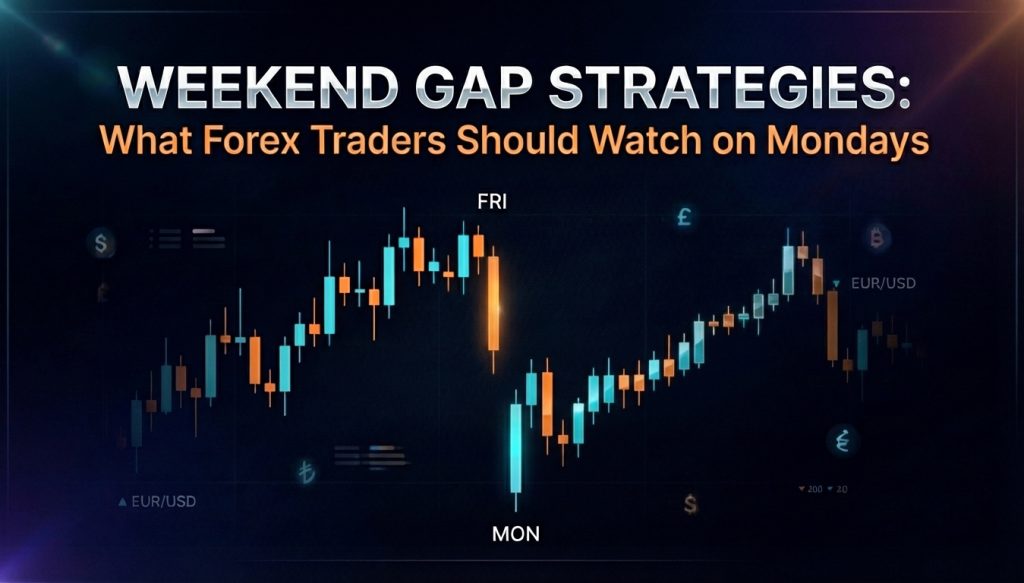

Weekend Gap Strategies: What Forex Traders Should Watch on Mondays

Weekend Gap Strategies: What Forex Traders Should Watch on Mondays

Can a calm weekend in crypto hide the kind of Monday move that catches a forex trader off guard? 

That question matters more than many new traders think. A quiet chart on Friday can turn into a sharp jump by the Monday open when fresh orders hit the market. For a crypto focused reader, the lesson feels familiar. News never really stops, and price can react fast when liquidity comes back.

In forex gap trading, the main weekly gap appears between the Friday close and the Monday open because retail trading pauses over the weekend while global events keep moving. A gap can open higher or lower than Friday’s last traded price. Also, that move can trigger fear, fast entries, or bad exits if the trader has no plan.

What a Weekend Gap Really Says

A weekend gap is not random noise. It often reflects new information that hit the market while forex trading was closed. That can include political news, central bank talk, election results, conflict headlines, or a sudden shift in market mood. So, the first job on Monday is not to chase price. The first job is to read what the gap is saying.

A small gap in a quiet pair may mean little. A large gap in EUR/USD, GBP/USD, or USD/JPY can point to strong order flow at the open. However, size alone is not enough. The trader still needs to check whether price starts to pull back toward Friday’s close or keeps moving in the gap direction.

That difference matters. Some Monday gaps move back toward the prior close, which traders often call a gap fill. Meanwhile, other gaps keep running because the weekend event changed sentiment in a real way.

Why Monday Needs a Different Mindset

Monday is not just another session. Early trading can have wider spreads, thinner liquidity, and quick fake moves before London volume comes in. As a result, traders who jump in during the first few minutes often pay a high price for poor timing.

For crypto readers, this is a familiar setup. Weekend emotion can build a strong story before real liquidity returns. In forex, that story gets tested when the market opens, and bigger players start showing their hand. So, patience often beats speed on Monday morning.

A smart trader watches the first reaction, not just the first print. If price gaps up and then stalls under a key level, buyers may be weak. However, if the price gaps down and then cannot push lower, sellers may lose control.

Monday Gap Signals Traders Should Track

The table below shows what matters most during the Monday open.


What to Watch What It Can Mean What a Trader Should Do
Gap size A bigger gap can signal stronger news or stronger emotion Compare the gap with recent Monday opens
Pair selection Major pairs often react cleaner than thin pairs Focus on EUR/USD, GBP/USD, and USD/JPY first
Spread at open A wide spread can ruin entry quality Wait for the spread to calm before acting
Friday close level This is the key line for a possible gap fill Mark it before the market opens
First 30 to 60 minutes Early candles show whether the move is accepted or rejected Let price show direction first
Weekend news flow News often explains whether the move may continue Check the economic calendar and headlines
Risk per trade Gaps can skip normal exits Cut position size and keep a hard risk limit


A Simple Monday Plan That Makes Sense

A trader can start by marking three prices before the open. The first is the Friday close. The second is the Monday open. The third is the nearest support or resistance level on the four-hour chart. Also, that quick map helps remove guesswork.

Next, the trader should check the weekend news and the economic calendar. If the gap came after major news, a full reversal is less likely. If there were no strong driver, the chance of a gap fill may be higher.

Then comes the key question. 

Is the price accepting the new level, or rejecting it? 

If candles hold above the gap area after a gap up, continuation may be the stronger idea. However, if the price quickly drops back into Friday’s range, the market may be trying to close the gap.

Risk control matters more than the entry. A trader should keep position size small, especially during the first hour. Stop placement also needs space because Monday volatility can be messy. A tight stop loss placed in panic often gets hit before the real move starts.

When the Best Trade Is No Trade

Not every weekend gap deserves action. Some are too small to matter after the spread cost. Others are so large that the reward-to-risk picture looks poor from the start. So, skipping weak setups is part of the strategy, not a failure.

This is where many newer traders slip. They see a dramatic price action move and think a trade must be taken at once. In reality, a clean no-trade decision can protect the account far better than a forced entry.

Another warning sign is conflict between time frames. If the daily chart is in a strong uptrend, fading a small gap up can be risky. Meanwhile, trading with the bigger trend often gives the price more room to work.

Monday Gaps Reward the Prepared Trader

The real edge in weekend gap strategies does not come from guessing. It comes from reading context, waiting for structure, and respecting risk. A trader who marks the Friday close, watches the Monday open, checks the news, and waits for spreads to settle already stands in a better spot than the crowd.

For a crypto audience, the lesson is clear. Weekend emotion can shape Monday action across markets. In forex, that action becomes sharp and visible at the open. So, the trader who stays calm, keeps size under control, and reacts to proof instead of fear has the better chance over time.

Disclaimer: This article is for educational purposes only and does not give financial advice. Trading forex and crypto carries risk, and losses can exceed expectations.


Post Disclaimer

The information provided on Financepdia.com is for educational and informational purposes only and should not be considered financial, investment, or trading advice. Cryptocurrency and financial markets are highly volatile and involve significant risk. Readers should conduct their own research (DYOR) and consult with a qualified financial advisor before making any investment decisions. Financepdia.com and its authors are not responsible for any financial losses resulting from actions taken based on the information provided on this website.

Best Passive Income Ideas That Can Generate Monthly Cash Flow

Best Passive Income Ideas That Can Generate Monthly Cash Flow

Can crypto still help build a monthly cash flow without watching charts all day or chasing the next hype coin?

That is the question many beginners and careful investors keep asking. They want passive income ideas that feel real, simple, and worth the risk. They also want income that can grow over time, not just one lucky trade.

For a crypto audience, the answer is yes, but only with the right plan. Crypto passive income is no longer just about buying a token and hoping it pumps. Today, it is more about picking systems that pay rewards for holding, staking, lending, or adding liquidity. However, not every option is safe, and not every yield lasts.

This article breaks down the best passive income ideas that can generate monthly cash flow for crypto-focused readers. It keeps the focus on methods that match the article title, reader intent, and current market behavior. As a result, readers can see which choices fit a beginner, which fit a higher-risk investor, and what to avoid.

Why Crypto Passive Income Still Gets Attention

Many investors want income without daily trading stress. That is why terms like crypto passive income, staking rewards, DeFi lending, yield farming, and monthly cash flow keep showing up in beginner searches and crypto guides. Recent educational pages from Coinbase on staking, Coinbase on crypto rewards, and Lido’s liquid staking page show that staking and reward-based models remain central to this space.

At the same time, regulators still warn that crypto yield products can carry serious risk. The U.S. investor bulletin on crypto interest-bearing accounts and the broader crypto asset securities alert both stress that losses can happen and investor protections may be limited. So, the smart path is not chasing the highest APY. It is choosing a method that fits the investor’s risk level.

Best Passive Income Ideas for Monthly Cash Flow in Crypto

1. Staking Blue-Chip Proof-of-Stake Coins

For many readers, staking is the cleanest starting point. A holder locks or delegates coins such as ETH, SOL, ADA, or ATOM and earns rewards for helping the network run. Coinbase explains staking as a way to earn rewards by putting crypto to work on a blockchain, and Lido shows how liquid staking lets ETH holders earn while keeping a usable token like stETH.

This method works best for investors who already plan to hold major proof-of-stake assets. In addition, it feels easier to understand than more advanced DeFi plays.

Why it works for monthly cash flow: rewards often build daily or over time, and they can be withdrawn or tracked as a recurring income stream.

2. Liquid Staking for More Flexibility

Traditional staking can lock funds. That is where liquid staking stands out. Lido states that users can stake ETH and receive stETH, which stays usable in the wider market while still reflecting staking rewards. Therefore, this can suit investors who want yield but also want room to move capital later.

Still, this option adds smart contract risk and token price tracking risk. So it is better for readers who understand basic DeFi wallets and on-chain tools.

3. DeFi Lending

Another strong option is DeFi lending. In simple terms, an investor deposits crypto into a lending market and earns interest when borrowers use that pool. This is one of the main models behind earn interest on crypto content across the market, and Coinbase’s rewards guide lists lending as one of the common reward paths in crypto.

This can work well with stable assets or large-cap crypto. Even so, readers should remember that lending has platform risk, token risk, and market stress risk.

4. Yield Farming and Liquidity Pools

Yield farming can create stronger returns, but it is not beginner-friendly. Investors add token pairs to liquidity pools and earn trading fees plus possible token rewards. Webopedia’s current guide notes that yield farming income often comes from transaction fees and incentive tokens, while also warning about impermanent loss.

This is a real passive income idea, but it should sit lower on a beginner’s list. For that reason, it fits readers who already know how DeFi pairs, pool ratios, and fee income work.

Quick Comparison Table


Passive income idea Best for Income style Main risk
Staking Beginners and long-term holders Steady reward flow Token price drops
Liquid staking Investors who want flexibility Staking rewards plus token mobility Smart contract risk
DeFi lending Moderate-risk investors Interest from borrowed funds Platform and borrower risk
Yield farming Advanced DeFi users Fees plus token rewards Impermanent loss and volatility


What Makes One Option Better Than Another

The best passive income idea is not the one with the loudest APY. It is the one that can still make sense after fees, taxes, price swings, and risk. A careful investor often starts with staking rewards on quality assets before moving into DeFi lending or yield farming.

Likewise, monthly cash flow in crypto should not be judged by payout speed alone. A method may pay often, but if the asset drops hard, the income does not help much. That is why simple, repeatable systems often beat flashy ones.

The Smart Way to Think About Monthly Cash Flow

A crypto investor who wants a monthly income should think in layers. One layer can be staking on major proof-of-stake coins. Another layer can be a smaller share in liquid staking or DeFi lending. Higher-risk methods, such as yield farming, should stay small unless the investor already knows the mechanics well.

Most importantly, passive income in crypto is still tied to market risk. It is income, but it is not fixed salary income. That mindset helps readers avoid poor choices.

Final Thoughts: Build Cash Flow Without Chasing Hype

The best passive income ideas that can generate monthly cash flow in crypto are the ones built on clear use, simple logic, and controlled risk. For most readers, that means starting with staking, learning how liquid staking works, and only then looking at DeFi lending or yield farming.

That path may look slower. Yet, slower often wins in crypto. A reader does not need ten income streams. A reader needs one or two solid systems that can be understood, tracked, and improved over time.

Disclaimer: This article is for educational purposes only and does not give financial, legal, or tax advice. Crypto assets are risky, volatile, and can lead to loss of capital. Readers should do their own research before making any decision.


Post Disclaimer

The information provided on Financepdia.com is for educational and informational purposes only and should not be considered financial, investment, or trading advice. Cryptocurrency and financial markets are highly volatile and involve significant risk. Readers should conduct their own research (DYOR) and consult with a qualified financial advisor before making any investment decisions. Financepdia.com and its authors are not responsible for any financial losses resulting from actions taken based on the information provided on this website.