





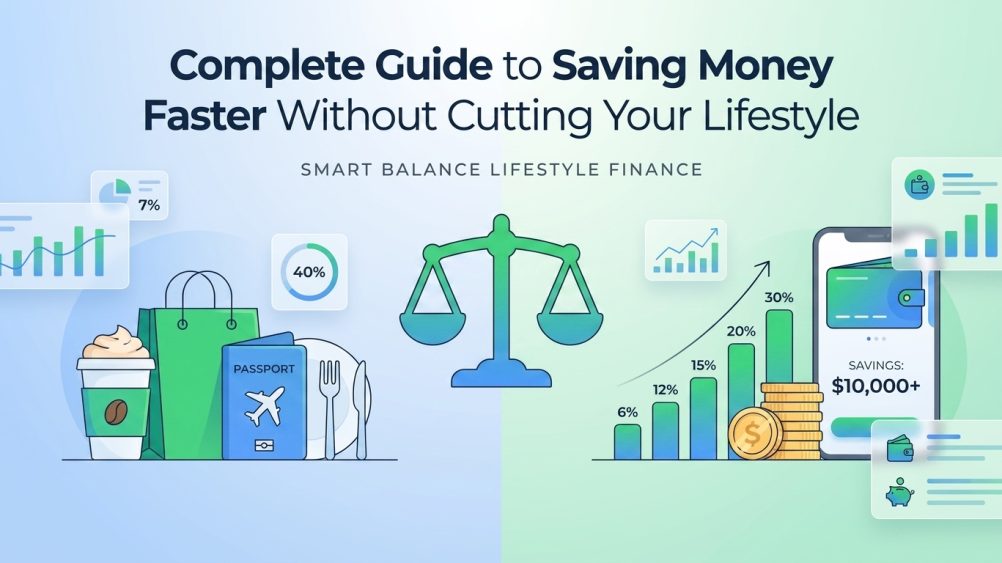
Ever feel like saving money means giving up everything fun? You’re not alone. Think about early Bitcoin buyers in 2010. They didn’t give up on everything. They just moved a small amount into the right place at the right time. The same principle applies to saving.
It’s not about sacrifice. It’s about strategy.
Most people believe saving requires radical cuts. Skip the coffee. Cancel the subscriptions. Stop eating out. But that approach burns out fast.
The better question is: where is your money quietly leaking? And how do you redirect it without feeling the loss?
This guide gives you a clear, practical system. No guilt. No deprivation. Just smarter habits that actually stick.
Key Takeaways
- Automate before you spend: Pay yourself first. Move savings the moment your paycheck lands.
- Subscriptions are the silent drain: The average household wastes over $300 per month on unused subscriptions.
- High-yield accounts beat standard savings: Some HYSAs offer rates 10x higher than traditional bank accounts.
- Small consistent wins beat big dramatic cuts: Redirecting $10 a day builds over $3,600 a year.
- Lifestyle inflation is the biggest hidden threat: More income without a plan just means more spending.
Why Most Saving Advice Fails (And What Actually Works)
Traditional budget advice is too rigid. It tells you to cut categories, track every dollar, and white-knuckle your way through the month. Most people quit within three weeks.
What works is a system you barely notice. Think of it like a passive income stream in reverse. Instead of money flowing in automatically, you redirect it before your brain registers it as “available.”
The psychology is simple. What you don’t see, you don’t spend. That’s why top investors automate their portfolio contributions. The same logic applies to personal savings.
The Savings Speed Framework: Four Levels
Not all saving strategies work at the same speed. Some give you results this week. Others compound over years. Knowing which level you’re on changes how fast your balance grows.
| Level | Strategy | Timeline | Effort | Potential monthly gain |
| 1 | Subscription audit | This week | Low | $50–$300 |
| 2 | Automate savings transfers | Day 1 | Very low | Depends on income |
| 3 | Switch to a high-yield savings account | 1–2 weeks | Low | $20–$150 in interest |
| 4 | Negotiate recurring bills | 1–3 weeks | Medium | $30–$200 |
Start at Level 1. The wins are immediate and they build momentum. Then stack each level on top.
Step One: Stop the Leak Before You Save a Single Dollar
You cannot save faster if money keeps escaping invisibly. Before opening a savings account, find the leaks.
Subscriptions:
The $300 problem
Most people have no idea how many subscriptions they pay for. Streaming services, apps, gym memberships, cloud storage.
A Forbes study found average households spend over $300 monthly on subscriptions. Many are duplicates or forgotten. One audit this week could free up hundreds.
Bills
Negotiate, don’t just pay
Internet, insurance, and phone bills are often negotiable. Providers routinely offer loyalty discounts when customers ask. A 10-minute phone call can reduce a monthly bill by $20 to $60. That’s up to $720 a year for one conversation.
Step Two: Automate Everything and Trust the System
Automation is the single most powerful saving tool available. Not budgeting apps. Not spreadsheets. Automation.
Set up a transfer to a separate savings account the day your paycheck arrives. Even $50 a week adds up to $2,600 in a year. You never see it. You never miss it. It just builds.
Think of it like dollar-cost averaging in investing. You don’t time the market. You just show up consistently. The same logic grows savings accounts.
Step Three: Make Your Money Work While You Sleep
A standard savings account at a big bank earns almost nothing. Many pay under 0.5% annual interest. That’s your money sitting idle while inflation quietly erodes its value.
High-yield savings accounts (HYSAs) are different. Some currently offer rates between 4% and 5% APY. Bankrate tracks the best current rates updated weekly. On a $10,000 balance, that difference could mean $400 or more in annual interest versus $50 at a standard bank.
The setup takes under 20 minutes online. The return starts immediately.
What to Actually Stop Spending On (Without Feeling It)
This is not a list of things to cut forever. It’s a list of spending that delivers almost no joy relative to cost. These are the easiest redirects.
- Unused gym memberships costing $40–$80 per month on average.
- Impulse food delivery fees that add 20–30% to any order total.
- Extended warranties that statistically almost never get claimed.
- Brand loyalty on everyday items like cleaning products and pantry staples.
- Paying interest on credit cards while keeping savings in a low-yield account simultaneously.
None of these cut things you love. They cut spending that was invisible until now.
The Lifestyle Inflation Trap and How to Sidestep It
Most people earn more over time. Most people also spend more over time. The gap between earning and spending rarely grows. This is lifestyle inflation.
The fix is simple. Every time income increases, direct at least half of the raise directly into savings before adjusting your lifestyle. The other half is yours to enjoy. You feel the benefit. Your balance also grows faster.
Crypto investors who held through market cycles understand this intuitively. Gains only become real wealth when you move them somewhere intentionally. Same principle here.
Frequently Asked Questions
Is saving money in a HYSA better than investing in the stock market?
They serve different purposes. A HYSA is for short-term goals and emergency funds; it’s stable and accessible. The stock market is for long-term wealth building but carries volatility. Financial planners generally recommend having 3 to 6 months of expenses saved in a liquid account before investing aggressively. Both can run simultaneously once your emergency fund is established.
How is saving money different now compared to 10 years ago?
The tools have improved significantly. Ten years ago, HYSAs offered less than 1% in most markets. Today, some accounts offer rates above 4% APY. Automation tools are built directly into most banking apps. The gap between informed and uninformed savers is now wider than ever, purely because the tools exist but most people don’t use them.
Can you save faster on a low income without a second job?
Yes, but the order of operations matters. Start with the leak audit first. Stopping outflows is faster than increasing inflows at lower income levels. Even a $75 monthly reduction in wasted spending, automated into savings, compounds meaningfully over 12 to 24 months. The amount matters less than the consistency of the habit.
Sources
- Forbes Advisor Subscription Spending Statistics 2024 forbes.com
- Bankrate Best High-Yield Savings Accounts bankrate.com
- NerdWallet How to Build an Emergency Fund nerdwallet.com
- Consumer Financial Protection Bureau Understanding Savings Accounts consumerfinance.gov
This article is for informational purposes only. It is not financial advice. Always do your own research before making any financial decisions.
Post Disclaimer
The information provided on Financepdia.com is for educational and informational purposes only and should not be considered financial, investment, or trading advice. Cryptocurrency and financial markets are highly volatile and involve significant risk. Readers should conduct their own research (DYOR) and consult with a qualified financial advisor before making any investment decisions. Financepdia.com and its authors are not responsible for any financial losses resulting from actions taken based on the information provided on this website.