






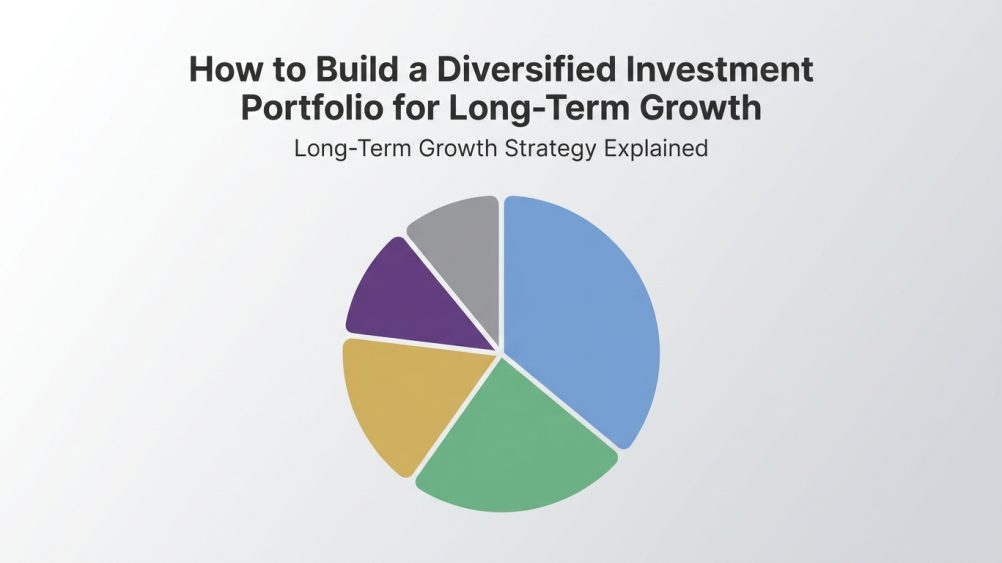
How to Build a Diversified Investment Portfolio for Long-Term Growth

How to Build a Diversified Investment Portfolio for Long-Term Growth

Worried that one bad crypto cycle could wipe out years of hard-earned gains? 

That fear is common among new investors who want growth but do not want to depend on one coin, one trend, or one market phase. A diversified investment portfolio gives a better path. It helps spread risk, smooth returns, and keep a long-term plan in place.

For a crypto-focused investor, this matters even more. Crypto assets carry traditional investing risk plus extra risks tied to volatility, custody, and service providers, according to FINRA’s crypto assets guidance

Asset allocation, diversification, and rebalancing are also core investing principles highlighted by the SEC’s Investor.gov guide. So, the goal is not to chase everything. The goal is to build a portfolio that can grow through time.

Why Diversification Matters for Crypto Investors

A portfolio is not diversified just because it holds many assets. If all holdings move the same way, the risk is still concentrated. The SEC’s investor education materials note that diversification should happen between asset categories and within asset categories.

That means a crypto investor should not stop at buying several altcoins. Bitcoin, Ethereum, large-cap crypto, selective altcoins, stable reserve cash, stocks, bonds, and cash equivalents can each play a different role. Also, the SEC warns that even investors who own several funds should still check the top holdings to see if they really differ. The same logic fits crypto. Ten coins from the same trend are still one crowded bet.

Start with Asset Allocation, Not Coin Picking

The strongest portfolios are built from percentages first. Coins come second. This helps an investor control emotion and avoid random buying. Asset allocation is the split between different asset groups based on time horizon, goals, and risk tolerance. That is a central point in the SEC guide on asset allocation and diversification.

For long-term growth, a crypto-leaning investor may use a simple structure like this:


Portfolio Bucket Purpose Example Range
Core traditional assets Stability and broad market growth 50% to 70%
Core crypto holdings Long-term upside from major networks 15% to 25%
Higher-risk crypto ideas Measured growth potential 5% to 10%
Cash or short-term reserve Flexibility and drawdown control 10% to 20%

This is not a fixed rule. It is a planning model. However, it shows a key point: a long-term investment portfolio does not need to be all-in on crypto to benefit from crypto growth. In fact, some CFA Institute analysis notes that crypto may offer diversification benefits for long-horizon investors, but only for those who can handle added short-term volatility.

Build Around a Strong Core

In crypto, the core usually starts with Bitcoin and Ethereum because they tend to be the most established and most watched assets in the market. Then the investor can add a small number of carefully chosen altcoins from different sectors such as infrastructure, DeFi, or exchange-related ecosystems. Also, a small cash reserve can help during sharp pullbacks.

This structure avoids a common mistake. Many beginners think diversification means owning as many coins as possible. It does not. Real portfolio diversification means owning assets with different jobs inside the portfolio. So, one part targets growth, one part manages risk, and one part gives liquidity when prices fall.

Use Dollar Cost Averaging to Reduce Timing Mistakes

A good portfolio can still fail if entries are poor and emotional. That is why dollar cost averaging matters. Coinbase explains DCA as investing a fixed amount at regular intervals, no matter the current price. This can reduce the impact of volatility and remove the pressure of trying to time the market.

For example, instead of putting all funds into crypto in one week, an investor can spread buys over months. Meanwhile, the same method can work for traditional assets too. This makes the process calmer, simpler, and easier to follow through a full market cycle.

Rebalance Before the Portfolio Drifts Too Far 

Over time, winners grow faster than the rest of the portfolio. That sounds good, but it can create hidden risk. If crypto jumps from 20% to 40% of a portfolio, the investor may now hold far more risk than planned. The SEC and Investor.gov both highlight rebalancing as a key way to bring a portfolio back to its target mix.

A simple rule works well here. Check the portfolio every quarter or every six months. Then trim overweight positions and add to underweight areas if the long-term view still makes sense. In addition, this process builds discipline. It helps the investor sell some heat and add where prices are more reasonable.

Risk Control Matters More Than Hot Picks

Crypto investors often search for the next 50x coin. Yet long-term results usually come from risk control, not excitement. FINRA states that crypto investing includes added risks beyond traditional markets. So, position sizing matters. Security matters. Storage matters.

That is why many investors cap speculative crypto at a small part of the portfolio. A simple rule is to keep high-risk tokens limited to the amount one can afford to see drop hard without changing the full plan. As a result, one bad trade does not ruin the entire portfolio.

The Simple Formula That Often Works Best

A practical long-term growth portfolio often follows this pattern:

  • Own a broad core
  • Keep crypto at a measured weight
  • Spread crypto across a few different use cases
  • Buy on a schedule
  • Rebalance on a schedule
  • Do not confuse activity with progress

That approach fits both search intent and real investor behavior. Readers looking for how to build a diversified investment portfolio, crypto portfolio diversification, asset allocation, risk management, and long term growth investing want a plan they can actually use. This one is clear, simple, and realistic.

A Smarter Path to Long-Term Growth

The best diversified portfolio is not the most complex one. It is the one an investor can hold through fear, greed, and market noise. Long-term growth comes from balance, patience, and repeatable habits. Crypto can be part of that future. However, it works better as one part of a wider plan, not the whole plan.

So, when an investor builds around asset allocation, diversification, dollar cost averaging, and rebalancing, the portfolio has a better chance to grow without becoming fragile. That is the real edge. Not guessing the next winner, but building something strong enough to last.

Disclaimer: This article is for general informational purposes only and does not offer financial, legal, or tax advice. All investments, especially crypto assets, carry risk, including possible loss of principal. Readers should do their own research and speak with a licensed financial adviser before making investment decisions.


Post Disclaimer

The information provided on Financepdia.com is for educational and informational purposes only and should not be considered financial, investment, or trading advice. Cryptocurrency and financial markets are highly volatile and involve significant risk. Readers should conduct their own research (DYOR) and consult with a qualified financial advisor before making any investment decisions. Financepdia.com and its authors are not responsible for any financial losses resulting from actions taken based on the information provided on this website.


Best Passive Income Ideas That Can Generate Monthly Cash Flow

Best Passive Income Ideas That Can Generate Monthly Cash Flow

Can crypto still help build a monthly cash flow without watching charts all day or chasing the next hype coin?

That is the question many beginners and careful investors keep asking. They want passive income ideas that feel real, simple, and worth the risk. They also want income that can grow over time, not just one lucky trade.

For a crypto audience, the answer is yes, but only with the right plan. Crypto passive income is no longer just about buying a token and hoping it pumps. Today, it is more about picking systems that pay rewards for holding, staking, lending, or adding liquidity. However, not every option is safe, and not every yield lasts.

This article breaks down the best passive income ideas that can generate monthly cash flow for crypto-focused readers. It keeps the focus on methods that match the article title, reader intent, and current market behavior. As a result, readers can see which choices fit a beginner, which fit a higher-risk investor, and what to avoid.

Why Crypto Passive Income Still Gets Attention

Many investors want income without daily trading stress. That is why terms like crypto passive income, staking rewards, DeFi lending, yield farming, and monthly cash flow keep showing up in beginner searches and crypto guides. Recent educational pages from Coinbase on staking, Coinbase on crypto rewards, and Lido’s liquid staking page show that staking and reward-based models remain central to this space.

At the same time, regulators still warn that crypto yield products can carry serious risk. The U.S. investor bulletin on crypto interest-bearing accounts and the broader crypto asset securities alert both stress that losses can happen and investor protections may be limited. So, the smart path is not chasing the highest APY. It is choosing a method that fits the investor’s risk level.

Best Passive Income Ideas for Monthly Cash Flow in Crypto

1. Staking Blue-Chip Proof-of-Stake Coins

For many readers, staking is the cleanest starting point. A holder locks or delegates coins such as ETH, SOL, ADA, or ATOM and earns rewards for helping the network run. Coinbase explains staking as a way to earn rewards by putting crypto to work on a blockchain, and Lido shows how liquid staking lets ETH holders earn while keeping a usable token like stETH.

This method works best for investors who already plan to hold major proof-of-stake assets. In addition, it feels easier to understand than more advanced DeFi plays.

Why it works for monthly cash flow: rewards often build daily or over time, and they can be withdrawn or tracked as a recurring income stream.

2. Liquid Staking for More Flexibility

Traditional staking can lock funds. That is where liquid staking stands out. Lido states that users can stake ETH and receive stETH, which stays usable in the wider market while still reflecting staking rewards. Therefore, this can suit investors who want yield but also want room to move capital later.

Still, this option adds smart contract risk and token price tracking risk. So it is better for readers who understand basic DeFi wallets and on-chain tools.

3. DeFi Lending

Another strong option is DeFi lending. In simple terms, an investor deposits crypto into a lending market and earns interest when borrowers use that pool. This is one of the main models behind earn interest on crypto content across the market, and Coinbase’s rewards guide lists lending as one of the common reward paths in crypto.

This can work well with stable assets or large-cap crypto. Even so, readers should remember that lending has platform risk, token risk, and market stress risk.

4. Yield Farming and Liquidity Pools

Yield farming can create stronger returns, but it is not beginner-friendly. Investors add token pairs to liquidity pools and earn trading fees plus possible token rewards. Webopedia’s current guide notes that yield farming income often comes from transaction fees and incentive tokens, while also warning about impermanent loss.

This is a real passive income idea, but it should sit lower on a beginner’s list. For that reason, it fits readers who already know how DeFi pairs, pool ratios, and fee income work.

Quick Comparison Table


Passive income idea Best for Income style Main risk
Staking Beginners and long-term holders Steady reward flow Token price drops
Liquid staking Investors who want flexibility Staking rewards plus token mobility Smart contract risk
DeFi lending Moderate-risk investors Interest from borrowed funds Platform and borrower risk
Yield farming Advanced DeFi users Fees plus token rewards Impermanent loss and volatility


What Makes One Option Better Than Another

The best passive income idea is not the one with the loudest APY. It is the one that can still make sense after fees, taxes, price swings, and risk. A careful investor often starts with staking rewards on quality assets before moving into DeFi lending or yield farming.

Likewise, monthly cash flow in crypto should not be judged by payout speed alone. A method may pay often, but if the asset drops hard, the income does not help much. That is why simple, repeatable systems often beat flashy ones.

The Smart Way to Think About Monthly Cash Flow

A crypto investor who wants a monthly income should think in layers. One layer can be staking on major proof-of-stake coins. Another layer can be a smaller share in liquid staking or DeFi lending. Higher-risk methods, such as yield farming, should stay small unless the investor already knows the mechanics well.

Most importantly, passive income in crypto is still tied to market risk. It is income, but it is not fixed salary income. That mindset helps readers avoid poor choices.

Final Thoughts: Build Cash Flow Without Chasing Hype

The best passive income ideas that can generate monthly cash flow in crypto are the ones built on clear use, simple logic, and controlled risk. For most readers, that means starting with staking, learning how liquid staking works, and only then looking at DeFi lending or yield farming.

That path may look slower. Yet, slower often wins in crypto. A reader does not need ten income streams. A reader needs one or two solid systems that can be understood, tracked, and improved over time.

Disclaimer: This article is for educational purposes only and does not give financial, legal, or tax advice. Crypto assets are risky, volatile, and can lead to loss of capital. Readers should do their own research before making any decision.


Post Disclaimer

The information provided on Financepdia.com is for educational and informational purposes only and should not be considered financial, investment, or trading advice. Cryptocurrency and financial markets are highly volatile and involve significant risk. Readers should conduct their own research (DYOR) and consult with a qualified financial advisor before making any investment decisions. Financepdia.com and its authors are not responsible for any financial losses resulting from actions taken based on the information provided on this website.

Is 2026 the Year of On-Chain Finance? DeFi, RWAs, and Stablecoins Explained

Is 2026 the Year of On-Chain Finance? DeFi, RWAs, and Stablecoins Explained

Can crypto finally become more than a trading story in 2026?

That is the question many investors keep asking after years of hype, sharp drops, and slow real-world use. Many still worry that crypto feels fast, but not always useful. They want to know whether digital assets can do more than move prices on a screen.

In 2026, that question looks more serious than before. On-chain finance is no longer just about meme coins or yield chasing. It now includes DeFi, stablecoins, and real-world assets, also called RWAs, moving into a shared lane. 

As a result, the market is starting to look less like a side experiment and more like a new financial rail. Recent data points support that shift, with DeFi TVL near $94.5 billion, stablecoin market cap above $317 billion, and tokenized real-world asset value on RWA.xyz at $26.7 billion distributed value. DefiLlama, DefiLlama stablecoins data, and RWA.xyz data all show that this part of crypto is growing into a bigger market structure, not just a passing theme.

What On-Chain Finanace Means in 2026  

On-chain finance means financial activity that happens on blockchain networks. That includes borrowing, lending, payments, trading, settlement, and ownership records. In simple terms, value moves on public or shared digital rails instead of old closed systems.

The IMF now describes tokenized finance as a deeper change in financial architecture, not a small efficiency update. It says tokenization can support atomic settlement, continuous liquidity management, and embedded compliance inside regulated finance. In turn, that matters because it shows that blockchain is being discussed as infrastructure, not only as speculation.

Why 2026 Feels Different

The biggest change is that the three key parts of on-chain finance are now starting to support each other.

  • DeFi gives the market open lending, swaps, and programmable trading.
  • Stablecoins give the market a dollar-linked unit for payments and settlement.
  • RWAs bring assets like Treasuries, private credit, fund shares, and gold on-chain.

That mix is important. Stablecoins bring usable money. RWAs bring assets with known value. DeFi brings around-the-clock access and code-based execution. Meanwhile, tokenized U.S. Treasuries alone are now about $10 billion on RWA.xyz, which shows where early institutional interest is landing first.

A Quick View of the Market 


Pillar What it does Why it matters in 2026
DeFi Lending, borrowing, trading, staking Keeps markets open 24/7 and cuts waiting time
Stablecoins Dollar-linked payments and settlement Makes crypto easier to use for transfers and pricing
RWAs Puts off-chain assets on-chain Connects blockchain with bonds, funds, credit, and more


This table matters because 2026 is not about one trend alone. It is about how these three parts connect into one financial stack.

Stablecoins Are Now the Base Layer in 2026 

Among all crypto use cases, stablecoins look the most mature. They are already used for exchange settlement, cross-border transfers, treasury movement, and trading liquidity. Visa says growing market cap, stronger infrastructure, and better policy clarity are setting the stage for firms to launch stablecoin-based products in 2026. An IMF paper from March 2026 also found that markets expect stablecoins to matter in payments, with pro-stablecoin legislation linked to an estimated 18% drop, or about $300 billion, in the market value of listed payment incumbents. That signals real competitive pressure.

At the same time, stablecoins are not risk-free. Chainalysis noted that stablecoins made up 84% of illicit virtual asset transaction volume in 2025, which is why compliance, wallet screening, and secondary market monitoring now matter more. So, growth is real, but trust and controls still decide how far the sector can go.

RWAs May be the Bridge that Crypto Needed 

If stablecoins are the money rail, RWAs may be the bridge between crypto and traditional finance. Investors have talked for years about putting bonds, funds, and credit products on-chain. In 2026, that idea looks less theoretical.

According to RWA.xyz, the market now shows $26.71 billion in distributed real-world asset value, while tokenized U.S. Treasuries stand near $10 billion. That matters because Treasuries are familiar, yield-bearing, and easier for institutions to understand than many crypto-native tokens. Meanwhile, McKinsey still sees tokenized financial assets reaching about $2 trillion by 2030, excluding cryptocurrencies and stablecoins. So the current market is still early if that path keeps building.

DeFi Still Matters, But its Role is Changing 

For years, DeFi was mostly judged by speculation and high yields. In 2026, the role is changing. It is becoming the execution layer for a broader market. That means lending against tokenized assets, swapping stable assets, and settling value faster.

DefiLlama currently shows DeFi TVL around $94.5 billion. That figure is still below the last cycle peak, but it remains large enough to matter. More important, the quality of activity is changing. When stablecoins and RWAs enter DeFi, the market gets assets that are easier to price and easier to explain. As a result, on-chain finance starts to look more usable for payments, treasury flows, and collateral management, not just speculation.

So, Is 2026 the Breakout Year?

The honest answer is that 2026 could be the year on-chain finance starts to look normal. That does not mean every token will win. It also does not mean risk disappears. The IMF has warned that tokenized finance can also increase speed, concentration, fragmentation, and cross-border stress if policy and legal rules stay weak.

Still, the upside case is clearer now. Stablecoins are becoming payment tools. RWAs are bringing known assets on-chain. DeFi is turning into the open engine that connects both. When those three pieces grow together, crypto starts to look less like a closed trading loop and more like a new market structure.

The Big Takeaway for Crypto Watchers

The strongest signal in 2026 is not one coin or one headline. It is the steady build of on-chain finance as a working system. DeFi, stablecoins, and RWAs are now forming a chain of money, assets, and execution. That shift may not grab attention like a meme rally. However, it may matter far more over time.

If this path continues, 2026 may be remembered as the year crypto moved closer to finance that people can actually use.

Disclaimer: This article is for informational purposes only and is not financial, legal, or investment advice. Crypto markets remain volatile, and readers should do their own research before making any decision.


Post Disclaimer

The information provided on Financepdia.com is for educational and informational purposes only and should not be considered financial, investment, or trading advice. Cryptocurrency and financial markets are highly volatile and involve significant risk. Readers should conduct their own research (DYOR) and consult with a qualified financial advisor before making any investment decisions. Financepdia.com and its authors are not responsible for any financial losses resulting from actions taken based on the information provided on this website.