



Speed wins markets. In crypto, a few hundred milliseconds can decide whether a trade lands at the right price or misses the move. That is why the Solana Alpenglow upgrade is getting so much attention.
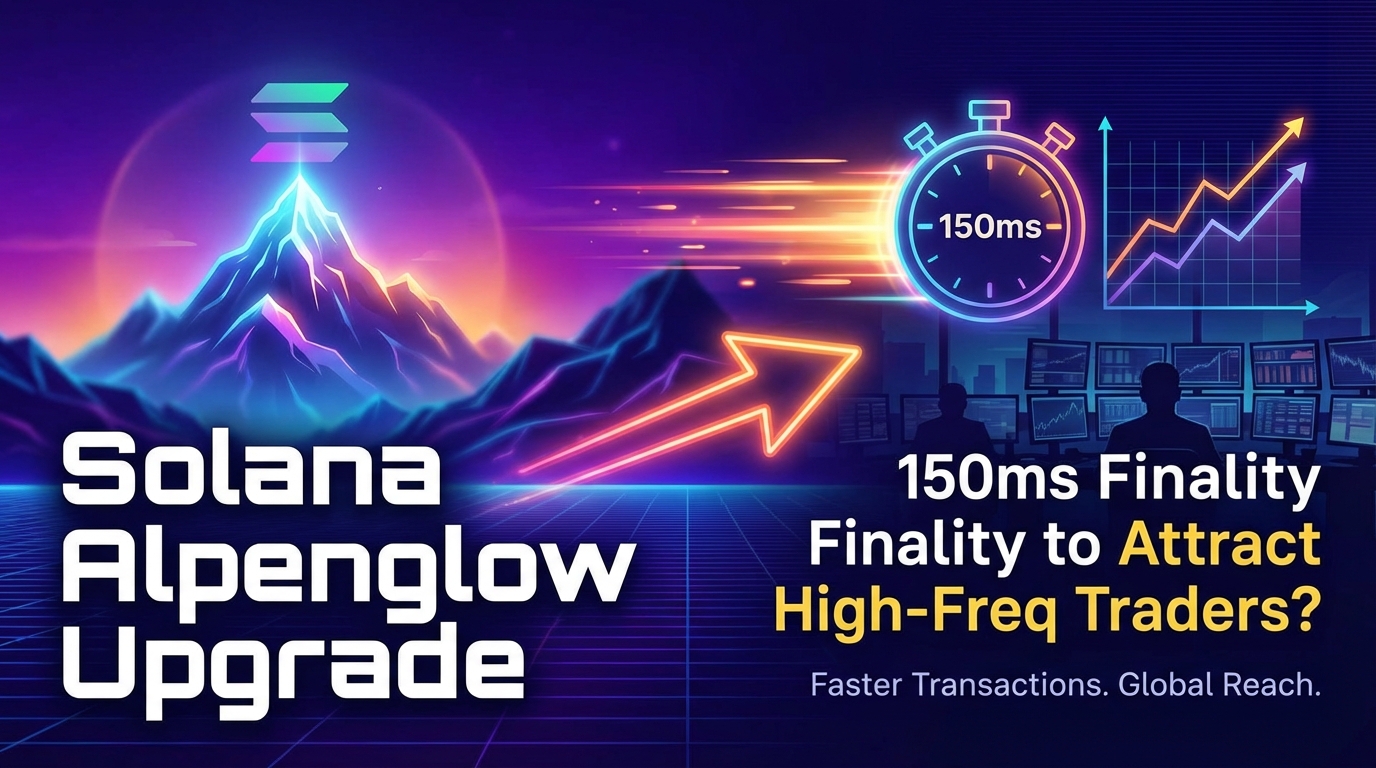
Anza, a major Solana development firm, says Alpenglow is a new consensus design for Solana. It is built to cut finality from about 12.8 seconds to around 150 milliseconds on median, with some cases near 100 milliseconds. That is a major shift for an L1 chain.
For traders, this matters. High-frequency traders market makers care about latency, finality, jitter, order execution, and risk after trade submission. A chain that settles faster can look more useful for on-chain order books, arbitrage, and short-horizon trading strategies. This is why Solana news around Alpenglow is now tied to crypto adoption and trading infrastructure.
What Is the Solana Alpenglow Upgrade?
Alpenglow is Solana’s planned new consensus protocol. It removes key older parts of the current design, including TowerBFT and Proof of History in the consensus flow, and replaces them with Votor for voting and finalisation, plus Rotor for data distribution.
Votor is built to finalise blocks in one round when 80% of the stake is active, or in two rounds when 60% is responsive. At the same time, Rotor cuts network hops compared with older data propagation methods, which helps lower delay across the network.
This matters because crypto trading infrastructure depends on both speed and trust in settlement. A trade is not truly done when it is only sent. It matters when the market can treat it as final. That is where finality becomes a real adoption trigger.
Why 150ms Finality Matters for High-Frequency Traders
High-frequency traders do not just want fast chains. They want predictable chains. When finality takes seconds, pricing risk stays open for longer. That creates more room for slippage, failed hedges, and stale quotes.
A median finality of about 150ms changes that picture. It moves Solana closer to the response standards traders expect from modern electronic markets. Anza also said this level of responsiveness could let Solana compete with Web2 infrastructure for real-time apps.
That does not mean traditional HFT firms will rush in overnight. Still, it does mean on-chain market makers, quant traders, and latency-sensitive DeFi teams may find Solana more attractive. Anza’s own roadmap links these lower-latency upgrades to attracting and keeping high-quality market makers and more retail trading volume.
Key Alpenglow Metrics at a Glance
| Feature | Current / Prior Solana Model | Alpenglow Target | Why It Matters |
| Block finality | ~12.8 seconds | ~150ms median | Lower post-trade risk |
| Best case finality | Far slower than 100ms | ~100ms in some cases | Better for fast trading |
| Consensus method | TowerBFT + PoH-based flow | Votor | Faster vote finalization |
| Data propagation | Gossip and older flow | Rotor | Fewer hops, lower delay |
| Mainnet timing | Current model active | Late 2025 or early 2026 target noted by Anza | Watched by traders and validators |
Anza said it was targeting late 2025 or early 2026 for mainnet activation in its roadmap update.
Could Alpenglow Help Solana Win More Trading Volume?
It could, especially in areas where fast settlement matters most. These include on-chain central limit order books, perpetual futures, arbitrage systems, cross-exchange strategies, and stablecoin payments that need quick confirmation.
Solana has long pushed the idea of internet-scale capital markets. In that roadmap, faster finality is presented as one part of a broader stack built for more liquid on-chain markets. That makes Alpenglow more than a speed story. It is also a market structure story.
As a result, the upgrade may help Solana compete harder for users who value execution quality. That includes not only professional traders, but also apps that want tighter spreads and deeper order books.
What Still Needs to Go Right
The big number alone is not enough. Traders will care about real mainnet performance, uptime, validator adoption, and how the network behaves under stress. Anza notes that the 100ms to 150ms figures come from simulations based on the current mainnet stake distribution and do not include computation overhead.
There is also the rollout question. Anza’s roadmap tied Alpenglow to a broader set of improvements, including lower-latency networking and later execution upgrades. So the full trading impact may depend on several parts landing well together.
In simple terms, Alpenglow looks promising, though traders will wait for proof on mainnet. That is normal in crypto markets.
A Fast Upgrade With Real Market Potential
The Solana Alpenglow upgrade looks like one of the most important protocol changes in Solana’s history. If the network reaches 150ms finality in real conditions, it could make Solana far more appealing for high-frequency trading, market making, and real-time DeFi.
That does not guarantee an immediate wave of institutional HFT desks. Even so, the direction is clear. Lower latency, quicker finality, and simpler consensus can make Solana a stronger home for active trading markets.
For crypto traders, this is the key point: Alpenglow is not just another upgrade headline. It may be a direct step toward faster on-chain finance.
Disclaimer: This article is for informational purposes only and is not financial or investment advice. Crypto assets are volatile, and readers should do their own research before making any decision.
Post Disclaimer
The information provided on Financepdia.com is for educational and informational purposes only and should not be considered financial, investment, or trading advice. Cryptocurrency and financial markets are highly volatile and involve significant risk. Readers should conduct their own research (DYOR) and consult with a qualified financial advisor before making any investment decisions. Financepdia.com and its authors are not responsible for any financial losses resulting from actions taken based on the information provided on this website.