





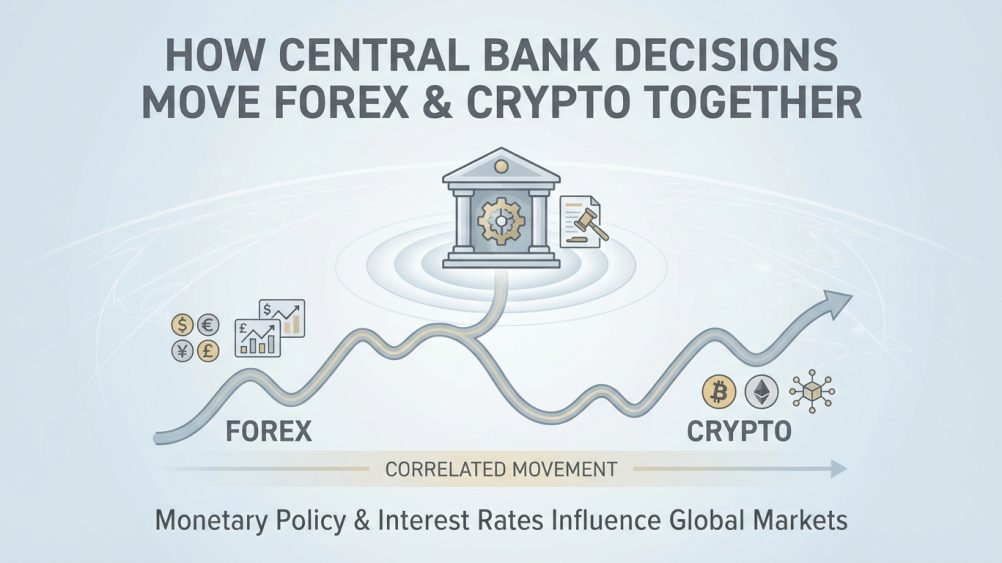
A rate decision in Washington or a fresh monetary policy decision in Europe can move forex and crypto within minutes. That is not random. It happens because both markets react to the same forces: interest rates, liquidity, and market mood.
For many traders, forex and crypto look separate. One trades national currencies. The other trades digital assets such as Bitcoin. However, both markets respond when central banks change the cost of money and overall financial conditions. The Federal Reserve states that changes in the federal funds rate affect foreign exchange rates, money, and credit conditions. The ECB also explains that policy decisions pass through the economy through several channels.
That link matters because capital does not stay still. When money becomes more expensive, traders often cut risk. When money becomes cheaper, traders often seek higher-return assets. As a result, the same central bank signal can move the US dollar and Bitcoin in the same trading session. This is one reason why crypto market sentiment and forex volatility often react to the same macro events.
Why Central Banks Matter to Both Markets
Central banks shape the price of money through interest rate policy, market operations, and policy guidance. Those decisions affect borrowing costs, returns on cash, and broad financial conditions. The ECB transmission mechanism shows that changes in official rates pass into lending, asset prices, and demand.
When a central bank raises rates, a currency can gain support because higher yields can attract capital. At the same time, risk assets often face pressure because financing gets tighter. Therefore, a hawkish policy signal can support the US dollar while weighing on crypto prices. This pattern becomes stronger when the market starts pricing more tightening ahead.
When a central bank cuts rates, the reaction can flip. The currency may lose some strength, while assets tied to risk demand may improve. So, lower rates can help explain why crypto and some forex pairs rise at the same time. The move is not always equal, but the driver is often shared.
The Channels that Connect Forex and Crypto
1. Interest rate expectations
Markets often move before the policy meeting. Traders focus on what central banks may do next, not only what they do today. If markets price in more hikes, the US dollar index, yields, and defensive trades may rise. Meanwhile, Bitcoin and altcoins can weaken because tighter policy can reduce risk demand.
2. Liquidity conditions
The BIS global liquidity indicators define global liquidity as the ease of financing in global financial markets. That matters because both forex and crypto react when financing becomes easy or tight. When liquidity shrinks, markets often get more selective. When liquidity improves, risk trades can recover.
This is especially important for crypto. Crypto liquidity is sensitive to changes in financial conditions because it depends heavily on market appetite and available capital. At the same time, forex traders also react as capital flows shift across currencies and regions. As a result, liquidity can push both markets in the same direction, even if crypto usually moves harder.
3. Risk sentiment
Central bank statements also change how traders feel about risk. A softer tone can calm markets. A harder tone can raise caution. That shift in risk sentiment can lift safe currencies such as the US dollar, Japanese yen, or Swiss franc, while high-volatility assets such as Bitcoin may come under pressure.
How the Reaction Often Looks in Real Trading
| Central bank signal | Common forex reaction | Common crypto reaction | Why it happens |
| Rate hike | USD may strengthen | Bitcoin and altcoins may fall | Cash yields rise and risk demand weakens |
| Rate cut | Currency may soften | Crypto may rise | Cheaper money can support speculative trades |
| Hawkish guidance | Safe currencies gain | Crypto turns cautious | Markets price tighter policy ahead |
| Dovish guidance | High-beta currencies may recover | Crypto sentiment improves | Markets expect easier financial conditions |
| Balance sheet tightening | Volatility can rise | Crypto liquidity may shrink | Less money moves through markets |
The table reflects how changes in the federal funds rate affect foreign exchange rates, money, and credit. And how the ECB describes monetary transmission through rates and financial conditions. It also matches the BIS view of global liquidity as a key market force.
Why the Federal Reserve has the Strongest Global Effect
Not every central bank moves markets the same way. The Federal Reserve has the biggest reach because the US dollar sits at the center of global finance. The Fed explains that its policy decisions shape short-term rates and wider financial conditions. Therefore, Fed policy often reaches both forex and crypto faster than any other central bank signal.
That is why a hawkish Fed can tighten global conditions, support the dollar, and pressure risk assets at once. On the other hand, a softer Fed can weaken dollar strength and help support crypto prices. For traders, that makes Fed meetings key events for BTC, ETH, and major forex pairs.
Why Crypto Does Not Always Follow Forex Tick for Tick
The connection is strong, but not perfect. Crypto still has its own market drivers such as regulation, exchange flows, ETF demand, and on-chain activity. The IMF has noted that crypto markets have their own risks and macrofinancial effects. However, on big policy days, central bank signals can still become the main force behind price action.
That is why correlation often rises during major macro events. In quieter periods, crypto-specific news can lead. But when the market is focused on rates, liquidity, and policy guidance, forex and crypto often move on the same wave.
What Traders Should Watch Around a Policy Decision
Before a central bank meeting, traders usually watch rate expectations, inflation data, bond yields, the US dollar, and changes in official guidance. They also watch the press conference because tone matters almost as much as the actual decision. Therefore, the first move is not always the final move. Markets can jump on the headline and reverse once traders read the full statement.
The Key Takeaway for Market Readers
Central bank decisions move forex and crypto together because both markets react to the same core force: the price and flow of money. Forex shows that move through currencies. Crypto shows it through risk appetite and liquidity demand. When policy turns tight, both markets feel it. When policy turns easier, both markets often respond again.
For that reason, traders who only look at charts can miss the real driver. When central banks shift policy, capital shifts too. And when capital shifts, forex pairs and crypto assets often move together in the same broader market cycle.
Disclaimer: This article is for educational purposes only and does not provide financial or investment advice. Readers should do their own research before making any trading or investment decision.
Post Disclaimer
The information provided on Financepdia.com is for educational and informational purposes only and should not be considered financial, investment, or trading advice. Cryptocurrency and financial markets are highly volatile and involve significant risk. Readers should conduct their own research (DYOR) and consult with a qualified financial advisor before making any investment decisions. Financepdia.com and its authors are not responsible for any financial losses resulting from actions taken based on the information provided on this website.