





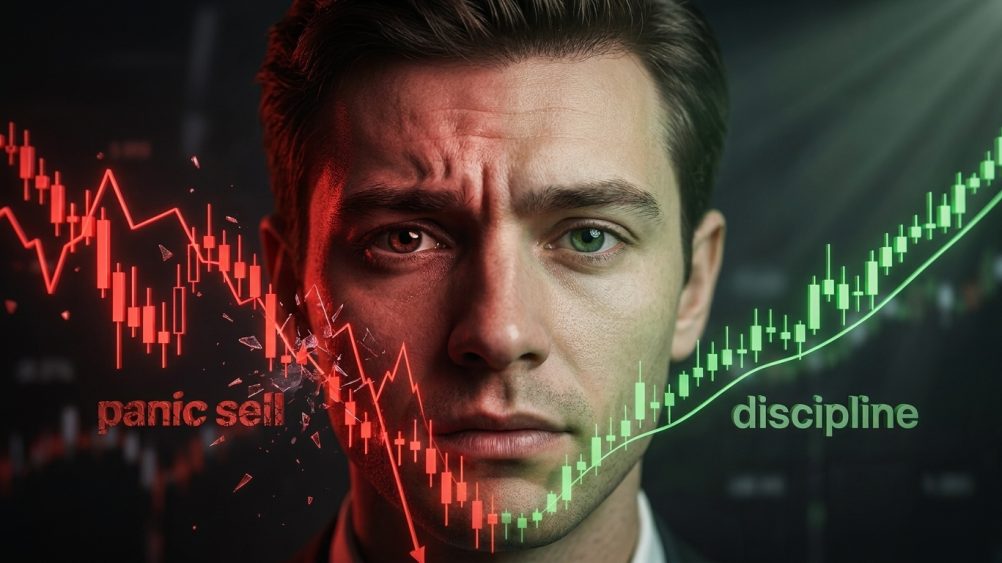
The market just crashed 15%. Your portfolio is bleeding red. Do you panic sell or hold tight? That split-second decision separates winners from losers.
In March 2020, Bitcoin dropped from $9,000 to $3,800 in 48 hours. Panic sellers locked in massive losses. Those who held saw Bitcoin hit $69,000 by November 2021. That’s an 18x gain they would have missed.
War breaks out. Sanctions hit. Inflation spikes. Markets swing violently. Your brain screams “sell everything now!” But hasty decisions during chaos cost you more than staying calm ever could.
Today, we break down the seven trading psychology mistakes that drain wallets. More importantly, we show you how to fix each one before your next trade.
Key Takeaways
- Fear and greed destroy 90% of trades
- Stop-losses protect you from catastrophic losses
- Written trading plans beat emotional decisions
Why Trading Psychology Matters More Than Strategy
A 2024 study of retail forex accounts found something shocking. Traders with a pre-trade emotional check-in routine had 34% better plan adherence. Same strategy. Different psychology.
Most traders spend 90% of their time perfecting entries. They spend zero time understanding why they abandon those entries when real money is at stake.
The problem is not your indicator. It is your mental patterns. Below are the seven most common trading psychology mistakes and how to fix each one.
Mistake 1: Trading on Fear and Greed Instead of Strategy
Fear makes you sell winners too early. Greed makes you hold losers too long. Both emotions destroy profits.
When Russia invaded Ukraine in February 2022, crypto markets tanked 20% overnight. Fear-driven sellers locked in losses. Strategic buyers accumulated at discount prices. Six months later, those buyers were up 40%.
The fix: Write down your entry and exit rules before opening any position. When fear or greed hits, read your rules. Follow them exactly. No exceptions.
Set price alerts instead of watching charts all day. Constant monitoring amplifies emotional reactions. Check your positions once daily at most.
Mistake 2: Holding Losing Positions Because You Hope They Recover
Hope is not a strategy. It is a prayer dressed up as patience.
You bought a token at $1. It drops to $0.70. You tell yourself “it will bounce back.” It drops to $0.40. You double down to “average down your cost.” Now you own twice as much of a failing asset.
This is called loss aversion bias. Your brain hates admitting defeat more than it loves winning.
The fix: Set a stop-loss on every single trade. If the price hits that level, you exit automatically. No thinking. No hope. Just out.
| Loss Amount | Gain Needed to Break Even | A 10% stop-loss protects your capital. You can recover from ten 10% losses. You cannot recover from one 70% wipeout. Notice the pattern? Small losses are recoverable. Big losses require miracles. |
| 10% loss | 11% gain | |
| 25% loss | 33% gain | |
| 50% loss | 100% gain | |
| 75% loss | 300% gain |
Mistake 3: Selling Winners Too Early Because You Fear Losing Profit
You bought Bitcoin at $20,000. It hits $22,000. You sell immediately to “lock in gains.” Bitcoin then runs to $30,000 without you.
This mistake comes from fear of regret. You would rather take a small win than risk watching profits disappear.
Professional traders do the opposite. They cut losses fast and let winners run long.
The fix: Use trailing stop-losses. If Bitcoin is up 20%, set a stop at 15% profit. If price keeps climbing, your stop moves up with it. You lock in gains while staying in the trend.
Never sell your entire position at once. Take 25% profit at your first target. Let the rest ride with a trailing stop protecting you.
Mistake 4: Revenge Trading After a Loss
You just lost $500 on a bad trade. Anger floods your brain. You immediately open a bigger position to “win it back fast.”
This is revenge trading. It is emotional gambling dressed up as strategy. Studies show revenge trades lose money 80% of the time.
The fix: After any loss, step away from the screen. Close your laptop. Go for a walk. Wait 24 hours minimum before your next trade.
Keep a trading journal. Write down what went wrong. What rule did you break? What will you do differently next time? This turns emotional pain into educational gain.
Mistake 5: Overtrading Because You Are Bored or Impatient
You check your portfolio 47 times today. Nothing is moving. You open a random trade just to “feel active.”
Boredom kills accounts faster than market crashes. Every trade costs you fees. More trades mean more chances to be wrong.
Professional traders wait for high-probability setups. They might go days without a single trade. Amateur traders trade daily because sitting still feels like doing nothing.
The fix: Trade only when your strategy gives a clear signal. No signal means no trade. Period.
Find other activities to fill the void. Exercise. Read. Learn a new skill. Just stop opening trades to cure boredom.
Set a maximum number of trades per week. Stick to that limit no matter what.
Mistake 6: Ignoring Your Own Trading Plan
You spent hours building a trading plan. Entry rules. Exit rules. Position sizing. Risk management. Then you ignore all of it on your first real trade.
Why? Because in the moment, your gut “feels” different than your plan. Your gut is wrong 90% of the time.
The fix: Print your trading plan. Tape it next to your screen. Before every trade, read it out loud. Ask yourself: “Does this trade follow my rules?”
If the answer is no, do not take the trade. Ever. Your plan exists to protect you from yourself.
Track every trade in a spreadsheet. Mark whether you followed your plan or broke it. Review monthly. You will see that your best trades followed the plan. Your worst trades ignored it.
Mistake 7: FOMO Buying at Market Peaks
Everyone is talking about a token. It is up 300% this month. You finally cave and buy at the top. The next day, it dumps 40%.
FOMO (fear of missing out) is the most expensive emotion in trading. It makes you chase pumps and buy at resistance levels.
Social media amplifies FOMO. You see others posting gains. You feel left behind. You buy high and sell low.
The fix: Never buy something just because it is trending on Twitter. Wait for pullbacks. Every asset retraces eventually.
Set buy orders at support levels below current price. If the asset dips to your level, you get in. If it keeps pumping without you, you saved yourself from buying the top.
Unfollow accounts that post constant “moon” predictions. Follow educators who teach strategy instead of hype.
Why Emotions Beat Logic in Real-Time Trading
Your brain has two systems. System 1 is fast, emotional, and instinctive. System 2 is slow, logical, and analytical.
Under stress, System 1 takes over. It protected your ancestors from predators. But it destroys your trading account.
Markets move fast. Prices flash red and green. Your heart rate spikes. Adrenaline floods your bloodstream. System 1 screams “do something now!”
That urgency is the enemy. Slow down. Breathe. Activate System 2 before you click buy or sell.
Building a Trading Routine That Beats Emotional Traps
Before the market opens:
- Review your trading plan
- Check economic news and events
- Identify high-probability setups only
During trading hours:
- Follow your plan exactly
- Set alerts instead of watching charts
- Take breaks every 90 minutes
After the market closes:
- Journal every trade you made
- Note what you did right and wrong
- Review your emotional state during each trade
This routine builds discipline. Discipline beats emotion every single time.
The One Thing That Separates Profitable Traders From Everyone Else
Winning traders accept losses as part of the game. They do not take losses personally. They do not take revenge trade. They simply move to the next setup.
Losing traders fight reality. They hold losers. They overtrade. They break their own rules. They blow up accounts.
The difference is not intelligence. It is emotional control.
You can learn technical analysis in a month. You can master chart patterns in a year. But controlling your emotions takes daily practice for life.
Start now. Pick one mistake from this list. Commit to fixing it this week. Track your progress. Repeat with the next mistake.
Small improvements compound. In six months, you will barely recognize your old trading self.
Final Thoughts
Trading psychology is not about being fearless. It is about recognizing fear and not letting it control you.
You will still feel FOMO. You will still want revenge after a loss. You will still hope losing positions recover.
The difference? You will have a system to catch yourself before those feelings cost you money.
Write your plan. Follow your rules. Journal your trades. Review your emotions. Repeat forever.
That is how you beat the seven mental mistakes. That is how you keep your money.
Frequently Asked Questions
How do professional traders manage emotions during high volatility?
They use pre-set stop-losses and take-profit orders so decisions happen automatically. Many also limit position sizes to 1-2% of total capital per trade. This reduces emotional attachment to any single position. They also avoid watching price action tick-by-tick during volatile periods.
What is the biggest difference between successful and unsuccessful crypto traders?
Successful traders follow a written plan consistently and accept small losses quickly. Unsuccessful traders hold losing positions hoping for recovery and break their own rules during emotional moments. The win rate matters less than how you handle losses when they occur.
Can you improve trading psychology or is emotional control just natural talent?
Trading psychology is a learnable skill, not inherited talent. Keep a detailed trading journal tracking both trades and emotions. Review it weekly to spot patterns in your decision-making. Most traders see measurable improvement within 90 days of consistent journaling and rule-following.
Disclaimer: This article is for informational purposes only. It is not financial advice. Always do your own research.
Post Disclaimer
The information provided on Financepdia.com is for educational and informational purposes only and should not be considered financial, investment, or trading advice. Cryptocurrency and financial markets are highly volatile and involve significant risk. Readers should conduct their own research (DYOR) and consult with a qualified financial advisor before making any investment decisions. Financepdia.com and its authors are not responsible for any financial losses resulting from actions taken based on the information provided on this website.