





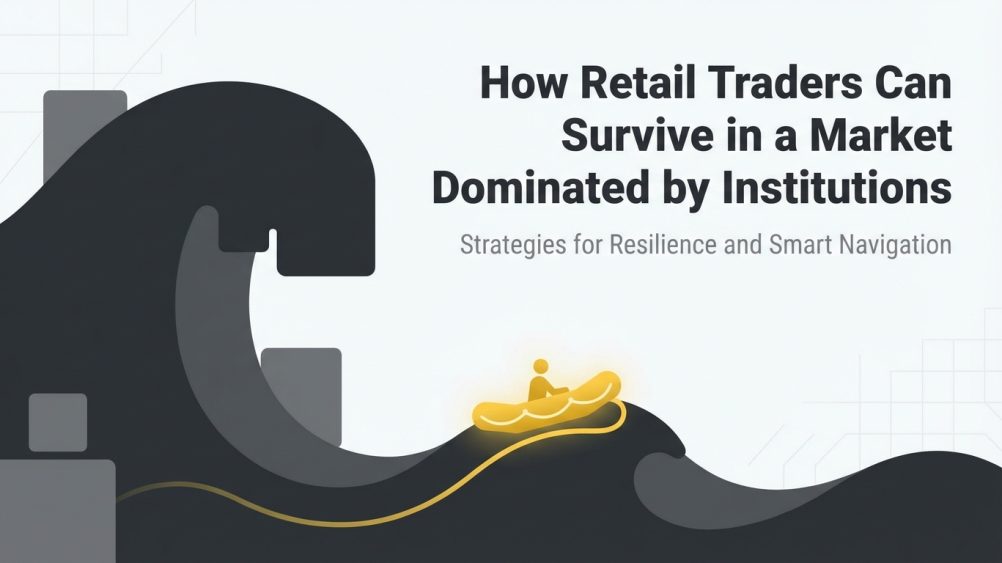
Can everyday traders still win when billion-dollar firms run the game? That question keeps a lot of people up at night. In 2013, buying Bitcoin was simple. Copy a wallet address. Hit send. Hope for the best. No ETFs. No Wall Street desks. No bots running around the clock. It was the people’s market.
Today, BlackRock alone manages over $100 billion in crypto-related products. The game has changed. But change does not mean over.
Retail traders who survive are not the bravest ones. They are the most disciplined.
Key Takeaways
- Institutions dominate: JPMorgan says crypto is shifting from retail speculation to a macro asset class.
- Retail still leads volatility: Retail traders made up over 66% of trading in assets like Dogecoin and Shiba Inu in 2025.
- Leverage is the top killer: Over $8 billion in liquidations hit exchanges during peak 2025 volatility weeks.
- DCA is proven: Buying fixed amounts regularly reduces emotional trading and timing risk.
- Survival first: Traders who sized positions wisely came through corrections intact.
Why Institutions Changed the Game
Big money did not just enter crypto. It moved in at scale.
Q1 2025 saw $21.6 billion in institutional crypto investments. Wealth managers now hold close to 50% of Bitcoin ETF assets. These firms think in years, not hours. That slow pace is your edge, not theirs.
Institutions also buy very different assets. They focus on Bitcoin, Ethereum, and infrastructure tokens. Retail traders own the meme coin and high-volatility space. That is not a weakness. That is a lane worth protecting.
What Retail Traders Still Do Better
Speed is the number one retail advantage.
Big funds cannot move fast without moving markets. A retail trader can enter and exit before a hedge fund clears compliance review. Token Metrics data shows many early trending signals originate from retail activity before institutions act.
Flexibility matters too. You have no board. No committee vote needed. You can pivot fast. That power is real, if used with discipline.
Why Most Retail Traders Lose in Drawdowns
The answer is almost always leverage.
During 2025’s worst weeks, liquidation cascades hit exchange after exchange. Prices dropped. Undercollateralized positions were closed automatically. That selling pushed prices lower. More liquidations followed. The loop was brutal.
The traders hurt most were not those who invested the most. They were those who invested money they could not afford to lose. Many expected short-term gains. They did not plan for volatility.
Institutions also took losses in 2025. But they had risk frameworks. Most retail traders did not.
Proven Strategies That Actually Work
These come from real advisors and traders, not theory.
Dollar-Cost Averaging
DCA means buying fixed amounts of crypto at regular intervals. Prices fall? You buy more units. Prices rise? You buy fewer. Over time, your average entry cost smooths out. It takes emotion out of the equation. That alone saves most traders from their biggest mistakes.
Position Sizing
Never risk more on one trade than you can afford to lose entirely. CMC Markets reports professional traders risk no more than 1% of capital per trade. Smaller positions keep you in the game when trades go wrong.
Hold Through the Fear
Fear is the most expensive impulse in crypto. Retail investors who panic-sold when Bitcoin fell below $87,000 in late 2025 locked in losses. Meanwhile, institutional capital kept flowing in. If your thesis has not changed, price alone is not a reason to exit.
Retail vs. Institutional: Side by Side
| Factor | Retail Traders | Institutional Traders |
| Capital | Small to mid-size | Millions to billions |
| Speed | Fast | Slow (compliance layers) |
| Emotional risk | High | Lower (systematic rules) |
| Asset focus | Meme coins, high-volatility | BTC, ETH, ETFs |
| BTC and ETH share | ~37% of portfolios | ~67% of portfolios |
| Time horizon | Hours to weeks | Months to years |
| Biggest risk | Overleveraging | Regulatory exposure |
Sources: Cryptocurrency in Investment, 7 Best Crypto Trading Strategies for 2025
Six Habits of Retail Traders Who Survive
The strongest retail survivors share these habits:
- Set stop-losses before entering any trade, not after the move.
- Never use leverage above 2x to 3x on volatile assets.
- Hold Bitcoin or Ethereum as a stable core position.
- Watch on-chain data, not just price charts.
- Rebalance regularly when one asset grows too large.
- Treat every drawdown as planned, not as a shock.
Frequently Asked Questions
Can retail traders still profit when institutions dominate crypto?
Yes, but the approach must change. Retail traders who profit are not trying to out-trade institutions. They move faster in narratives that big money has not yet priced in. Early-stage tokens and short-term volatility plays still create edge. The key is exiting before institutions arrive and reset the ceiling.
How is crypto riskier for retail traders than the stock market?
Crypto trades 24/7 with no government insurance, no circuit breakers, and no bailouts. Bitcoin’s implied volatility hovered around 50% in late 2025 versus 20% for the S&P 500. Traditional stocks carry regulatory protections that crypto does not. Risk management in crypto must be stricter, not looser.
Are Bitcoin ETFs safer than spot trading for retail investors?
ETFs remove wallet security risks and offer regulated exposure. DCA into Bitcoin ETFs can reduce downside risk while capturing long-term trends. But ETFs do not protect against market drops. If Bitcoin falls 40%, your ETF falls with it. ETFs are a safer vehicle, not a safe bet.
Disclaimer: This article is for informational purposes only. It is not financial advice. Always do your own research.
Post Disclaimer
The information provided on Financepdia.com is for educational and informational purposes only and should not be considered financial, investment, or trading advice. Cryptocurrency and financial markets are highly volatile and involve significant risk. Readers should conduct their own research (DYOR) and consult with a qualified financial advisor before making any investment decisions. Financepdia.com and its authors are not responsible for any financial losses resulting from actions taken based on the information provided on this website.