





Can a small crypto investor still find a fair edge when markets never sleep, prices swing in minutes, and bots react faster than any human can click?
That question now sits at the center of a major shift in crypto trading. More traders are turning to AI trading bots. More builders are launching on-chain agents that can hold wallets, send funds, and act through smart contracts. So, the real issue is not whether the tools are real. The real issue is whether they can keep winning once everyone has access to them.
At first glance, the case looks strong. The crypto market is still huge, even after a rough year. CoinGecko reported that the total crypto market cap ended 2025 at $3.0 trillion, while decentralized perpetual trading volume jumped 346% to $6.7 trillion for the year. That kind of size gives automation more room to matter. Meanwhile, Coinbase now offers tooling that lets an AI agent hold a wallet, spend stablecoins, and trade tokens on Base.
What Makes these Tools Different Now?
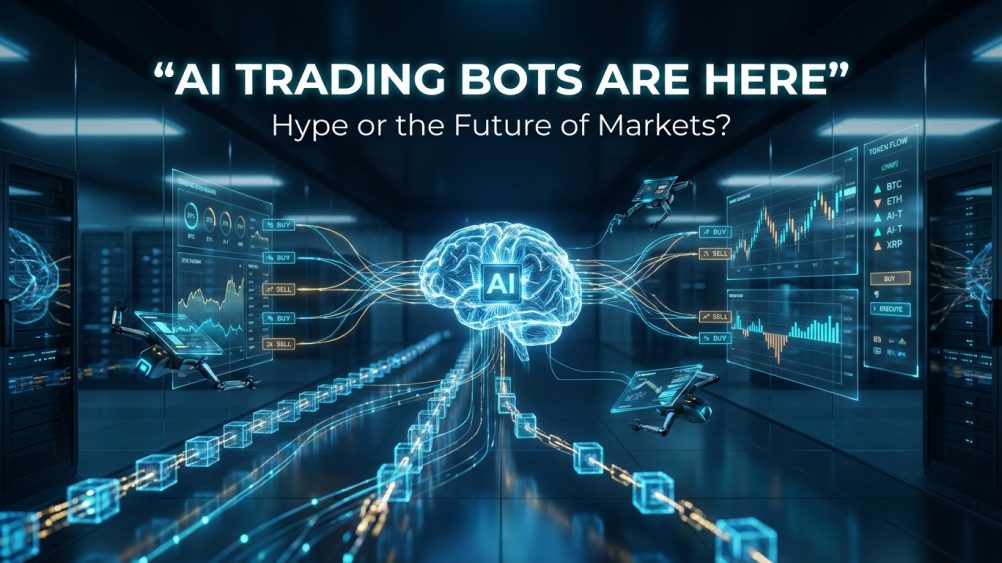
A basic crypto trading bot is not new. It follows rules. It buys, sells, sets stop losses, and scans price moves. An on-chain agent goes further. It can connect an AI model to a wallet and let software take actions on-chain, not just send alerts. That means the tool may trade, move funds, pay for data, or even respond to changing market conditions with little human input. Still, the jump from rule-based automation to action-taking software also raises the risk of faster mistakes.
Why The Hypes Keeps Growing
The hype is not coming from thin air. Crypto runs 24/7. Human traders get tired. Bots do not. In fast markets, automated trading can remove hesitation, follow fixed rules, and react to data in seconds. That matters more in a market where stablecoins have gone mainstream and on-chain activity keeps rising. a16z said stablecoins have become one of the fastest and cheapest ways to send dollars, while Coinbase argued that every autonomous AI agent can become a new 24/7 blockchain user. As a result, many traders now see algorithmic trading and on-chain trading as a natural next step, not a side experiment.
Where The Edge Maybe Real
The strongest case for AI trading bots is not magic price prediction. It is discipline. Bots can size positions by rule, cut losses on time, rebalance without emotion, and watch many markets at once. In choppy conditions, that can matter more than trying to guess the next big coin. Likewise, an on-chain agent may help with simple tasks such as yield moves, liquidity checks, treasury actions, and cross-platform execution.
However, the edge is often operational, not mystical. A bot that saves time, avoids panic, and respects risk may beat a careless human trader. That does not mean it beats the market. It may simply lose less often. For many crypto users, that is already valuable.
Where The Story Starts to Crack
This is where the debate gets real. If thousands of traders run similar signals, the edge gets crowded fast. Fees, slippage, and bad fills can quietly kill a strategy. In DeFi trading, another problem appears: MEV bots. They scan for chances to jump in front of, behind, or around user trades. That changes execution quality in ways many retail traders do not see.
Cointelegraph Research, using EigenPhi data, said Ethereum still saw 60,000 to 90,000 sandwich attacks per month through much of 2025. It also found that about 30% of active sandwich bots recorded net losses, while about one-third hovered near breakeven. So, even bot operators are not printing easy money. The competition itself is cutting returns.
A Quick Look at The Current Setup
| Area | What looks promising | What can go wrong |
| AI trading bots | Fast execution, no emotion, constant market watch | Overfitting, fee drag, crowded signals |
| On-chain agents | Wallet actions, payments, trading, task automation | Bad prompts, bad permissions, smart contract risk |
| DeFi trading | Open access, high activity, many venues | Slippage, MEV, thin liquidity in some pairs |
| Automated strategies | Better rule-following, easier scaling | One bug can repeat the same loss many times |
Why On-Chain Agents Matter More Than Many Traders Think
The bigger shift may not be the bot that buys Bitcoin on a moving average cross. It may be the agent that can act like a tiny market worker. Coinbase’s Agentic Wallet says an AI agent can hold and spend stablecoins, trade tokens, and pay for services without direct private key access. That moves the idea from “trading tool” to “economic actor.” Meanwhile, Base documentation and AgentKit show that builders are already making this stack easier to build on.
Even so, that does not mean all agents will be useful. Many will be thin wrappers on hype. Some will just automate bad ideas at high speed. The long-term winners will likely be the ones tied to clear jobs, clear limits, and clear audit trails.
So, Hype or Future?
The honest answer is both. The hype is real because the labels are getting ahead of the results. Many products sell “AI” when they mostly repackage old bot logic with a chat box. That part should make any serious trader cautious. Yet the future part is also real because the market now has the plumbing for software agents to hold value, act on-chain, and join crypto market activity at scale.
The Real Test Is Not Speed. It Is Survival
The market does not reward a bot just because it sounds smart. It rewards systems that survive fees, volatility, bad data, and crowded trades. That is why AI trading bots and on-chain agents should not be judged by hype cycles or social posts. They should be judged by risk control, execution quality, and staying power. For now, the smart view is cautious interest. The tools look real. The easy edge does not.
Disclaimer: This article is for educational purposes only and is not financial or investment advice. Crypto assets are risky, and losses can happen quickly.
Post Disclaimer
The information provided on Financepdia.com is for educational and informational purposes only and should not be considered financial, investment, or trading advice. Cryptocurrency and financial markets are highly volatile and involve significant risk. Readers should conduct their own research (DYOR) and consult with a qualified financial advisor before making any investment decisions. Financepdia.com and its authors are not responsible for any financial losses resulting from actions taken based on the information provided on this website.