





Have you ever wondered why some traders make big gains in crypto while others lose everything overnight?
The answer often comes down to one thing: which type of trading they used.
Think about Bitcoin in 2020. It was trading around $10,000 in October. By April 2021, it hit nearly $65,000. That’s a 550% gain in six months. But how you traded it mattered enormously. A spot trader held coins and rode that wave.
A futures trader using high leverage might have been wiped out by a single dip along the way.
Understanding spot trading, futures, and options isn’t just a nice-to-have. It’s the difference between building wealth and blowing up your account.
Let’s break each one down clearly.
Key Takeaways
- Spot trading is the simplest entry point. You buy and own the actual asset with no expiry date or leverage required.
- Futures contracts use leverage. This amplifies both gains and losses, making them higher risk for beginners.
- Options give you the right, not the obligation, to trade. Your max loss is capped at the premium you paid.
- Crypto derivatives markets are massive. Daily crypto futures volume regularly exceeds $50 billion globally, dwarfing spot volumes on most exchanges.
- Each product suits a different risk profile. Matching the right tool to your goals is the most important decision you’ll make.
What Is Spot Trading?
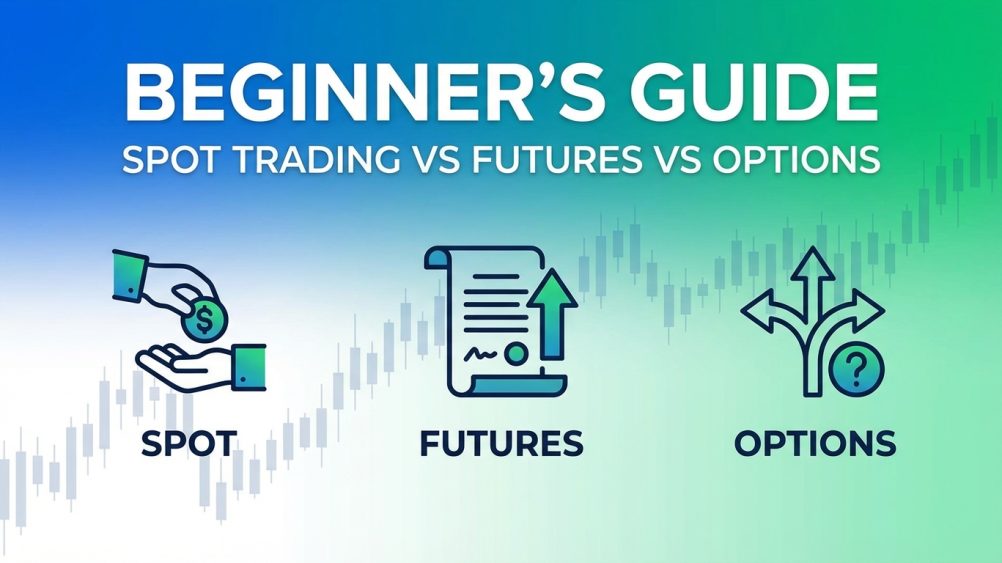
Spot trading is the most straightforward form of crypto investing. You buy an asset at the current market price and own it immediately. If you buy 1 Bitcoin at $60,000, you have 1 Bitcoin. Full stop.
There’s no expiry date. No leverage unless you choose it. No complex contract to manage. You profit when the price goes up. You lose when it goes down. That’s it.
Spot markets are where most beginners start. They’re liquid, transparent, and available on every major exchange including Coinbase, Binance, and Kraken.
The biggest downside? You need full capital upfront. And in a bear market, you hold the asset as its value drops with nothing to hedge your position.
What Are Crypto Futures?
Futures are contracts that let you agree to buy or sell an asset at a set price on a future date.
In crypto, most futures are perpetual contracts. They don’t expire. Instead, they use a funding rate mechanism to keep prices close to the spot market.
The big draw is leverage. With 10x leverage, a $1,000 position controls $10,000 worth of Bitcoin. A 5% price move becomes a 50% gain or loss. That math cuts both ways. Many exchanges like Bybit and OKX offer leverage from 5x up to 125x.
Futures are popular with institutional traders and experienced retail traders. They’re also useful for hedging. If you hold Bitcoin but expect a short-term drop, you can short a futures contract to offset losses.
But make no mistake: high leverage can liquidate your position in minutes. This is not a product for casual investors.
What Are Crypto Options?
Options give you the right, but not the obligation, to buy or sell an asset at a specific price before a set date.
A call option profits when prices rise. A put option profits when prices fall. The price you pay to enter the contract is called the premium. That’s the most you can lose.
For example: you buy a Bitcoin call option with a strike price of $70,000, expiring in 30 days, for a $500 premium. If Bitcoin reaches $80,000, you profit. If it doesn’t reach $70,000, you lose only the $500 you paid.
This defined-risk structure is what makes options attractive to more sophisticated retail investors. Deribit handles the majority of crypto options volume globally, with Bitcoin and Ethereum being the most traded underlying assets.
The downside? Options are complex. Pricing is influenced by volatility, time decay, and the distance from the current price to the strike. Getting these factors wrong erodes premiums quickly.
Side-by-Side Comparison
| Feature | Spot Trading | Futures | Options |
| Ownership | You own the asset | No ownership contract only | No ownership right to buy/sell |
| Leverage | None by default | Up to 125x on some exchanges | Built-in via premium structure |
| Max loss | 100% of investment | 100% + liquidation risk | Premium paid only |
| Expiry | None | None (perpetual) or fixed date | Fixed expiry date |
| Complexity | Low | Medium–High | High |
| Best for | Beginners, long-term holders | Active traders, hedgers | Experienced traders, hedgers |
| Key risk | Price depreciation | Liquidation via leverage | Time decay (theta) |
| Where to trade | Coinbase, Kraken, Binance | Bybit, OKX, Binance Futures | Deribit, OKX Options |
When to Use Each One
Matching the right instrument to your goals is more important than picking the right coin. Here’s a breakdown of common use cases:
- Use spot trading if you’re new to crypto, believe in long-term price appreciation, and want to avoid liquidation risk entirely.
- Use futures for hedging if you hold large spot positions and want to protect against short-term downturns without selling your assets.
- Use futures for speculation only if you understand leverage deeply, use stop-losses consistently, and can afford to lose your margin.
- Use call options if you believe in a big upside move but want to cap your downside to a known premium cost.
- Use put options if you want downside protection on spot holdings, similar to buying insurance on a stock portfolio.
- Avoid leverage products entirely during high-volatility events like Bitcoin halvings, major regulatory announcements, or macro shocks.
Understanding Risk and Reward
Risk isn’t just about how much you can lose. It’s about how fast you can lose it and whether you can survive long enough for the market to recover.
Spot trading gives you time. If Bitcoin drops 30%, you still own Bitcoin. You can wait. Futures traders with 20x leverage have no such luxury. A 5% drop triggers liquidation.
Options sit in the middle. You can lose your premium fast if volatility collapses or time runs out. But you cannot lose more than you paid. That hard floor is what attracts institutional desks to options for portfolio hedging.
According to Coinglass, over $200 million in crypto futures positions are liquidated on average daily during volatile periods. That number spikes to billions during major corrections. Spot traders don’t appear in liquidation data. That contrast tells you everything.
Frequently Asked Questions
Can I use futures and spot trading at the same time?
Yes, and professional traders do this regularly. It’s called a hedge. You hold a long spot position while holding a short futures position. If the price drops, your futures profit partially offsets your spot loss. This strategy requires active management and a clear understanding of your net exposure at all times.
Are crypto options taxed differently than spot trades?
In most jurisdictions, yes. Options premiums, expirations, and exercises can each be separate taxable events. The IRS in the US and HMRC in the UK both treat crypto derivatives as distinct from spot asset sales. Always consult a qualified tax professional before trading derivatives, as rules vary significantly by country and are still evolving.
How do crypto options compare to traditional stock options?
Crypto options work on the same basic mechanics as equity options. The core difference is volatility. Crypto implied volatility (IV) regularly exceeds 80-100%, versus 15-30% for most large-cap stocks. This makes crypto option premiums significantly more expensive relative to asset price. It also means price moves are larger and faster, which cuts both ways for options buyers and sellers.
Disclaimer: This article is for informational purposes only. It is not financial advice. Always do your own research.
Sources
- CoinGecko Crypto Derivatives Market Overview: coingecko.com/en/derivatives
- Coinglass Crypto Liquidations Data: coinglass.com
- Deribit Crypto Options Exchange: deribit.com
- Binance Academy Futures Trading Guide: academy.binance.com
Post Disclaimer
The information provided on Financepdia.com is for educational and informational purposes only and should not be considered financial, investment, or trading advice. Cryptocurrency and financial markets are highly volatile and involve significant risk. Readers should conduct their own research (DYOR) and consult with a qualified financial advisor before making any investment decisions. Financepdia.com and its authors are not responsible for any financial losses resulting from actions taken based on the information provided on this website.