




Money is not staying still in 2026. It is moving fast, and it is choosing sides. DeFi vs TradFi is no longer just a debate. It is now a real shift in where serious capital is going.
Investors are watching closely. Institutions are adjusting strategies. Meanwhile, retail traders are following signals from large capital flows. As a result, the question is simple. Where is smart money going today?
This article breaks down capital movement trends, key differences, and what is driving this shift in decentralized finance (DeFi) and traditional finance (TradFi).
Understanding DeFi and TradFi in 2026
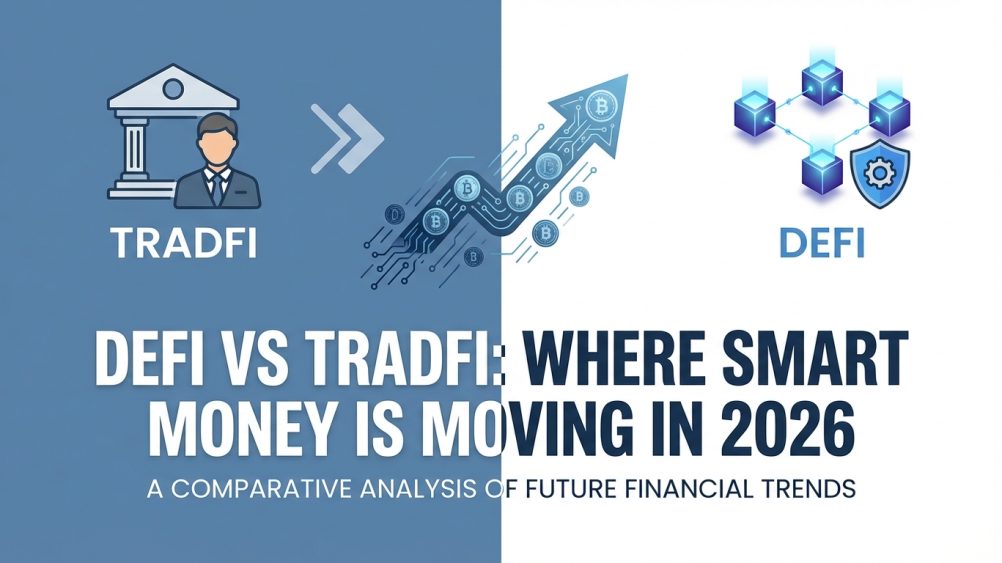
Traditional finance (TradFi) includes banks, stock markets, and regulated financial systems. It is stable, trusted, and widely used. However, it is often slow and controlled by intermediaries.
On the other hand, decentralized finance (DeFi) runs on blockchain. It removes middlemen. It allows users to lend, borrow, and trade directly. Therefore, it offers speed, transparency, and global access.
However, both systems now coexist. And smart money is not choosing one blindly. Instead, it is rotating between them based on opportunity.
Key Capital Flow Trends in 2026
Large investors are not emotional. They move funds based on risk, yield, and liquidity. Therefore, current trends show a clear pattern.
1. Yield Hunting in DeFi
Many funds are moving into DeFi protocols for higher returns. For example, staking, yield farming, and liquidity pools offer better yields than traditional savings.
However, this comes with a higher risk. So, smart money enters DeFi during strong market conditions and exits during uncertainty.
2. Stability Shift Back to TradFi
When markets become unstable, capital flows back to TradFi assets like bonds, ETFs, and blue-chip stocks. Therefore, TradFi still acts as a safety net.
3. Hybrid Strategies Are Growing
Many institutions now combine both systems. They hold crypto assets while maintaining positions in traditional markets. As a result, this balanced approach reduces risk.
DeFi vs TradFi: A Quick Comparison
| Feature | DeFi | TradFi |
| Control | User-controlled wallets | Bank-controlled accounts |
| Speed | Fast transactions | Slower processing |
| Accessibility | Global and open | Restricted access |
| Risk Level | High volatility | Lower volatility |
| Transparency | Public blockchain data | Limited visibility |
| Yield Potential | High returns | Moderate returns |
This table shows why capital does not stay in one place. Instead, it moves based on market conditions.
Why Smart Money Is Entering DeFi
Several factors are driving capital into DeFi investments in 2026.
First, higher returns attract attention. Many protocols offer double-digit yields. Therefore, funds are shifting small portions of capital into DeFi for growth.
Second, on-chain transparency builds trust. Investors can track transactions in real time. As a result, decision-making becomes data-driven.
Third, tokenized assets are gaining traction. Real-world assets like real estate and bonds are now available on blockchain. This bridges the gap between DeFi and TradFi.
However, risk remains a concern. Smart money does not go all in. Instead, it allocates carefully.
Why TradFi Still Holds Strong
Despite the rise of DeFi, traditional finance trends remain important.
First, regulations provide security. Institutions prefer regulated environments. Therefore, large funds still rely on TradFi for stability.
Second, liquidity depth in stock markets is unmatched. Big trades can happen without major price impact. This is critical for large investors.
Third, central banks still influence global markets. Interest rates and policies affect capital flows. As a result, TradFi continues to guide macro trends.
Where Smart Money Is Moving Right Now
In 2026, capital is not choosing one system. It is rotating.
- During bullish crypto markets, funds move into DeFi protocols
- During uncertainty, capital shifts back to TradFi assets
- Long-term investors hold both for balance
Therefore, the real strategy is not DeFi vs TradFi. It is timing and allocation.
Moreover, institutional players are increasing their exposure to crypto markets, but in a controlled way. They are entering through ETFs, custodial services, and regulated platforms.
At the same time, DeFi is improving security and compliance. This is attracting more serious capital.
Risks That Cannot Be Ignored
Even though opportunities exist, risks remain.
In DeFi, smart contract vulnerabilities can lead to losses. Therefore, investors must research protocols carefully.
In TradFi, inflation and interest rate changes can reduce returns. As a result, capital may lose value over time.
Because of this, smart money spreads risk across both systems.
What This Means for Investors
This shift is not random. It follows clear patterns.
Investors should watch:
- Market sentiment
- Interest rate changes
- Crypto adoption trends
- Institutional activity
Therefore, understanding capital rotation between DeFi and TradFi is key to making informed decisions.
The Real Game Is Balance
The future is not about choosing one system over the other. It is about knowing when money moves and why.
Smart money in 2026 is flexible. It enters DeFi for growth and returns to TradFi for safety. As a result, success comes from adapting to these shifts.
Investors who follow these patterns can stay ahead. Those who ignore them may fall behind.
Disclaimer: This article is for informational purposes only and does not constitute financial advice. Readers should conduct their own research before making any investment decisions.
Post Disclaimer
The information provided on Financepdia.com is for educational and informational purposes only and should not be considered financial, investment, or trading advice. Cryptocurrency and financial markets are highly volatile and involve significant risk. Readers should conduct their own research (DYOR) and consult with a qualified financial advisor before making any investment decisions. Financepdia.com and its authors are not responsible for any financial losses resulting from actions taken based on the information provided on this website.