



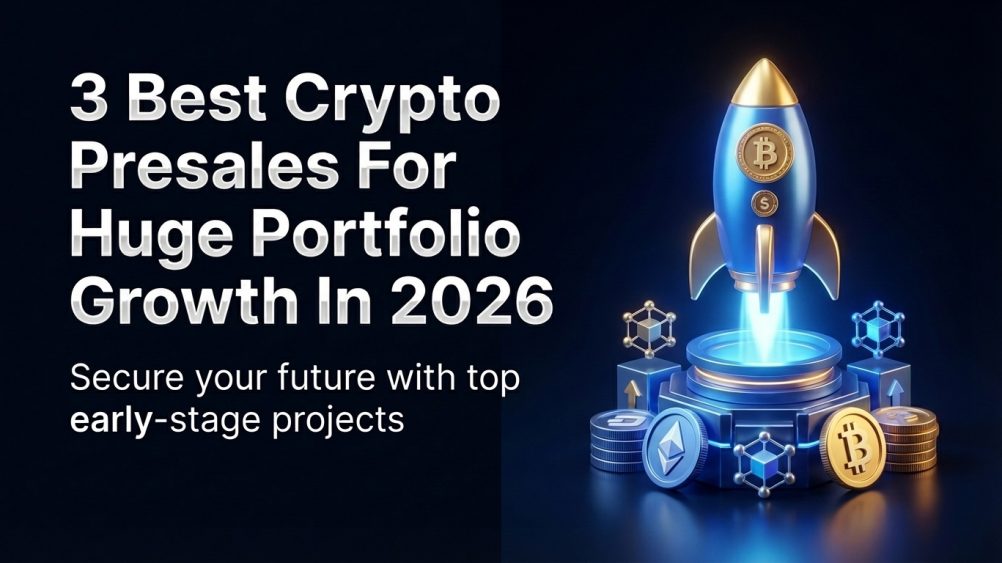
3 Best Crypto Presales For Huge Portfolio Growth In 2026: IPO Genie, DeepSnitch AI, And Ozak AI

3 Best Crypto Presales For Huge Portfolio Growth In 2026: IPO Genie, DeepSnitch AI, And Ozak AI


What if the biggest gains of 2026 are already taking shape, long before headlines and exchange listings bring mass attention? Huge portfolio growth in 2026 will likely favor investors who position early, not those who wait for confirmation after prices move. 

Once a token lists and starts trending, a large portion of the upside is often already priced in. That is why serious investors are scanning the best crypto presales while entry levels remain low and allocation stages are still open.

The strategy is simple but disciplined: identify strong narratives, confirm real demand, and enter before liquidity expands. Themes like AI-driven platforms, tokenized real-world access, and structured utility are attracting early capital for a reason. In this guide, we highlight three projects positioned for huge portfolio growth in 2026, focusing on early access before broader market participation drives valuations higher.

Best Crypto Presales for Massive Growth 

1. IPO Genie: The Best Crypto Presale Targeting Trillion-Dollar Private Markets

IPO Genie is gaining attention as one of the best crypto presales for investors who want exposure beyond meme coins and short-term speculation. Its focus is direct and strategic: open access to private and pre-IPO opportunities that are usually reserved for venture capital firms and institutional players. That private investment market is worth over $3 trillion, yet retail investors rarely get early access at reasonable entry prices. According to industry reporting, tokenized access to private markets is emerging as a real growth theme for savvy investors in 2026.

At the center of the platform is its Sentient Signal Agents system, designed to analyze startup traction, funding activity, and performance signals to highlight high-potential opportunities before broader market attention pushes valuations higher.

The token’s structure adds to the growth case. IPO Genie has a maximum supply of 437 billion $IPO tokens and uses a disciplined allocation model:

  • 50% dedicated to presale (community-first approach)
  • 20% reserved for liquidity and exchange support
  • 18% for community rewards
  • Team tokens locked for 2 years, showing long-term alignment

Why It Supports Huge Portfolio Growth in 2026

  • Early-stage entry pricing before exchange listings gives room for expansion
  • Limited presale supply creates scarcity as phases sell out
  • Token utility tied to deal access, staking, and governance increases real demand
  • Tokenomics designed for stability and long-term growth
  • Exposure to a multi-trillion-dollar private investment market before broad retail entry

With real market access, structured allocations, and early pricing still available, IPO Genie presents a clear case for meaningful portfolio expansion in 2026 for those who enter while momentum builds.

 2. DeepSnitch AI: On-Chain Intelligence Built For 2026 Growth

DeepSnitch AI focuses on one clear need in crypto markets: real-time on-chain intelligence. Instead of promising abstract innovation, it delivers tracking tools that monitor large wallet movements, unusual transaction spikes, and shifting market sentiment. For beginners, this means access to clearer data before making trading or investment decisions.

Traders searching for the best crypto presales often look at infrastructure projects that solve real problems. DeepSnitch AI positions itself as a data-driven platform where token utility connects directly to analytics access. As trading volumes grow, demand for reliable insights tends to increase as well.

DeepSnitch is well known for: 

  • Whale wallet tracking to detect major capital shifts
  • Monitoring of high-volume transactions across networks
  • Sentiment scanning to measure crowd behavior
  • Token utility linked to platform features and access

Why It Could Drive Huge Portfolio Growth In 2026

  • Rising demand for faster and clearer trading intelligence
  • Expansion of data-focused tools as markets mature
  • Early positioning before the next wave of AI-driven crypto platforms

DeepSnitch AI appeals to investors who value measurable utility, structured growth, and exposure to a sector that supports the entire trading ecosystem.

 3. Ozak AI: Predictive Blockchain Analytics With Explosive Presale Momentum

Ozak AI centers its model on predictive blockchain analytics and decentralized data infrastructure. The platform focuses on processing large volumes of on-chain information and structured market data to generate forward-looking insights. For investors, this means exposure to a project built around measurable data rather than speculation alone.

Within conversations around the best crypto presales, Ozak AI is frequently highlighted for its forecasting angle. The project connects automation tools with decentralized physical infrastructure networks (DePIN), allowing data to be sourced and verified across distributed systems. This adds a layer of credibility and long-term relevance as analytics demand continues to expand.

It is known for: 

  • Predictive data models designed for market forecasting
  • Decentralized data feeds supporting transparency
  • Automation-based infrastructure tools
  • Reported multi-million-dollar presale traction

Why It Could Deliver Huge Portfolio Growth In 2026

  • Strong alignment with the expanding AI-token narrative
  • Exposure to the fast-growing DePIN and analytics sectors
  • Early valuation levels compared to projected listing scenarios

For investors reviewing the best crypto presales, Ozak AI presents a structured, data-focused opportunity positioned for 2026 expansion.

Quick Comparison: Which Presale Fits Your 2026 Growth Style?


Presale Best For Core Narrative Why It Can Pop in 2026
IPO Genie High-upside early investors AI + tokenized private market access Largest market opportunity, strong momentum, real access to utility
DeepSnitch AI Traders & active investors AI-powered market intelligence Growing demand for signals, alerts, and risk tracking tools
Ozak AI Long-term AI-focused investors Predictive analytics + data infrastructure Expanding analytics sector and infrastructure-driven adoption


This comparison keeps it simple. IPO Genie targets investors chasing early access to massive private markets. DeepSnitch AI appeals to those who want trading intelligence and actionable data. Ozak AI fits investors looking at long-term infrastructure growth within analytics and decentralized data systems.

How These 3 Presales Could Boost Portfolios in 2026

Presales offer one clear advantage: early pricing before public demand sets the market value. When a token is still in its early allocation stages, supply is controlled, and pricing tiers are lower. That structure creates room for upside if momentum builds. Investors who track the best crypto presales focus on this phase because percentage gains are typically strongest before exchange exposure.

All three projects follow a similar growth framework. Entry begins at structured presale tiers. As each phase sells out, the token price increases. This staged model rewards early participants and reduces available supply over time. When listings begin, liquidity expands and access becomes easier for a wider audience. That often brings new buying pressure.

The Growth Setup

  • Lower presale pricing before public trading
  • Limited allocations that create scarcity
  • Increased visibility once exchange listings go live
  • Broader adoption as narratives gain traction

Enter early, before pricing reflects full market attention. This is why investors actively evaluate the best crypto presales ahead of 2026, aiming to position themselves before demand accelerates.

Wrap Up!

What if the real opportunity is not in what is already trending, but in what is still early? 2026 may reward investors who position themselves before listings, not after prices surge. IPO Genie, DeepSnitch AI, and Ozak AI all align with strong AI-driven growth trends and expanding blockchain use cases. 

Among them, IPO Genie stands out as the best crypto presale for exposure to tokenized private markets and structured early access. For those targeting huge portfolio growth in 2026, these projects offer calculated, high-risk, high-reward entry points while pricing remains in early stages.

Disclaimer: This content is provided for general informational purposes only and does not constitute legal, financial, or investment advice. Any references to products, services, or features are subject to change and applicable regulations.


Post Disclaimer

The information provided on Financepdia.com is for educational and informational purposes only and should not be considered financial, investment, or trading advice. Cryptocurrency and financial markets are highly volatile and involve significant risk. Readers should conduct their own research (DYOR) and consult with a qualified financial advisor before making any investment decisions. Financepdia.com and its authors are not responsible for any financial losses resulting from actions taken based on the information provided on this website.
Why Liquidity Matters: Hidden Factor That Can Make or Break Your Trade 

Why Liquidity Matters: Hidden Factor That Can Make or Break Your Trade 

Are you losing money on crypto trades without understanding why? In May 2021, a trader bought $50,000 worth of a small-cap altcoin. The order filled at 8% higher than the displayed price.

Within minutes, the loss totaled $4,000 before the market even moved. This wasn’t market volatility. It was a liquidity problem. 

Most new crypto investors don’t realize that liquidity can silently destroy profits faster than any price crash.

Key Takeaways

  • Low liquidity causes instant slippage losses
  • Slippage costs 0.5% to 5% per trade
  • Thin order books enable price manipulation

What Liquidity Actually Means in Crypto Trading

Liquidity measures how easily you can buy or sell an asset without moving its price.

High liquidity means many buyers and sellers exist at similar price points. Your order fills quickly at the expected price. Low liquidity means fewer participants and wider price gaps. Your order moves the market simply by existing.

Think of liquidity like a swimming pool. A deep pool lets you dive without hitting the bottom. A shallow pool causes instant impact. In crypto, the “depth” is measured by order book size.

The order book shows all pending buy and sell orders. Deep order books have many orders clustered near the current price. Shallow order books have few orders with large price gaps between them.

Bitcoin and Ethereum typically maintain deep liquidity on major exchanges. Daily Bitcoin trading volume exceeds $30 billion across global markets. Small-cap tokens often trade under $100,000 daily, creating severe liquidity constraints.

How Slippage Drains Your Trading Account

Slippage is the difference between expected price and execution price.

You click buy at $1.00. Your order fills at $1.03. That 3% gap is slippage. It happens because your order consumes available liquidity at each price level.

Market orders guarantee execution but not price. They match against existing orders in the book. If the order book is thin, your trade walks up the price ladder. Each step costs more than the last.

Limit orders set a maximum price but don’t guarantee execution. The market might move away before your order fills. You avoid slippage but risk missing the trade entirely.

Consider this scenario. You want to buy $10,000 of Token X. The order book shows:

  • 100 tokens at $1.00
  • 200 tokens at $1.02
  • 500 tokens at $1.05
  • 1,000 tokens at $1.10

Your $10,000 order needs roughly 9,500 tokens at $1.00. The book only offers 100 at that price. Your order climbs through each level. Average fill price reaches $1.08. You just paid 8% more than expected.

Academic research indicates that slippage costs increase exponentially as order size grows relative to available liquidity.

The Stop Hunt Problem in Thin Markets

Stop-loss orders become visible targets in low liquidity environments.

Stop hunts occur when large traders deliberately push prices to trigger clusters of stop orders. Once triggered, those orders become market orders that push prices even further. The manipulator profits from both the initial push and the cascade.

Here’s how it works:

  1. A large trader identifies where retail stop orders concentrate
  2. They place orders to push price toward those stops
  3. Stops trigger and convert to market orders
  4. The cascade drives price further in the same direction
  5. The manipulator closes their position at profit
  6. Price often rebounds after the hunt completes

Thin order books make this strategy cheaper to execute. Moving Bitcoin’s price requires millions of dollars. Moving a small-cap token might cost only thousands.

Decentralized exchanges often show worse liquidity than centralized platforms. Automated market makers use bonding curves instead of order books. Large trades against these curves suffer significant price impact regardless of timing.

Comparing Liquidity Across Market Conditions

Different market structures create vastly different liquidity profiles.

Market Type Typical Spread Order Book Depth Slippage Risk Manipulation Risk
Major CEX (BTC/ETH) 0.01% – 0.05% Very High Very Low Very Low
Major CEX (Mid-caps) 0.1% – 0.5% Moderate Low Low
Minor CEX (Small-caps) 0.5% – 2% Low High Moderate
DEX (Major pairs) 0.3% – 1% Moderate Moderate Low
DEX (New tokens) 2% – 10%+ Very Low Very High High

The spread represents the gap between best bid and best ask prices. Tighter spreads indicate better liquidity. Wider spreads signal liquidity problems.

Centralized exchanges aggregate liquidity from professional market makers. These firms continuously quote buy and sell prices. Their algorithms adjust quotes based on inventory and market conditions.

Decentralized platforms rely on liquidity providers depositing token pairs. Incentives attract providers but don’t guarantee depth. A pool might have $1 million in total value but poor execution for $10,000 trades.

Five Factors That Affect Trading Liquidity

Understanding what drives liquidity helps you avoid costly mistakes.

Trading volume patterns: High volume suggests active trading but doesn’t guarantee tight spreads. Volume might concentrate in large block trades rather than continuous market making.

Time of day effects: Cryptocurrency markets show clear patterns tied to global time zones. Liquidity peaks when US, European, and Asian markets overlap. It drops significantly during off-hours.

Market maker presence: Professional market makers provide the majority of liquidity on centralized exchanges. Their participation depends on volatility, fees, and competition. Aggressive market conditions can cause them to withdraw.

Token economics: Tokens with large holder concentration show poor liquidity. If 80% of supply sits in inactive wallets, only 20% trades actively. This creates artificial scarcity and price manipulation opportunities.

Check out the example of token economics in the image below.

Exchange listing count: Tokens listed on multiple major exchanges distribute liquidity across platforms. This typically improves overall market quality. Single-exchange tokens concentrate risk and manipulation potential.

Protecting Yourself from Liquidity Problems

Smart traders adjust strategy based on liquidity conditions.

Start by checking order book depth before placing orders. Most exchanges show this data visually. Look for clustering near the current price. Avoid tokens where the order book shows large price gaps.

Use limit orders for anything except urgent trades. Market orders in thin markets guarantee slippage. Limit orders let you set maximum acceptable prices. You might miss some trades but avoid catastrophic fills.

Split large orders across time and price levels. Dumping $50,000 into a thin market causes maximum slippage. Breaking it into ten $5,000 orders over several hours reduces market impact.

Monitor spread percentages before trading. If the bid-ask spread exceeds 0.5%, consider waiting for better conditions. Spreads above 2% indicate serious liquidity problems.

Avoid trading during low-volume hours unless necessary. Check historical volume patterns for your target asset. Schedule trades during peak liquidity windows when possible.

Consider the total order book depth relative to your position size. If you’re trading 10% or more of available depth, expect significant slippage. Reduce position size or choose more liquid alternatives.

Frequently Asked Question

What’s the difference between liquidity and volume in crypto markets?

Volume measures total trading activity over time. Liquidity measures how easily you can trade without affecting price. A token can have high volume from a few large trades but terrible liquidity for average traders. Order book depth and spread width indicate true liquidity better than volume alone.

Can decentralized exchanges ever match centralized exchange liquidity?

DEX liquidity has improved significantly through concentrated liquidity pools and cross-chain aggregation. However, professional market makers still prefer centralized platforms for most serious liquidity provision. DEXs excel at long-tail assets and censorship resistance. They typically lag on execution quality for large trades compared to major centralized venues.

How does liquidity affect stop-loss strategy effectiveness?

Stop-losses work best in highly liquid markets where execution happens near trigger prices. In thin markets, stop orders can execute far below trigger levels during rapid moves. This defeats their protective purpose. Wide stop placement and smaller position sizes work better than tight stops in low liquidity environments. Some traders avoid stops entirely in illiquid markets.

Disclaimer: This article is for informational purposes only. It is not financial advice. Always do your own research.


Post Disclaimer

The information provided on Financepdia.com is for educational and informational purposes only and should not be considered financial, investment, or trading advice. Cryptocurrency and financial markets are highly volatile and involve significant risk. Readers should conduct their own research (DYOR) and consult with a qualified financial advisor before making any investment decisions. Financepdia.com and its authors are not responsible for any financial losses resulting from actions taken based on the information provided on this website.

How to Build a Long-Term Investment Plan in a High-Inflation World

How to Build a Long-Term Investment Plan in a High-Inflation World

Is hard-earned money losing value faster than it grows in today’s inflation-heavy economy?

Many investors now face this exact concern. Prices rise, savings shrink, and uncertainty grows around traditional investing. This is why many turn toward crypto investing strategies and diversified portfolios to stay ahead.

However, building a long-term investment plan in such an environment requires more than chasing trends. It demands discipline, clarity, and smart allocation. Moreover, investors must focus on stability while still aiming for growth. Therefore, a structured approach becomes essential.

Understand Inflation and Its Impact on Investments

Inflation reduces the purchasing power of money over time. As a result, holding idle cash becomes risky. According to data from the , even moderate inflation can erode value significantly over years.

In addition, traditional low-yield assets often fail to keep pace. This is where inflation-resistant assets like crypto, commodities, and equities come into play. Therefore, investors must shift focus toward assets with growth potential.

Set Clear Long-Term Investment Goals

A strong plan starts with clear goals. Investors should define timelines, risk tolerance, and expected returns. For example, someone investing for 10 years will take different steps than someone planning for retirement in 30 years.

Moreover, clear goals help avoid emotional decisions. In volatile markets like crypto, this becomes even more important. Therefore, consistency matters more than short-term gains.

Diversify Across Asset Classes

Diversification remains one of the most effective ways to reduce risk. A balanced portfolio spreads investments across multiple assets.

Below is a simple allocation example:


Asset Class Purpose Example Allocation
Crypto Assets High growth potential 20%
Stocks (Equities) Long-term capital growth 40%
Commodities Hedge against inflation 15%
Bonds Stability and income 15%
Cash Reserves Liquidity for opportunities 10%

However, allocation depends on risk tolerance. A younger investor may hold more crypto assets, while a conservative investor may prefer bonds. Therefore, balance is key.

Focus on Strong Crypto Fundamentals

Crypto plays a growing role in modern portfolios. However, not all projects hold long-term value. Investors should focus on:

  • Blockchain utility
  • Real-world use cases
  • Strong developer activity
  • Transparent tokenomics

For instance, platforms like show how smart contracts support real applications. In addition, Bitcoin remains a popular store of value due to its limited supply.

Therefore, careful selection helps reduce unnecessary risk.

Use Dollar-Cost Averaging Strategy

Timing the market is difficult. Instead, many investors follow dollar-cost averaging (DCA). This means investing a fixed amount at regular intervals.

As a result, investors avoid buying only at market peaks. Over time, this method smooths out volatility. Moreover, it builds discipline and reduces emotional trading.

Therefore, DCA works well for both beginners and experienced investors.

Rebalance the Portfolio Regularly

Market conditions change frequently. As a result, portfolio allocations shift over time. For example, a strong crypto rally may increase exposure beyond the intended level.

Therefore, periodic rebalancing is important. Investors should review portfolios every few months. This helps maintain the desired risk level and protects gains.

In addition, rebalancing prevents overexposure to volatile assets.

Manage Risk with Clear Rules

Every investment carries risk. However, managing it properly makes a major difference. Investors should:

  • Set stop-loss levels
  • Avoid over-investing in a single asset
  • Keep an emergency fund

Moreover, emotional decisions often lead to losses. Therefore, predefined rules help maintain control during market swings.

Stay Informed but Avoid Noise

The crypto space moves fast. News, trends, and opinions flood the market daily. However, not all information is reliable.

Investors should rely on credible sources for market data. In addition, long-term trends matter more than short-term hype.

Therefore, filtering information becomes a valuable skill.

Think Long Term, Not Short Term

Short-term trading often leads to stress and poor decisions. In contrast, long-term investing builds wealth steadily.

For example, historical data shows that holding assets like Bitcoin over longer periods has delivered strong returns despite volatility. However, patience is required.

Therefore, staying committed to the plan becomes essential.

Build Stability in an Uncertain World

A strong long-term investment plan in a high-inflation world focuses on balance, discipline, and informed decisions. Investors who stay consistent and avoid panic tend to perform better over time.

Moreover, combining crypto investing strategies, diversification, and risk control creates a more stable path forward. Therefore, the goal is not quick profits but steady progress.

In the end, a clear plan brings confidence even in uncertain markets.

Disclaimer: This article is for informational purposes only and does not constitute financial advice. Investors should conduct their own research and consult a financial advisor before making investment decisions.


Post Disclaimer

The information provided on Financepdia.com is for educational and informational purposes only and should not be considered financial, investment, or trading advice. Cryptocurrency and financial markets are highly volatile and involve significant risk. Readers should conduct their own research (DYOR) and consult with a qualified financial advisor before making any investment decisions. Financepdia.com and its authors are not responsible for any financial losses resulting from actions taken based on the information provided on this website.