






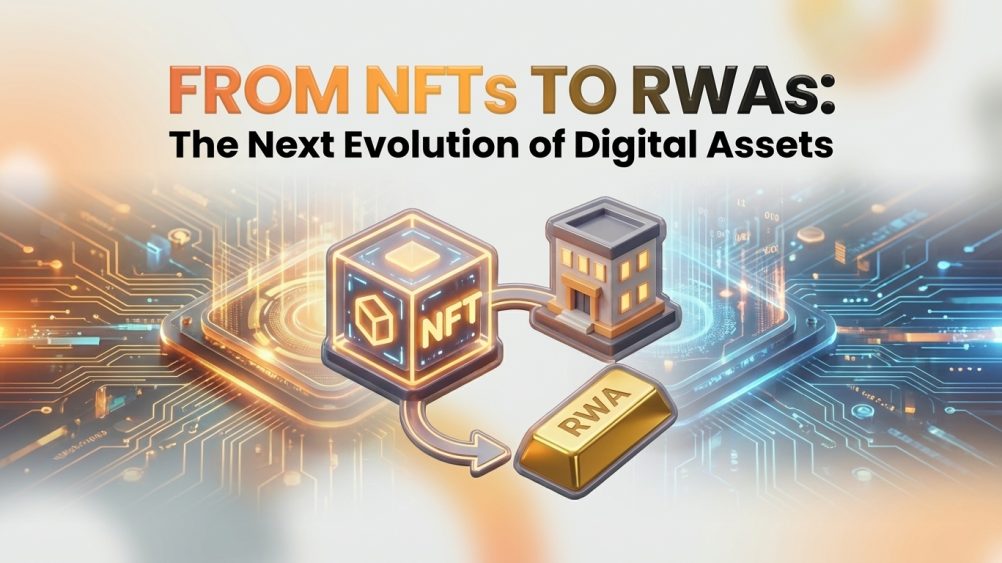
From NFTs to RWAs: The Next Evolution of Digital Assets

From NFTs to RWAs: The Next Evolution of Digital Assets

The digital asset world moves fast. What was popular yesterday can fade tomorrow. NFTs proved this in a big way.

In 2021, NFT sales hit roughly $24.9 billion. Celebrities bought cartoon apes for millions. A single digital artwork sold for $69.3 million. The world could not stop talking about NFTs.

Then the crash came. By 2024, art NFT trading volume had dropped 93%. Average prices fell from $2,044 to under $500. Many NFTs became worthless almost overnight.

But blockchain technology did not die with NFTs. Instead, it found a new, stronger purpose. That purpose is Real World Assets, or RWAs.

RWAs put real things on the blockchain. Think government bonds, real estate, or gold. These are not cartoon pictures. These are things with real, measurable value.

By March 2026, tokenized real world assets on-chain passed $12 billion. That number doubled in just over one year. Major banks and investment firms are building here now.

This article explains the full story. You will learn what happened to NFTs. You will understand what RWAs are. And you will see why this shift matters.

Key Takeaways

  • NFTs peaked in 2021 at ~$24.9 billion in sales, then crashed over 90% by 2024. 
  • RWA tokenization crossed $12 billion on-chain by March 2026, doubling in about one year. 
  • BlackRock, Franklin Templeton, and JPMorgan are actively building tokenized fund products.
  • Tokenized U.S. Treasuries alone account for $5.8 billion as of March 2026. (Source: Blocklr, rwa.xyz)
  • Standard Chartered projects the RWA market could reach $30 trillion by 2034. McKinsey estimates $2 trillion by 2030.

What Are NFTs?

NFT stands for Non Fungible Token. “Non fungible” means one of a kind. A dollar bill is fungible. Any dollar can replace another dollar. But a painting is non fungible. No two paintings are exactly the same.

NFTs use blockchain technology. The blockchain is a digital record book. It tracks who owns what. When you buy an NFT, the blockchain records it.

Most NFTs lived on the Ethereum blockchain. They included digital art, music, and game items. Some were profile pictures called “PFPs.” Others were virtual land in online worlds.

The NFT Boom and Bust

The NFT market exploded in 2021. Sales jumped from about $94.9 million in 2020. They rocketed to roughly $24.9 billion in 2021. That is a massive increase in just one year.

Christie’s auction house sold a Beeple artwork for $69.3 million. Celebrities like Snoop Dogg and Justin Bieber bought in. Wallets trading NFTs grew from 545,000 to 28.6 million. The hype felt unstoppable.

But it was a bubble. Average NFT sale prices dropped 92% by early 2023. Prices went from $3,894 to just $293. NFT trading volume fell from $17 billion to $466 million. Bloomberg called it a 97% collapse.

Several things caused the crash. The broader crypto market lost $2 trillion in value. FTX, a major crypto exchange, went bankrupt. Terra/LUNA collapsed, wiping out $60 billion. Fear spread across all crypto markets.

The NFT market was also flooded with low quality projects. Speculation replaced real value. By 2024, art NFT trading volume was down 93% from 2021. It fell from $2.9 billion to just $197 million. Active traders dropped 96% from their 2022 peak.

NFT Market Timeline: Rise and Fall

Year NFT Trading Volume Key Event Market Sentiment
2020 ~$94.9 million Early growth phase Niche interest
2021 ~$24.9 billion Beeple sells for $69.3M Peak hype and mania
2022 ~$26.3 billion* FTX collapse, Terra crash Sharp decline begins
2023 ~$11.8 billion OpenSea cuts 50% staff Sustained downturn
2024 ~$197 million (art) 93% drop from 2021 peak Market bottoming out

Note: 2022 volume was high in early months but fell 97% by September.

What Are Real World Assets (RWAs)?

RWA stands for Real World Asset. It means putting real, physical things on the blockchain. These are not digital pictures or cartoons. These are things that exist in the real world.

The RWA Market in 2026

The RWA market is growing fast. By March 2026, tokenized assets on-chain passed $12 billion. That is more than double the $5 billion in early 2025. This data comes from rwa.xyz.

Tokenized U.S. Treasuries lead the market. They account for about $5.8 billion as of March 2026. These are short term government bonds on the blockchain. They offer steady yields to token holders.

Private credit is another large category. Active on chain private credit exceeded $18.91 billion. Companies like Maple, Centrifuge, and Goldfinch issue these loans. Borrower yields often fall between 8% and 12%.

Gold tokens also have a strong presence. Tokenized commodity value exceeds $3.5 billion. Gold makes up over 80% of that activity. Each token is backed by real gold in a vault.

Who Is Building the RWA Market?

The biggest banks are here now. BlackRock holds $1.9 billion in tokenized Treasuries. Franklin Templeton and JPMorgan have live products. Ondo Finance manages over $773 million on chain. Citi, HSBC, and Goldman Sachs are running pilots too. This level of institutional backing is unprecedented in crypto.

Why the Market Shifted from NFTs to RWAs

The move from NFTs to RWAs was not random. Several clear forces drove this shift. Each one pushed the market toward real value.

  • Speculation gave way to utility. NFTs were mostly about flipping for profit. RWAs produce real income from bonds, rent, or interest.
  • Institutional demand arrived. Banks and asset managers need practical blockchain uses. Tokenized Treasuries fit that need perfectly.
  • Regulatory clarity improved. Europe’s MiCA framework is live. The U.S. GENIUS Act advanced with bipartisan support. Clear rules attract big money.
  • Technology matured. Better smart contracts, cross chain bridges, and lower fees make tokenization practical at scale.
  • Fractional ownership opened access. You once needed millions to buy a Treasury bond portfolio. Now you can own a small piece with a single token.
  • Yield became the focus. Crypto users wanted income, not just price speculation. RWAs deliver steady, predictable returns.

How RWAs Differ from NFTs

The differences are important to understand. They explain why RWAs attract institutional money. They also show why RWAs may be more durable.

Value source: NFT value came from hype and scarcity. RWA value comes from the real asset behind the token.

Income: Most NFTs produced zero income. RWAs can generate yield from interest, rent, or dividends.

Regulation: NFTs operate in a gray area. RWAs are built within regulatory frameworks.

Audience: NFTs were mostly retail speculators. RWAs attract banks, pension funds, and asset managers.

Where Is the RWA Market Headed?

Multiple credible firms have published forecasts. All of them point in the same direction: significant growth.

McKinsey estimates the RWA market could reach $2 trillion by 2030. Standard Chartered projects $30 trillion by 2034. The Bank for International Settlements (BIS) projects 10% of global GDP could be tokenized by 2034.

The Deloitte Center for Financial Services expects $4 trillion in tokenized real estate alone by 2035. That would be a huge jump from about $300 billion in 2024.

These are projections, not guarantees. I cannot confirm these numbers will be reached. But they show the level of confidence from major institutions.

Risks and Challenges to Know

RWAs are not risk free. Investors should understand the challenges.

Counterparty risk: Someone holds the real asset off chain. If that entity fails, the token may lose its backing.

Smart contract bugs: Code errors can lead to losses. Even well audited contracts carry some risk.

Low secondary market activity: A 2025 academic analysis found most tokenized assets have low trading volumes. Selling quickly may be difficult.

Custody challenges: Traditional custodians are still building digital wallet capabilities. This creates hesitation among institutional investors.

Regulatory changes: Rules are still evolving in many countries. New regulations could impact how RWAs operate.

What This Means for Everyday Investors

The shift from NFTs to RWAs is good news. It means blockchain is maturing. The technology now serves practical financial needs.

Fractional ownership lowers the barrier to entry. You do not need a huge portfolio to participate. Small investors can access Treasury yields on chains.

But do your own research before investing. Understand the platform, the issuer, and the risks. Never invest more than you can afford to lose.

Frequently Asked Questions

1. Can NFTs and RWAs work together?

Yes. NFT technology can serve as a container for RWAs. A non fungible token can represent a unique deed or certificate. Some projects use NFTs to track ownership of specific real estate parcels. The technology itself is neutral. Its value depends on what it represents.

2. Do I need cryptocurrency to invest in RWAs?

In most cases, yes. Many tokenized assets live on blockchains like Ethereum. You typically need a crypto wallet and some crypto to transact. However, some platforms are building fiat on ramps. These let you invest using traditional currency directly.

3. Are RWAs regulated like traditional investments?

It depends on the jurisdiction. In Europe, the MiCA framework now covers many digital assets. In the U.S., the SEC and CFTC have issued joint guidance. Many RWA issuers register as Money Services Businesses. Regulation is getting clearer, but it varies by country.

Sources

  1. CoinDesk – RWA Market Has Grown Almost Fivefold 
  2. DappRadar – NFT Art’s Shocking Collapse 
  3. Blocklr – RWA Tokenization in 2026  

Disclaimer: This article is for informational purposes only. It is not financial advice. Always do your own research before making investment decisions. The author is not a financial advisor. Market projections cited are from third party sources and are not guarantees of future performance.


Post Disclaimer

The information provided on Financepdia.com is for educational and informational purposes only and should not be considered financial, investment, or trading advice. Cryptocurrency and financial markets are highly volatile and involve significant risk. Readers should conduct their own research (DYOR) and consult with a qualified financial advisor before making any investment decisions. Financepdia.com and its authors are not responsible for any financial losses resulting from actions taken based on the information provided on this website.

US Crypto Tax Rules 2026: Track Your IPO Genie Gains Properly

Learn the US crypto tax rules for 2026 and how to track IPO Genie gains correctly. Understand taxable events, cost basis, and new IRS reporting rules.

The win feels great until tax season shows up

You made solid gains on IPO Genie. Watching the numbers go up feels great. But then tax season arrives, and suddenly the questions start piling up.

Where did you buy the tokens?
How much did you pay for them?
Did you swap them anywhere before selling?

Many crypto investors discover too late that profit alone is not enough. The IRS wants proof of how that profit happened. If your trades sit across exchanges, wallets, and token swaps, missing records can turn a clean gain into a stressful filing situation. So here’s the real question: can you clearly show how much you earned and how you calculated that number?

Understanding the U.S. crypto tax rules for 2026 helps you avoid surprises and track your IPO Genie gains the right way.

What Changed In 2026 For U.S. Crypto Taxes?

Crypto taxes did not suddenly appear in 2026. The IRS has already taxed digital assets for years. What changed now is how closely transactions get tracked and reported. Several reporting updates and compliance rules now push investors toward better record-keeping.

Here are the changes that matter most.

1. Exchanges Now Report Crypto Activity Through Form 1099-Da

The biggest shift comes from Form 1099-DA, a new reporting form created specifically for digital asset transactions.

  • Crypto exchanges and brokers must send this form to both you and the IRS.
  • It reports sales and exchanges of digital assets made on the platform.
  • The rule applies to transactions starting January 1, 2025, which means investors begin seeing these forms when filing in 2026

This move gives the IRS clearer visibility into crypto trading activity. The IRS now receives more direct information about your transactions. If the numbers on your tax return do not match exchange reports, questions may follow.

2. Cost Basis Reporting Becomes More Important

Early versions of the reporting system focus mainly on gross proceeds, meaning the amount you received when selling crypto.  But starting with 2026 transactions, brokers will begin including cost basis details, the price you originally paid for the asset. 

That number determines the real taxable gain.

For example:

  • Buy IPO Genie tokens for $4,000
  • Sell them later for $10,000

Your taxable gain = $6,000, not $10,000.

Without proper basis records, the IRS could assume the entire sale amount counts as profit. This is why tracking purchase price matters more than ever.

3. Crypto Still Counts As Property, Not Currency

One rule has not changed:

The IRS treats cryptocurrency as property. That means crypto transactions follow the same general tax rules as other investment assets.

Several common actions can trigger taxes:

  • Selling crypto for cash
  • Swapping one crypto for another
  • Using crypto to buy goods or services

Each of these events can create capital gains or losses. Many investors assume taxes only apply when money hits their bank account. In reality, tax events can happen long before that.

4. The IRS Now Asks Every Taxpayer About Digital Assets

Another important compliance step sits right on the tax return itself.

Every taxpayer must answer a question on their federal return asking whether they received, sold, or exchanged digital assets during the year. That simple yes-or-no question forces investors to acknowledge crypto activity during filing.

Skipping it or answering incorrectly can create problems later if the IRS already has transaction data from exchanges.

5. Broker Reports Do Not Show Everything

Even with improved reporting, exchange forms still miss some information.

For example, a broker may not see:

  • Transfers between wallets
  • Transactions on foreign exchanges
  • DeFi activity without intermediaries 

So even with Form 1099-DA, your own records still matter. Think of exchange reports as a starting point, not the full picture.

Crypto tax rules did not suddenly change overnight. What changed is visibility. More reporting forms, clearer IRS oversight, and stronger documentation requirements mean casual record-keeping no longer works.

If you want to keep your IPO Genie gains clean and easy to report, tracking your transactions carefully is no longer optional.

What Counts As A Taxable IPO Genie Gain?

Many investors believe taxes only apply when they convert crypto into cash. That assumption creates confusion for many traders. In reality, several common crypto activities can trigger a taxable event under U.S. tax rules.

1. Selling IPO Genie Tokens For Dollars

Selling IPO Genie tokens for U.S. dollars or converting them into stablecoins that are later turned into cash usually creates a capital gain or capital loss.

The IRS calculates this gain using a simple formula. It compares:

  • Your purchase price (cost basis)
  • The amount you receive when selling

For example, if you bought IPO Genie tokens for $3,000 and later sold them for $7,000, the taxable gain would be $4,000. That difference becomes the amount used when calculating your crypto tax obligation.

2. Swapping IPO Genie For Another Cryptocurrency

Many investors trade one token for another instead of selling directly for cash. However, this type of transaction can still trigger taxes.

When you swap IPO Genie tokens for another cryptocurrency, the IRS generally treats the transaction as if you sold the first asset and then purchased the second one.

Even though no cash changes hands, the value of the tokens at the time of the swap determines whether you made a gain or a loss.

3. Using Crypto To Pay For Goods Or Services

Crypto payments can also trigger taxes. When you use IPO Genie tokens to buy a product or pay for a service, the IRS treats that transaction as disposing of the asset.

This means the token’s market value at the time of payment gets compared to the price you originally paid for it. If the value increased, the difference becomes a taxable gain. If the value dropped, you may record a loss.

These rules often surprise new investors. Many people assume taxes only start when crypto turns into cash. In practice, the IRS treats digital assets like property. Because of that classification, many types of transactions can create taxable events, not just withdrawals to a bank account.

The One Number That Matters: Your Cost Basis

When it comes to crypto taxes, one number drives the entire calculation: your cost basis. Many investors focus only on the selling price of a token, but the IRS looks at something different. It wants to know how much you originally paid for the asset before deciding how much of your profit is taxable.

Your cost basis represents the total value you spent to acquire the cryptocurrency. This amount forms the starting point for calculating gains or losses when you sell, swap, or use that asset.

In simple terms, cost basis answers one question: What did this investment actually cost you?

What Cost Basis Includes

Cost basis usually includes more than just the price of the token. It can also include certain costs related to the transaction.

Typical components may include:

  • The purchase price of the token
  • Exchange or trading fees
  • Transaction or network fees tied to the purchase
  • Broker or platform charges

For example, if you buy IPO Genie tokens worth $2,500 and the exchange charges a $100 transaction fee, your actual investment becomes $2,600, not $2,500. That full amount becomes your cost basis.

Understanding this detail matters because fees can slightly reduce your taxable gain later.

How Cost Basis Determines Your Crypto Gain

Whenever you sell, exchange, or spend crypto, the IRS calculates whether the asset increased or decreased in value during the time you held it.

The formula remains straightforward:

Capital Gain or Loss = Sale Value – Cost Basis

If the sale value is higher than your cost basis, you record a capital gain.
If the sale value is lower than your cost basis, you record a capital loss.

This simple comparison determines the amount that appears on your tax return.

A Simple IPO Genie Example

Imagine you purchased IPO Genie tokens early and decided to sell later.

  • You bought IPO Genie tokens for $2,500
  • You paid $100 in exchange fees
  • Your total cost basis becomes $2,600

Later, you sell the tokens for $6,500.

Your taxable gain would be calculated like this:

$6,500 – $2,600 = $3,900

That $3,900 becomes the capital gain reported on your tax return.

If the token value had dropped and you sold the tokens for $2,000 instead, the calculation would look like this:

$2,000 – $2,600 = $600 capital loss

Losses can sometimes offset gains, which is why accurate basis tracking works in your favor.

Why Cost Basis Tracking Gets Complicated In Crypto

Tracking cost basis becomes more difficult in crypto compared to traditional investments. Many investors buy tokens in one place, move them somewhere else, and eventually sell them on a different platform.

For example:

  1. You purchase IPO Genie tokens on Exchange A
  2. You transfer them to a personal wallet
  3. Later, you move them to Exchange B
  4. You sell them there

Exchange B may know how much you sold the tokens for, but it may not know how much you originally paid for them.

Because of that gap, exchange reports may only show the sale proceeds, not the full gain calculation. That leaves the responsibility on you to track the missing information.

Multiple Purchases Create Multiple Cost Bases

Another layer of complexity appears when investors buy the same token multiple times.

Let’s say you buy IPO Genie tokens in three separate transactions:

  • First purchase: $1,000
  • Second purchase: $1,500
  • Third purchase: $2,000

Each purchase creates a separate cost basis because the tokens were acquired at different prices.

When you later sell part of your holdings, tax rules determine which purchase price applies to the sale. This process affects how much gain or loss you report. Without organized records, these calculations quickly become confusing.

Why Missing Cost Basis Can Create Tax Problems

Failing to track cost basis can create several problems during tax filing.

First, exchange reports may not match your tax return if important details are missing. That mismatch can lead to questions or corrections during filing.

Second, missing basis information can make your gains look larger than they actually are.

For instance, if the IRS only sees a sale worth $6,500 but does not see the original $2,600 purchase, it might assume the entire amount represents profit. That situation could inflate the reported taxable gain.

Proper records prevent this kind of confusion.

A Simple Tracking Checklist For IPO Genie Investors

Staying organized does not require complex spreadsheets. You only need to capture the right details.

Track these basics for every transaction:

  • Date you bought the token
  • Amount purchased
  • Price paid in USD
  • Fees or gas costs
  • Wallet or exchange used
  • Transfer records between wallets
  • Date sold or swapped
  • Value received at the time of disposal

Keeping these details organized ensures that when you eventually sell the tokens, your gain calculation stays accurate and easy to verify. In the world of crypto taxes, price movements grab attention. But when filing season arrives, cost basis becomes the number that matters most. 

Final Thoughts

Crypto profits feel exciting. But tax season quickly exposes weak record-keeping. In 2026, stronger reporting rules mean the IRS sees far more digital asset activity than before. Exchanges send transaction summaries. Tax returns ask direct questions about crypto activity.

That does not mean crypto taxes need to become complicated. Track your IPO Genie purchases. Record transfers between wallets. Keep your cost basis clear.

Do that consistently, and tax filing becomes a simple calculation instead of a stressful reconstruction of your trading history.

Frequently Asked Questions

Will Crypto Be Taxed In 2026?

Yes. Crypto remains taxable in the U.S. because the IRS treats digital assets as property, meaning gains from selling, swapping, or using crypto can create capital gains taxes.

What Is The New Rule In 2026 For Crypto?

The IRS introduced Form 1099-DA, requiring crypto exchanges and brokers to report digital-asset sales and transactions to both taxpayers and the IRS. This increases reporting transparency and helps the IRS match exchange data with your tax return.

Will Crypto Be Tax Free In The USA?

No. Crypto is not tax-free in the U.S.; profits from selling or trading cryptocurrency are generally subject to capital gains tax.

Is The IRS Delaying Crypto Tax Reporting Until 2026?

Not exactly. Reporting begins for transactions from 2025, with exchanges sending the first Form 1099-DA statements to taxpayers in early 2026


Post Disclaimer

The information provided on Financepdia.com is for educational and informational purposes only and should not be considered financial, investment, or trading advice. Cryptocurrency and financial markets are highly volatile and involve significant risk. Readers should conduct their own research (DYOR) and consult with a qualified financial advisor before making any investment decisions. Financepdia.com and its authors are not responsible for any financial losses resulting from actions taken based on the information provided on this website.