




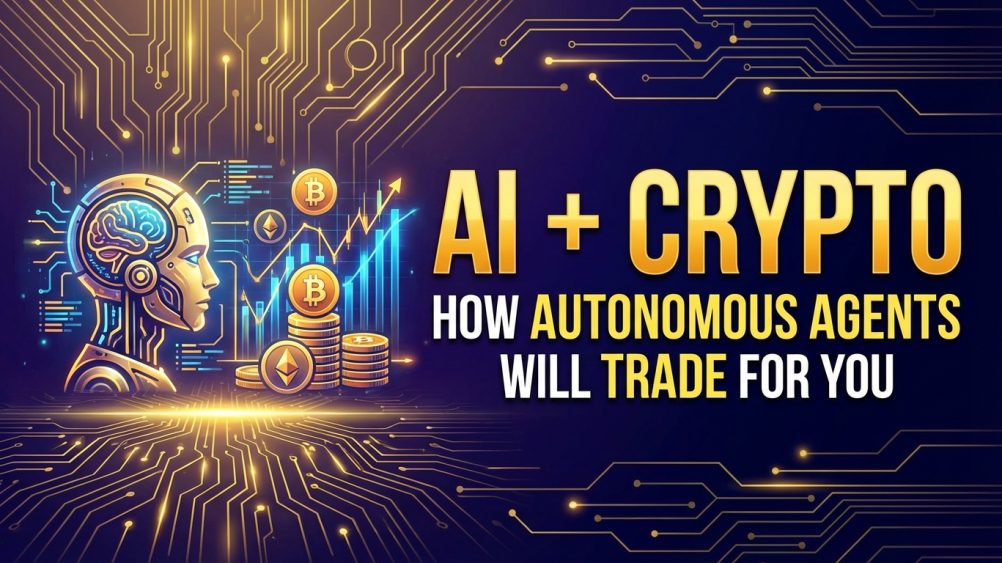
Crypto never closes, and that is what makes AI feel so relevant to this market. Prices move without pause, sentiment changes fast, and opportunities rarely wait for human attention. In that setting, autonomous crypto trading begins to look less like an experiment and more like a serious shift.
Not because machines are flawless, but because crypto rewards speed, consistency, and constant monitoring. Still, the real question is not whether AI will trade faster than people. It is whether AI can become a tool for capital allocation, while humans continue to define the limits of risk, judgment, and control.
Crypto may be the first market where that balance is tested in real time, which is exactly why it has become the most natural place to examine how autonomous agents may trade for you.
What “Autonomous Trading” Really Means
Autonomous trading is more than automation. A basic bot follows instructions.
An autonomous agent reads conditions, makes a choice, executes the trade, and keeps adjusting as the market changes.
That means it is not limited to one preset trigger. It can weigh several inputs at once and respond without waiting for constant human direction. In crypto, that matters because conditions can change in minutes, not hours.
A system moving toward autonomous trading may be able to:
- Read price action and liquidity
- Track volatility and order flow
- Connect to a wallet or exchange
- Open or close positions
- Adjust exposure when risk rises
- Cut losses or lock in gains
The key difference is simple.
Automation executes a command. Autonomy makes a decision.
That does not mean the agent is fully independent in every sense. Humans still set the rules, limits, and risk boundaries. But once those boundaries are in place, the agent can act inside them with far less day-to-day input.
From Trading Bots to Autonomous Agents
Crypto trading did not begin with autonomous systems. It began with trading bots built to follow clear instructions.
- A trading bot can buy, sell, rebalance, or react to preset signals. It is fast, consistent, and useful when the market behaves as expected.
But that is also its limit. A trading bot can execute a strategy, but it cannot rethink one.
- That is where autonomous agents begin to stand apart. Instead of repeating the same playbook, autonomous agents can learn from market behavior and adjust as conditions change.
They are designed to process several inputs at once, respond to shifts in volatility, and refine decisions using new data. That makes autonomous agents more flexible in a market as unstable as crypto.
The real shift is not just speed. It is the move from fixed execution to adaptive decision-making.
How Autonomous Agents Could Trade for You
An autonomous agent can process more market input than most traders can handle at once. It can monitor price action, sentiment, on-chain flows, liquidity, and exchange activity in real time.
That wider view helps it act with more context. Instead of waiting for one trigger, it can weigh several conditions before making a move.
In practice, an autonomous agent could:
- Enter when conditions align
- Exit when momentum fades
- Reduce exposure when risk rises
- Stay out when signals look weak
- Adjust size during high volatility
That matters because crypto changes fast. A system that can read and react in the same moment has a clear advantage over delayed action.
The aim is not perfect prediction. It is faster, steadier decision-making in a market that never pauses.
That is the promise of autonomous crypto trading. The agent does not just place orders. It helps manage trades inside the limits set by the trader.
Where the Real Edge Comes From
The appeal of autonomous agents is not a perfect prediction. Their real edge comes from how they handle decisions under pressure. They can respond faster than a human trader, monitor markets without stopping, and act without panic or hesitation. That matters in crypto, where even small delays can change the outcome of a trade.
An autonomous agent does not get tired, second-guess itself, or hold a losing position out of hope. It can react to gains and losses with the same discipline, whether the market is calm or chaotic. That is where the advantage becomes clear. The value is not in making magical calls or somehow removing risk from trading.
It is in sharper decision-making at machine speed. That means faster execution, steadier reactions, and more consistent risk control in a market that rarely gives traders time to think twice.
The real strength is not prediction. It is a disciplined action when timing matters most.
Why Crypto Still Breaks the Machine
Even the smartest autonomous agents are still exposed to the kind of chaos crypto produces without warning. They can process data quickly, but they cannot fully escape the market’s structural weaknesses.
A model may work well in normal conditions, then fail when liquidity disappears or volatility spikes beyond anything in its training. That is where speed stops being an advantage and starts becoming a liability.
Black swan events, exchange failures, sudden narrative shifts, and weak liquidity can all break a system that looked reliable only hours earlier. In those moments, an agent may still act fast, but fast execution does not guarantee good judgment.
That is the central weakness of autonomous crypto trading. A machine can react instantly, yet still react to the wrong environment.
Fast systems can still fail fast. And in crypto, failure often arrives before a model has time to adjust.
Will Traders Hand Over Control?
The deeper shift is not really about AI replacing traders overnight. It is about changing what the trader actually does.
Instead of making every entry and exit by hand, people may begin to act more like supervisors. They set the objectives, define the risk limits, and decide how much freedom the system gets.
In that model, the autonomous agent handles execution while the human controls the boundaries. That keeps judgment, accountability, and restraint in human hands, even as more decisions move to machines.
This may be where trading is heading next. Not toward full surrender, but toward a new division of roles.
The trader stops being only an executor and becomes the manager of a system that makes the moves. That may prove more realistic than the idea of AI taking over the entire process alone.
The Future of Trading May Be Agent-Led
The future of trading may not belong to people placing every order by hand. It may belong to traders who know how to work with autonomous agents and guide them well.
The real question is no longer whether AI can assist with trading. It is how far traders will trust machines with capital, timing, and risk in a market built for speed.
In that sense, autonomous crypto trading may become less about replacement and more about supervision, control, and smarter delegation.
Disclaimer: This article is for informational and educational purposes only and should not be considered financial or investment advice. Cryptocurrency markets are volatile and involve risk.
Post Disclaimer
The information provided on Financepdia.com is for educational and informational purposes only and should not be considered financial, investment, or trading advice. Cryptocurrency and financial markets are highly volatile and involve significant risk. Readers should conduct their own research (DYOR) and consult with a qualified financial advisor before making any investment decisions. Financepdia.com and its authors are not responsible for any financial losses resulting from actions taken based on the information provided on this website.