





In 2026, choosing a crypto exchange isn’t set up work. It’s a trading edge that affects cost, speed, and control. Spot trades can quietly lose money to spreads and weak execution. Futures trades can bleed through funding, slippage, and liquidation risk.
Staking yields can shrink after lockups, fees, and platform cuts. Most CEX vs DEX guides compare features and ignore real outcomes.
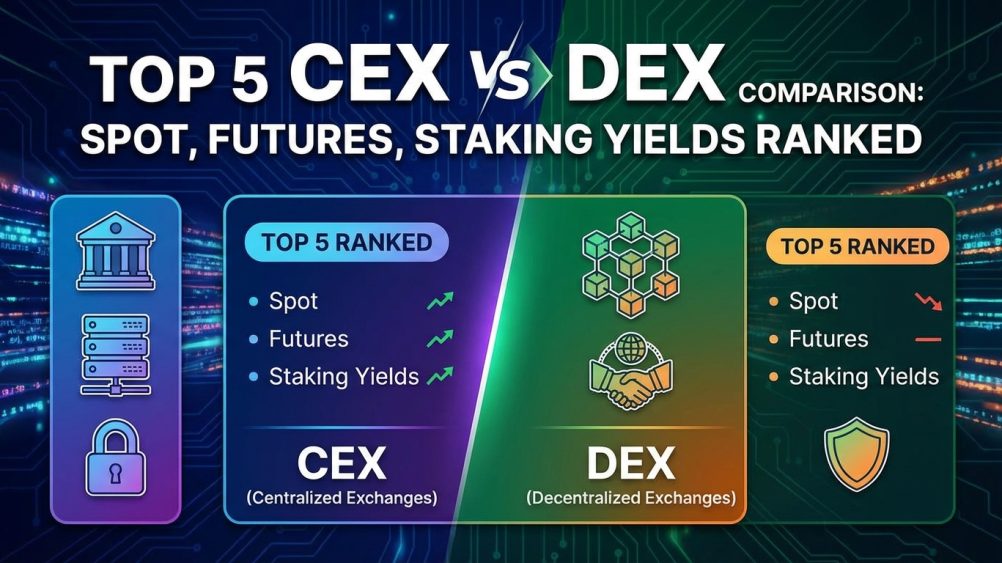
This guide delivers a top 5 CEX vs DEX comparison built for platform selection. First, we compare CEXs and DEXs across Spot, Futures, and Staking Yields. Each section focuses on measurable factors that impact results. Then we rank the top 5 platforms using one scoring model.
You’ll get clear winners for spot execution, perp trading, and yield quality. Use the rankings to pick the best exchange for your goals.
Safety: CEX vs DEX
Safety is paramount in crypto because hacks and scams can wipe out funds. CEXs and DEXs sit on top of blockchain infrastructure, but their custody models differ. Here’s how these stack up in 2026, with verified examples.
CEX Safety
Strengths: Major CEXs strengthened controls after major industry failures. They rely on managed custody, security teams, and account protections like MFA and withdrawal allowlists. Some also publish Proof of Reserves style attestations, and some hold emergency funds for incident response. Cold-storage custody remains a core protection in large venues.
Risks: CEXs are custodial, meaning the exchange holds keys for on-platform balances. This creates a single point of failure for attackers and insiders. It also introduces insolvency and withdrawal-freeze risk during stress events.
2026 examples:
- In January 2026, BtcTurk halted withdrawals after reports of a $48M multi-chain hot wallet hack. The incident highlighted ongoing CEX custody exposure.
- In February 2026, Bithumb mistakenly credited 620,000 BTC in a “phantom Bitcoin” internal error. The mistake triggered a regulator probe and raised internal control concerns.
DEX Safety
Strengths: DEXs are non-custodial, so users trade from wallets and retain key control. There is no central operator that can freeze balances across accounts. On-chain execution improves transparency and auditability, and most DEXs avoid KYC.
Risks: Smart contract bugs can drain pools and user approvals. Permissionless listings enable fake tokens and rug pulls. Wallet phishing and bad approvals cause irreversible losses, and there is no formal recovery support.
2026 examples:
- In January 2026, a SwapNet smart-contract exploit drained up to $13.3M from Matcha Meta users. Matcha Meta urged users to revoke approvals tied to the SwapNet router.
- In January 2026, Saga paused its SagaEVM chainlet after a $7M exploit that hit its ecosystem. The incident showed how contract exploits can force emergency pauses and liquidity stress.
Performance: Speed, Liquidity, and Usability
Performance decides how efficiently you trade. Speed affects fills and slippage. Liquidity affects spread and price impact. Usability affects errors and friction. Here’s the 2025 comparison.
CEX Performance
Speed: CEXs match orders off-chain using order books. This enables fast fills during normal conditions. It also reduces confirmation delays seen on-chain.
Liquidity: CEXs usually have deeper books on major coins. Higher depth reduces slippage on large orders. In February 2026, Coinbase reported a brief disruption where some customers could not buy, sell, or transfer crypto. The issue was attributed to a technical problem, not trading volume.
Usability: CEXs support fiat deposits and withdrawals. Interfaces are familiar to new users. Support channels exist for account access issues. KYC is required on most major platforms.
DEX Performance
Speed: DEX trades settle on-chain or on an L2. Execution speed depends on block time and congestion. Confirmation delays vary by network conditions.
Liquidity: DEX liquidity depends on each pool and token pair. Thin pools cause higher price impact and slippage. As of March 2026, CoinGecko tracked 1,158 DEXs with about $9.3B in total 24h trading volume. CoinGecko also showed DeFi volume dominance near 6%, which reflects thinner liquidity than top CEXs.
Usability: DEX use requires a wallet, gas, and token approvals. Mistakes are harder to reverse. Direct customer support is usually absent.
Verdict: CEXs usually win for speed, liquidity, and beginner usability. DEXs compete well on liquid pools and L2 venues. DEXs also win on self-custody control.
Profitability: Spot, Futures, and Staking Yield Quality
This section mirrors the three pillars. Profitability here means net results after all costs.
A) Spot profitability
CEX spot cost is not only the trading fee. Spread, execution quality, and withdrawals affect the total. In cryptocurrency trading, all-in cost matters more than headline fees.
DEX spot cost includes more layers. You pay the pool fee and network gas. You also face slippage and price impact. Approvals can add cost and risk. Small trades can be gas-heavy on busy chains. Large trades can be slippage-heavy on thin pools.
Spot checklist
- Check maker and taker fees.
- Check the typical spread on your pair.
- Estimate slippage at your order size.
- Include gas and approval overhead.
B) Futures and perps profitability
Maker and taker fees matter for active traders. Funding often matters more for held positions. Funding can flip with market bias. Liquidation mechanics shape tail-risk outcomes. Liquidity under stress decides the exit cost. Slippage on forced exits can be severe.
Perps checklist
- Compare fee tiers and rebates.
- Track typical funding on your markets.
- Review margin modes and liquidation rules.
- Prefer deeper books for large position sizes.
C) Staking yields profitability
Staking APY is not the final yield. Net yield equals rewards minus all cuts. Lockups and unbonding delays carry opportunity cost. Custody choice changes risk exposure. Claim rules can add friction and missed compounding.
Yield quality checklist
- Identify the reward source and payout asset.
- Check lockup and unbonding time.
- Check the platform cut and validator commission.
- Evaluate custody and withdrawal conditions.
Verdict
CEXs fit predictable costs at scale and mainstream tools. DEXs can offer higher upside through access and DeFi routes. DEXs also require stricter risk controls from users.
Quick Snapshot & Scoring Method
The table sets the comparison before the rankings. It keeps the ranking accountable.
| Platform | Type | Spot cost drivers | Futures cost drivers | Staking and yield drivers |
| Binance | CEX | Low fees, deep books, spread varies by pair | Deep perps menu, fees vary by tier, funding matters | Earn products, custody risk, terms vary by asset |
| Kraken | CEX | Competitive fees, strong fiat rails in many regions | Solid derivatives in some regions, risk tools matter | Staking options, custody, and availability vary |
| Coinbase | CEX | Higher retail costs, strong UX, and spread can be higher | Derivatives access varies; fees can be higher | Staking simple; net yield depends on cuts |
| Uniswap | DEX | Pool fee + gas + slippage, strong for liquid ERC pairs | Not a perp’s venue, spot only focus | LP yield possible, IL risk applies |
| dYdX | DEX | Not primary for spot, focus is perps | Perps-first, fees, and funding drive net results | Staking is tied to protocol economics, self-custody |
Scoring method
Spot (35) + Futures (35) + Staking Yield Quality (20) + Safety (10) = 100. It’s the weighting formula used to turn your comparison into a single 100-point ranking.
- Spot scoring inputs
Fees, spreads, execution, withdrawals, and friction.
- Futures scoring inputs
Fees, funding transparency, liquidity, and risk tooling.
- Staking scoring inputs
Net yield clarity, lockups, cuts, and custody exposure.
- Safety scoring inputs
Custody risk, user-risk burden, and failure modes.
Rankings: Top 5 Overall and Category Winners
Scores reflect the scorecard above. They target typical use-cases in 2026.
Overall ranking
1) Binance: 86/100
Spot 30, Futures 34, Yield 14, Safety 8.
- High liquidity supports better execution for many pairs.
- Futures depth supports active trading and risk tools.
- Best for: active traders who use spot and perps.
2) Kraken: 80/100
Spot 28, Futures 26, Yield 18, Safety 8.
- Strong security posture and clear controls help beginners.
- Competitive spot fees and usable interfaces support steady trading.
- Best for: safety-first users and steady spot traders.
3) Coinbase: 74/100
Spot 24, Futures 18, Yield 20, Safety 12.
- Simple UX reduces errors for new users.
- Costs can be higher on retail flows.
- Best for: beginners who value simplicity and compliance.
4) dYdX: 72/100
Spot 10, Futures 34, Yield 20, Safety 8.
- Perps-first design suits derivatives-focused users.
- Users must manage keys and wallet security.
- Best for: perp traders who accept self-custody workflows.
5) Uniswap: 68/100
Spot 30, Futures 0, Yield 28, Safety 10.
- Strong spot access for many tokens on supported chains.
- Gas and slippage drive the total cost for many users.
- Best for: self-custody spot access and selective LP strategies.
Category winners
- Best for Spot: Binance or Uniswap, depending on your trade size.
Binance fits majors and frequent trades with low friction.
Uniswap fits self-custody and long-tail token access.
- Best for Futures/Perps: Binance or dYdX.
Binance fits broad contract menus and deep liquidity.
dYdX fits self-custody perps users with L2 comfort.
- Best for Staking Yields: Coinbase or Kraken for simplicity.
Uniswap can outperform via LP yield, with IL risk.
dYdX staking can fit protocol-aligned users.
This is the ranked core of the top 5 CEX vs DEX comparison.
Which Should You Choose in 2026
Choose based on your goal. If you are spot-first and new, pick the Spot winner with simple fiat rails. If you trade futures, pick the Futures winner with deep liquidity and reliable execution. If you hold for yield, pick the platform with the best yield quality and clear lockups.
A hybrid approach works well for many users. Use a CEX for fiat entry and major coin liquidity. Use a DEX for self-custody access and niche tokens. Move funds only when needed and plan withdrawals in advance.
For safety, enable 2FA and withdrawal allowlists on CEX accounts. Avoid keeping all funds on the exchange. On DEXs, use a hardware wallet and verify token addresses. Review approvals and watch gas costs before signing transactions.
The Bottom Line
There is no single best exchange for every user. Your goal decides the right venue for spot, futures, or staking. This guide compared CEXs and DEXs first, then ranked the top 5 for clear selection.
Use the winners to match your trade size, cost tolerance, and custody preference. A CEX vs DEX comparison is most useful when you measure real costs, not headlines. Start small, track fees and slippage, and adjust as you gain experience.
Disclaimer: This content is for informational purposes only and should not be considered financial or investment advice. Always do your own research before trading or investing in cryptocurrencies.
Post Disclaimer
The information provided on Financepdia.com is for educational and informational purposes only and should not be considered financial, investment, or trading advice. Cryptocurrency and financial markets are highly volatile and involve significant risk. Readers should conduct their own research (DYOR) and consult with a qualified financial advisor before making any investment decisions. Financepdia.com and its authors are not responsible for any financial losses resulting from actions taken based on the information provided on this website.