






Why does one person get approved for a low-interest loan in minutes, while another gets rejected without a clear reason? In most cases, the difference is their credit score. Your credit score is a three-digit number that shows how responsibly you handle borrowed money. Lenders use it to judge risk before approving loans or credit cards. It reflects your payment history, how much of your available credit you use, and how steadily you manage debt.
It does not measure your income, job title, or savings. It focuses only on your credit behavior, which is summarized in your credit report and evaluated using a credit scoring model such as FICO Score or VantageScore.
Scores usually range from 300 to 850. Higher scores signal lower risk and often unlock better rates and approvals. Your score changes with your habits. Paying on time helps. High balances and missed payments hurt. What matters most is consistent behavior over time. Now that you understand what a credit score actually is, let’s look at what truly makes it rise or fall.
How Credit Scores Are Calculated (The 5 Core Factors)
Your credit score is not pulled out of thin air. It is calculated using five specific factors, and each one plays a clear role in shaping your number.
- Payment history carries the most weight. Lenders look at whether you pay your bills on time. Late payments, collections, and defaults can lower your score quickly because they signal higher risk.
- Credit utilization is the second major factor. This is the percentage of your available credit that you are using. If you have a $10,000 limit and carry a $5,000 balance, you are using 50%. Lower usage generally helps your score.
- Length of credit history shows stability. Older accounts with steady activity build trust.
- Credit mix considers the types of credit you manage, such as credit cards, auto loans, or mortgages.
- New credit and hard inquiries reflect recent applications. Multiple applications in a short period can signal risk.
Lenders rely on this score to decide loan approvals, interest rates, credit limits, rental approvals, and even certain background checks. A stronger score gives you leverage and better financial terms.
What Really Matters
Payment History: The Single Most Important Factor
If there is one area you cannot afford to ignore, it is payment history. This factor carries the most weight in your credit score calculation. Lenders review whether you paid at least the minimum amount by the due date. A payment that is 30 days late or more can be reported as a delinquency, which can lower your score.
More severe delays, such as 60 or 90 days late, cause greater damage and may lead to default status. Negative marks can remain on your credit report for up to seven years under the Fair Credit Reporting Act (FCRA). The impact fades over time, but the record stays. Consistent, on-time payments build long-term credibility.
Credit Utilization: The Second Biggest Lever
Credit utilization measures how much of your available credit you are using. It is calculated as a percentage. If your total credit limit is $5,000 and your balance is $1,500, your utilization is 30%. Staying below 30% is important for maintaining a healthy score.
Staying closer to 10% shows stronger control. High balances, even when paid on time, can lower your score because they signal higher risk.
Length Of Credit History: Why Time Works In Your Favor
Your score considers the age of your oldest account and the average age of all accounts. Older accounts demonstrate stability. Closing a long-standing credit card can reduce your average account age and lower your score. Time and steady management strengthen your profile.
Stability And Consistency Over Short-Term Moves
Credit scoring models reward steady behavior. Frequent account openings, balance spikes, or sudden closures can create instability. Reliable patterns carry more weight than temporary strategies. Building credit is a long-term process.
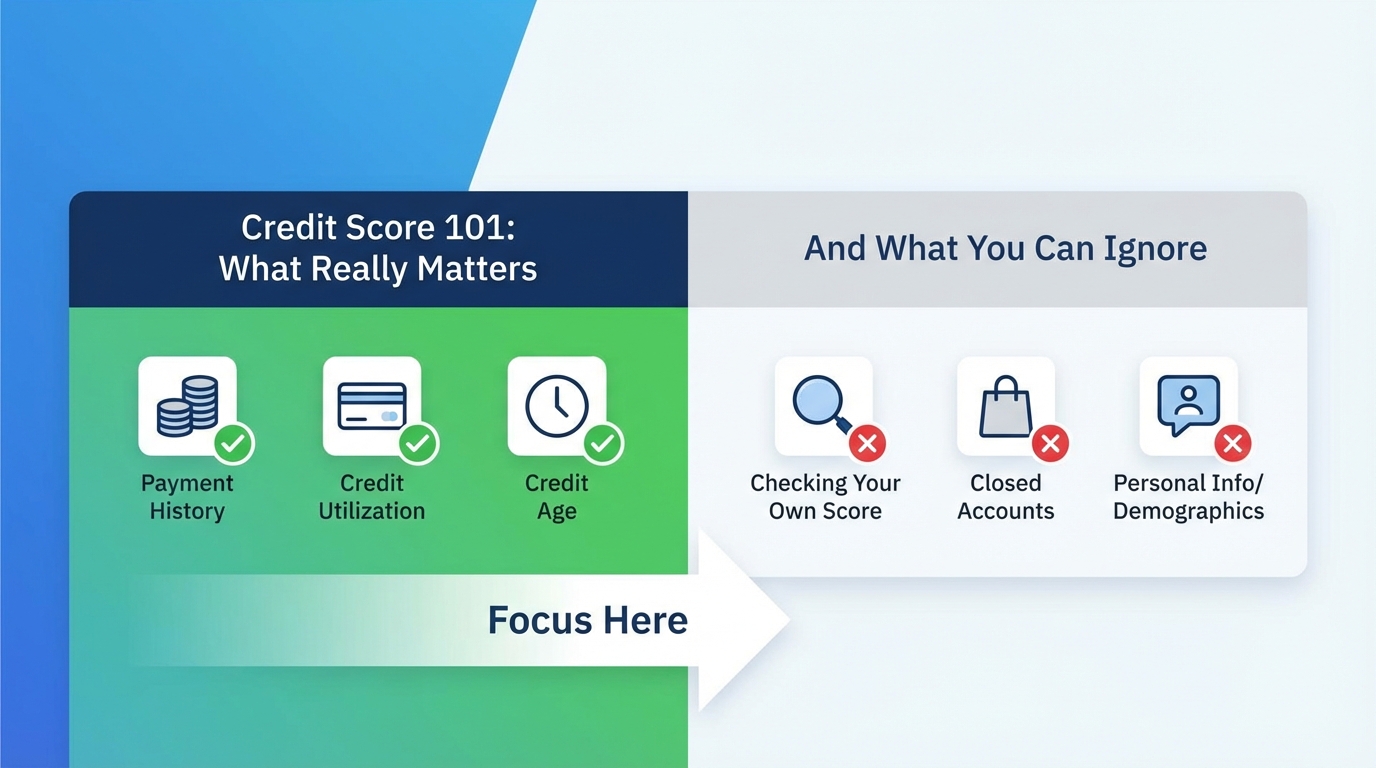
If You Only Focus On Three Things
To simplify your approach, prioritize these habits:
- Never miss a payment.
- Keep your credit utilization low.
- Maintain older accounts whenever possible.
These actions drive most of your score and remove unnecessary guesswork.
What You Can Ignore
Many people lose points in their own mind before they ever lose them on paper. Credit advice online often sounds urgent, but not every warning deserves your attention. Knowing what to ignore protects your focus and reduces unnecessary stress.
Checking Your Own Credit Score
Reviewing your own credit report creates a soft inquiry. Soft inquiries do not affect your score. You can check your score as often as you like without damage. In fact, regular monitoring helps you catch errors early.
Carrying A Balance To “Build Credit”
You do not need to carry a balance to improve your score. Paying your statement in full still counts as positive activity in your payment history record. Interest charges do not strengthen your credit profile. Responsible use matters more than revolving debt.
Income Level
Your salary is not included in credit score calculations. Credit scoring models evaluate behavioral data, not income verification. A higher income may influence debt-to-income ratio (DTI) during loan underwriting, but it does not directly raise your score.
Small Score Fluctuations
Changes of 5 to 10 points are normal. Balances update monthly, and minor shifts reflect normal activity. Focus on trends, not small swings.
Occasional Hard Inquiries
A single hard inquiry may lower your score slightly, often by only a few points. The effect is usually temporary. Multiple applications in a short period matter more than one.
Credit Mix Obsession
You do not need every type of loan to build strong credit. Opening unnecessary accounts adds risk without real benefit. Solid payment history and low balances carry far more weight.
A Simple Framework to Evaluate Your Own Credit Health
If you want clarity about your credit, you do not need advanced tools. You need a focused checklist. Most strong credit profiles share three clear traits. When these areas are healthy, your score usually reflects it. When one area weakens, your score responds. This framework keeps your attention on the factors that carry real weight.
1) Payment Discipline
- Are you 100% on time with every payment?
- Have you avoided any 30-day late reports?
- Are automatic payments set up for key accounts?
Payment history is the largest scoring factor. A single reported late payment can remain on your record for up to seven years. Consistent, on-time payments build measurable trust.
2) Utilization Control
- Is your total credit usage below 30% of your limits?
- Are you closer to 10% or lower for stronger positioning?
Utilization is calculated as a percentage of your available credit. Lower balances show financial control and reduce perceived risk.
3) Stability
- Are your oldest accounts still open and active?
- Is your average account age increasing over time?
Long-standing accounts signal reliability. Stability strengthens your profile and supports long-term growth.
How To Improve Your Credit Score Step By Step
Improving your credit score is not about luck. It is about following clear steps in the right order. When you focus on actions that directly affect scoring factors, results become easier to track. This plan is practical and direct. Each step targets a specific part of your credit profile. Follow it consistently, and you create steady improvement instead of short-term spikes.
Step 1: Pull Your Credit Report
- Request your report from the three major credit bureaus: Experian, Equifax, and TransUnion.
- Review every account, balance, and payment record carefully.
- Check for errors, duplicate accounts, or unfamiliar activity.
Accurate information is the foundation of a strong score.
Step 2: Identify Late Payments
- Look for any 30, 60, or 90-day late payments.
- Confirm whether each mark is correct.
- Dispute inaccuracies promptly through the reporting bureau.
Payment history carries the most weight, so accuracy is critical.
Step 3: Reduce High Balances
- Focus on accounts above 30% utilization.
- Prioritize paying balances down toward 10% or lower.
- Consider mid-cycle payments to lower reported balances.
Lower utilization can lead to noticeable improvement within a few months.
Step 4: Set Autopay
- Enable automatic payments for at least the minimum due.
- Choose a payment date before the deadline for safety.
This protects your payment history from avoidable mistakes.
Step 5: Monitor Monthly
- Review balances and payment activity each month.
- Track utilization levels and new inquiries.
- Adjust spending if balances begin to rise.
Consistent monitoring keeps progress steady and prevents setbacks.
Why Understanding What To Ignore Reduces Financial Stress
Worry often comes from misunderstanding how credit scoring works. When you know what truly matters, you stop reacting to every small change and start focusing on steady progress. That shift alone reduces financial pressure and builds control.
Score fluctuations are normal. Changes of 5–10 points can happen when balances update each month. Small dips do not signal long-term damage.
You do not need a perfect 850. Scores in the upper 700s already qualify for competitive rates in most lending decisions.
Lenders review ranges, not exact numbers. Moving into a stronger bracket matters more than minor point increases.
Consistency beats quick fixes. On-time payments and low balances drive lasting results.
When you focus on patterns instead of perfection, your confidence grows and stress decreases.
How Credit Scores Impact Loans, Credit Cards, And Rates
Your credit score directly affects what lenders offer you. It influences approvals, interest rates, and credit limits. Even a small move between score ranges can change the cost of borrowing.
- Score ranges drive decisions. Scores above 760 often qualify for the lowest rates, while scores below 650 face higher interest and tighter approval standards.
- Higher scores reduce total loan costs. A lower rate can save thousands over the life of a mortgage or auto loan.
- Strong credit increases flexibility. It improves approval odds, raises borrowing limits, and gives you better negotiating power with lenders.
Summing Up
Why does one person get approved for a low-interest loan in minutes, while another gets rejected without a clear reason? The answer is rarely income or luck. It is usually a stronger credit profile built over time.
Your credit score rewards measurable behavior. On-time payments carry the most weight. Low credit utilization strengthens your position. Older accounts add stability. These are not theories. They are the core drivers behind lending decisions.
You need consistent habits. Small fluctuations are normal. What lenders watch is your long-term pattern. When you focus on what truly matters and ignore distractions, your progress becomes steady and predictable. Strong credit is built through discipline, and discipline creates financial opportunity.
Disclaimer: This content is for educational and informational purposes only and does not constitute financial advice. Always consult a qualified financial professional before making credit decisions.
Post Disclaimer
The information provided on Financepdia.com is for educational and informational purposes only and should not be considered financial, investment, or trading advice. Cryptocurrency and financial markets are highly volatile and involve significant risk. Readers should conduct their own research (DYOR) and consult with a qualified financial advisor before making any investment decisions. Financepdia.com and its authors are not responsible for any financial losses resulting from actions taken based on the information provided on this website.