






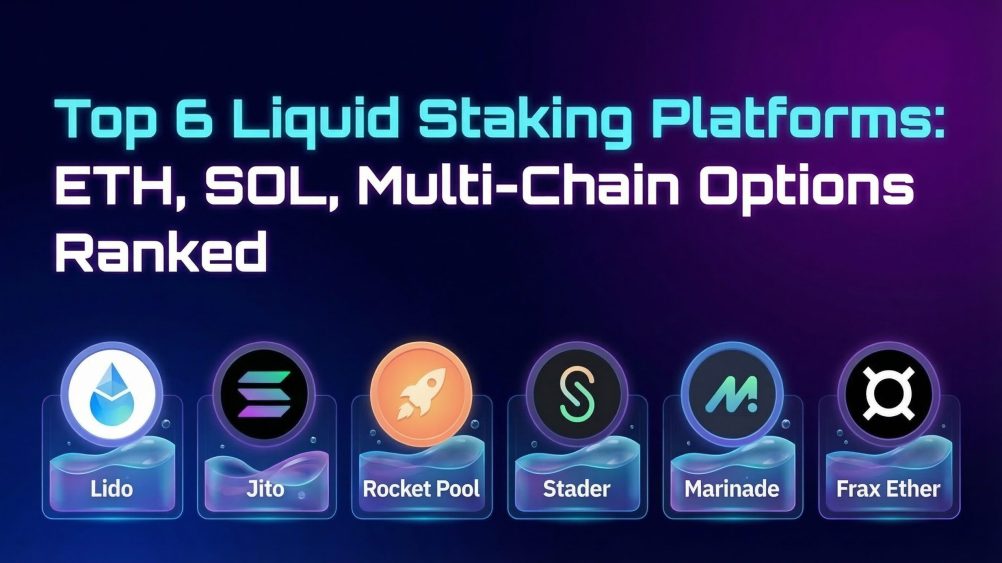
Do you know that the Liquid staking platforms stay popular with DeFi yield hunters for one clear reason?
Because they let capital earn staking rewards while the same capital can still move across lending, liquidity pools, and other on-chain plays. That matters in a market where idle assets often mean missed yield. As a result, liquid staking remains one of the most watched parts of DeFi.
This comparison ranks the best liquid staking platforms for ETH, SOL, and multi-chain staking based on liquidity, DeFi use, decentralization, token design, and chain focus. The list keeps the scope tight. It sticks to platforms that already matter for crypto staking rewards and liquid staking tokens. Meanwhile, yield hunters who like both steady yield and higher-risk upside often also track side themes such as IPO Genie.
Quick Comparison Table
| Rank | Platform | Main Chain Focus | Liquid Token | Best Fit | Key Strength |
| $1 | Lido | Ethereum | stETH / wstETH | ETH DeFi users | Deep liquidity and wide DeFi support |
| $2 | Jito | Solana | JitoSOL | SOL yield hunters | MEV-linked rewards and strong Solana use |
| $3 | Rocket Pool | Ethereum | rETH | Decentralization-focused ETH stakers | Permissionless node model |
| $4 | Marinade | Solana | mSOL | SOL users who want a validator spread | Automated validator delegation |
| 5 | Stader | Multi-chain | ETHx, MATICx, BNBx, and more | Users who want a chain choice | Broad chain coverage |
| 6 | Frax Ether | Ethereum | frxETH / sfrxETH | Advanced ETH DeFi users | Strong fit for DeFi rotation |
1. Lido
Lido stays the top pick for Ethereum liquid staking. When ETH is staked through the protocol, holders receive stETH, which stays liquid and can move across DeFi. Lido’s docs also state that staked tokens can be used across a range of DeFi apps, and the protocol runs separate staking pools for supported networks. Its site highlights stETH, 100+ integrations, and 800+ operators.
That mix gives Lido the strongest all-around position in this ranking. However, the main edge is not only size. The bigger edge is liquidity depth. For yield hunters, that usually means easier entry, easier exit, and more places to park liquid staking ETH. Therefore, Lido ranks first for users who want the most battle-tested ETH staking route with broad DeFi support.
2. Jito
For Solana liquid staking, Jito is one of the strongest choices. Jito says stakers can stake any amount of SOL, keep liquidity, and receive auto-compounding rewards enhanced by MEV through JitoSOL. Its docs also point to reward distribution mechanics and validator selection methods.
That MEV angle gives Jito a clear identity. In other words, Jito is not only a staking token. It is also a yield product shaped by Solana’s trading flow. That makes it very attractive for SOL staking rewards hunters who care about extra basis points. Still, the trade-off is chain focus. Jito is a strong Solana staking platform, not a multi-chain hub.
3. Rocket Pool
Rocket Pool remains one of the clearest choices for users who value decentralized ETH staking. Its docs describe the protocol as community-owned, decentralized, trustless, and open to users staking with as little as 0.01 ETH through rETH. The same docs also stress support for node operators, which matters for decentralization.
That structure gives Rocket Pool a different appeal from Lido. By contrast, Rocket Pool stands out less for raw scale and more for its permissionless node model. For ETH holders who care about validator spread and protocol design, that matters a lot. So, Rocket Pool takes third place because it fits a more specific user profile, yet it stays one of the best liquid staking protocols on Ethereum.
4. Marinade
Marinade is a major name in Solana staking. Its docs say users can stake SOL natively or through liquid staking for mSOL, and both routes use the same validator delegation logic. Marinade also says the protocol delegates stake across a selected validator set and pays rewards every epoch.
That makes Marinade a smart option for users who want validator distribution as part of their staking thesis. At the same time, mSOL has a known place across Solana DeFi, which supports lending and liquidity strategies. Even so, Marinade ranks below Jito because Jito has a stronger MEV-linked yield angle for pure yield hunters right now.
5. Stader
Stader earns its place because it covers more than one chain. Its platform pages state support for Ethereum, Polygon, BNB Chain, Hedera, and more, with liquid staking products such as ETHx and other chain-specific tokens.
That chain spread matters for users who do not want all staking exposure on one network. As a result, Stader is the most useful pick in this list for multi-chain staking. It may not dominate one single chain the way Lido or Jito does. Yet, for portfolio flexibility, it fills a different role and does it well.
6. Frax Ether
Frax Ether is a strong fit for more active DeFi users. Frax docs explain that frxETH acts as the base ETH-pegged asset, while sfrxETH is the yield-bearing version that receives validator profit.
That dual-token design gives advanced users more ways to rotate between liquidity and staking yield. For that reason, Frax Ether works well inside complex DeFi stacks. It ranks sixth only because it is more niche than the names above. Still, for skilled ETH users, it stays one of the more interesting liquid staking ETH plays in the market.
What Matters Most When Ranking Liquid Staking Platforms
The ranking is not about hype. It is about usable yield. The key filters are token liquidity, DeFi integrations, validator design, chain support, and reward structure. Also, risk still matters.
- Smart contract risk,
- validator risk,
- peg drift,
- and liquidity crunches can all hit returns.
That is why the best platform often depends on the asset first. For ETH, Lido and Rocket Pool stay near the front. For SOL, Jito and Marinade lead the field. For multi-chain exposure, Stader has the clearest case.
Which Platform Wins for Yield Hunters?
For pure ETH liquid staking, Lido is still the safest first stop in this ranking because of its liquidity and DeFi reach. For Solana liquid staking, Jito has the sharper edge for yield-focused users due to its MEV-linked design. For broader chain access, Stader offers the best spread.
Meanwhile, smart yield hunters rarely look at one lane only. Many keep liquid staking as the lower-risk yield layer, then watch higher-upside themes on the side. Still, inside the staking lane alone, the six platforms above are the ones that deserve the closest look today.
Disclaimer: This article is for informational purposes only and does not provide financial, investment, or legal advice. Crypto, DeFi, and liquid staking carry risk, and readers should do their own research before making any decision.
Post Disclaimer
The information provided on Financepdia.com is for educational and informational purposes only and should not be considered financial, investment, or trading advice. Cryptocurrency and financial markets are highly volatile and involve significant risk. Readers should conduct their own research (DYOR) and consult with a qualified financial advisor before making any investment decisions. Financepdia.com and its authors are not responsible for any financial losses resulting from actions taken based on the information provided on this website.