



Ever wished you could bet on Bitcoin without a deadline? Without rolling contracts every month? Without buying the coin itself?
That wish became real in May 2016. A small team at BitMEX built something new. They called it the perpetual swap. A futures contract with no expiration date.
You could hold it 5 minutes or five months. Longs profit when the price rises. Shorts profit when it falls. No settlement date. No rollovers.
It did not catch fire overnight. But perps soon became crypto’s most traded product. By late 2025, they made up over 90% of global crypto derivatives volume. Roughly $80 billion changed hands every day.
That growth came with a cost. In 2025, traders lost $154 billion to forced liquidations. That averages $400 to $500 million wiped daily.
This guide covers how perps work and what can go wrong.
Key Takeaways
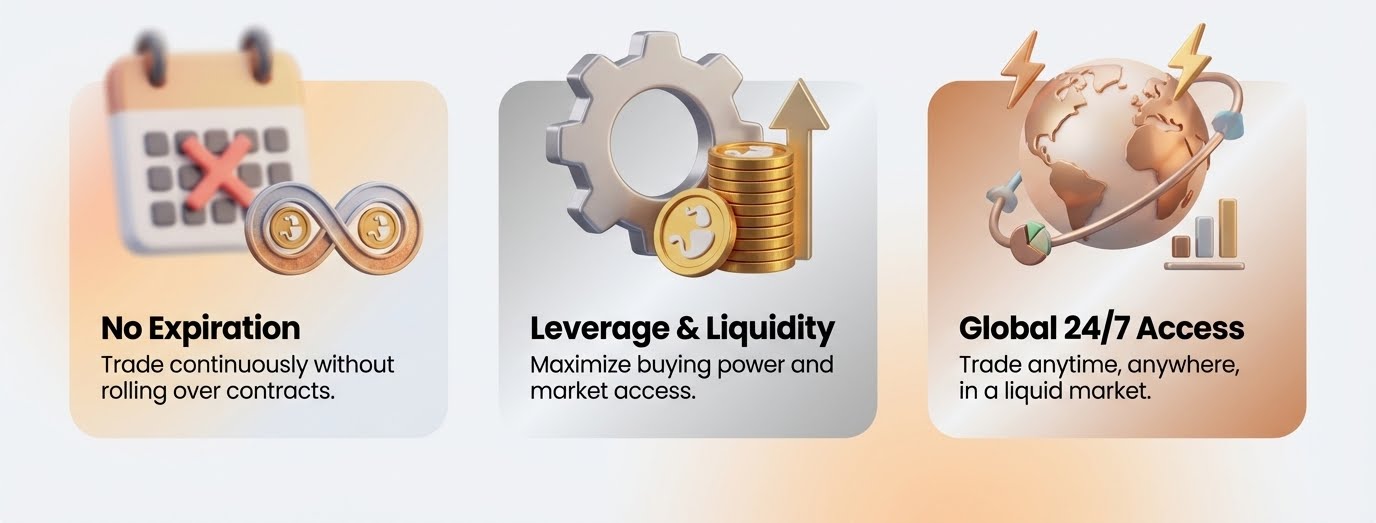
- No expiration date. Hold a position as long as you want. No monthly rollovers needed.
- Funding rates keep prices honest. Every few hours, one side pays the other to anchor perp prices to spot.
- Leverage cuts both ways. Exchanges offer 100x or even 125x leverage. Small moves can wipe you out.
- Perps dominate crypto volume. Top 10 exchanges processed $84.2 trillion in perp volume in 2025.
- U.S. regulation arrived in 2025. Coinbase launched the first CFTC-regulated perps on July 21, 2025. Cboe followed in December.
What Is a Perpetual Futures Contract?
A regular futures contract has an end date. On that date, you settle or close your position.
A perpetual futures contract removes that end date. You hold your trade open as long as you want.
Perps are cash-settled. You never own the actual Bitcoin. You bet on price direction. Go long if you expect a rise. Go short if you expect a drop.
Most perps trade 24/7. Traditional futures close on weekends. Perps do not.
Economist Robert Shiller proposed perpetual futures in 1992. Nobody built a working version until crypto came along. Alexey Bragin created the first inverse perpetual in 2011. BitMEX launched its perp swap on May 13, 2016. That is the version that caught on globally.
How Funding Rates Work
Without an expiration, there is no natural price anchor. Funding rates solve that problem.
Every few hours, one side pays the other. Direction depends on perp price versus spot price.
If the perp trades above spot, too many people are long. Longs pay shorts. That nudges the price back down.
If the perp trades below spot, shorts pay longs. Same idea, reversed.
Quick example from Britannica: funding rate is 0.06%. A $100,000 long position pays $60 to the short side. This happens every eight hours on most exchanges.
Exchanges do not collect this fee. It flows between traders. Think of it as a built-in balancing system.
Leverage: The Risk Multiplier
Leverage makes perps popular. It also makes them dangerous.
With 10x leverage, you control $10,000 using $1,000. A 5% gain nets you $500. That is a 50% return on your deposit.
But a 5% drop costs you $500 too. A 10% move wipes your margin completely. The exchange closes your position. That is liquidation.
Some offshore exchanges offer 100x leverage. At that level, a 1% move triggers liquidation.
| Leverage | Margin for $10,000 Position | Move to Liquidation |
| 2x | $5,000 | ~50% |
| 10x | $1,000 | ~10% |
| 25x | $400 | ~4% |
| 50x | $200 | ~2% |
| 100x | $100 | ~1% |
These are simplified numbers. Actual triggers vary by exchange. Higher leverage means a smaller margin for error.
The $154 Billion Lesson of 2025
The 2025 numbers tell a brutal story. Over $154 billion in forced liquidations hit perp markets, per Coinglass data.
The worst day: October 10, 2025. A geopolitical shock triggered a flash crash. Over $19 billion vanished in hours. Bitcoin dropped roughly 14%. Some altcoins fell 40% to 80%.
About 87% of those were long liquidations. Traders had piled into leveraged bets expecting more upside. When markets flipped, cascading sells fed on themselves.
-
- Hyperliquid processed over $10 billion in liquidations that day.
- Bybit handled $4.65 billion.
- Binance saw $2.41 billion.
The lesson: leverage without risk management is reckless.
Where Perps Trade Today
Perps trade on centralized exchanges (CEXs) and decentralized ones (DEXs).
Binance leads the centralized side. It processed about $25 trillion in perp volume in 2025. OKX and Bybit each held around 21% market share.
On the decentralized side, Hyperliquid dominates. It controls over 60% of on-chain perp market share.
The U.S. market opened in 2025. Coinbase launched CFTC-regulated BTC and ETH perps in July. Cboe followed with its own contracts in December 2025.
U.S. products cap leverage at lower levels than offshore. Regulators want guardrails in place.
Perps Are Spreading Beyond Crypto
Perps are no longer crypto-only. In March 2026, Coinbase launched stock perpetual futures for non-U.S. users. These cover stocks like Apple and Nvidia.
On-chain perp volume on DEXs topped $1.2 trillion monthly in 2025. That pace is growing in 2026.
Hyperliquid even added gold and silver perps. A contract that never expires is finding its way into traditional markets.
FAQs
How are perps different from CFDs?
Both let you bet on price without owning the asset. CFDs are private deals between you and a broker. Perps trade on a public exchange with an order book. Perps use funding rates to track spot prices. CFDs do not.
Can I earn passive income from funding payments?
Some traders hold the “receiving” side of the funding rate. But this is not free money. You still face price risk. If the market moves against you, losses can dwarf your funding income. Pros often hedge with spot holdings to reduce that risk.
What happens to my position during a flash crash?
The exchange does not wait for you. If margin drops below the minimum, liquidation is automatic. Stop-loss orders help but are not foolproof. In thin order books, fills can be much worse than expected. During the October 2025 crash, depth shrank over 90% on some venues.
Sources
- Britannica Money, “Perpetual Futures” https://www.britannica.com/money/perpetual-futures
- Sherwood News, “Perpetual futures grow beyond crypto” https://sherwood.news/crypto/perpetual-futures/
- Chainalysis, “An Introduction to Perpetual Futures” https://www.chainalysis.com/blog/perpetual-futures/
Disclaimer: This article is for informational purposes only. It is not financial advice. Always do your own research.
Post Disclaimer
The information provided on Financepdia.com is for educational and informational purposes only and should not be considered financial, investment, or trading advice. Cryptocurrency and financial markets are highly volatile and involve significant risk. Readers should conduct their own research (DYOR) and consult with a qualified financial advisor before making any investment decisions. Financepdia.com and its authors are not responsible for any financial losses resulting from actions taken based on the information provided on this website.