





Is the Fed Finally Done Hiking? What 2026 Policy Signals Mean for Investors

Is the Fed Finally Done Hiking? What 2026 Policy Signals Mean for Investors

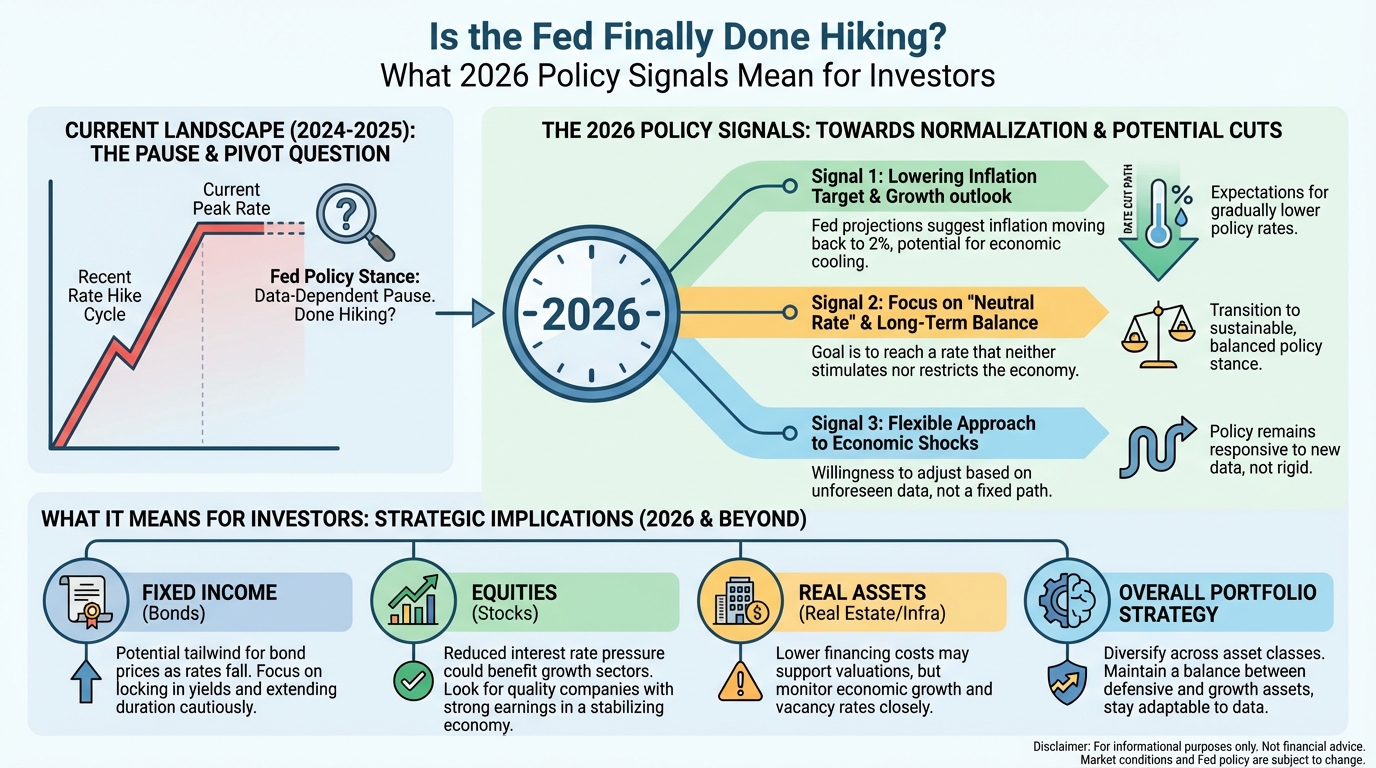
For nearly three years, interest rates dictated the direction of markets. Now in 2026, the tone feels different. The hikes have paused. Cuts are being discussed. But one question keeps resurfacing:

Is the Federal Reserve truly done raising rates?

The answer is not absolute. It is conditional. The Fed appears finished with aggressive tightening, but that does not mean policy risk has disappeared. The path forward depends on inflation, employment, and external shocks that could quickly change expectations.

Where Rates Stand in 2026?

The Federal Funds Rate currently sits around 3.50% to 3.75%, following gradual cuts in late 2025. In early 2026, the Fed chose to hold rates steady, reinforcing that policy remains restrictive.

This is not an easing cycle in full swing. It is a pause.

Officials continue to stress that inflation has improved but is still above the 2% target. That is the anchor. As long as inflation remains above that line, the Fed will move carefully. Markets anticipated faster cuts. The Fed delivered patience.

Inflation Remains the Deciding Variable

Inflation has cooled significantly from its peak, but progress has slowed. Core inflation, particularly in services, remains sticky. Housing costs are easing gradually. Energy prices have been volatile due to global tensions.

The difference between inflation running at 2.3% versus 3% may look small. For policymakers, it is substantial.

If inflation steadily moves closer to target, gradual cuts in late 2026 become more realistic. If inflation stalls or rebounds, the Fed will keep rates elevated. Officials have acknowledged that additional hikes remain possible if inflation reaccelerates.

That probability is low. But it exists.

The Labor Market Is Holding Up

Employment data has not cracked. Job growth has slowed compared to prior years, yet unemployment remains relatively low. Wage growth is cooling but still firm enough to support consumption.

A resilient labor market gives the Fed breathing room. Policymakers do not need to rush into cuts if jobs remain stable. However, a sharp rise in unemployment would shift the conversation quickly.

Right now, the labor market reflects moderation, not weakness. That supports the current holding pattern.

Markets Expect Cuts. The Fed Expects Data.

Futures markets are leaning toward one or two rate cuts in the second half of 2026. Many investors believe slowing growth and easing inflation justify gradual normalization.

The Fed’s message is more restrained. Officials repeat the phrase “data dependent.”

There is no preset timeline. No guarantee of cuts by a specific meeting. Each inflation report and employment release carries weight.

This disconnect between market optimism and Fed caution creates volatility. If inflation surprises higher, expectations will reset quickly.

External Risks Could Change the Outlook

Policy decisions do not exist in isolation.

Oil prices have shown renewed volatility due to geopolitical developments. Sustained increases in energy costs could lift headline inflation again. That would complicate any move toward easing.

Global growth trends also matter. A slowdown abroad could help cool inflation. Stronger global demand could keep price pressures alive.

Leadership transition adds another layer of uncertainty. With Jerome Powell’s term nearing completion, investors are watching closely for signals about the future direction of policy tone.

Uncertainty itself can influence markets.

If the Fed Is Done Hiking

If rate hikes are truly over, the market environment stabilizes.

Bond yields are likely to settle into a range. Longer-duration bonds could benefit if inflation continues easing. Equity valuations face less pressure from rising discount rates. Growth sectors regain breathing space.

Credit markets would also improve. Lower refinancing stress supports corporate balance sheets.

Stability encourages risk-taking.
Is the Fed Finally Done Hiking? What 2026 Policy Signals Mean for Investors

If Another Hike Occurs

If inflation remains stuck above 3% or energy prices surge, the Fed may need to tighten again. Even one additional hike would surprise markets positioned for cuts.

Potential effects include:

  • Equity valuation compression
  • Higher bond yields
  • Increased market volatility
  • Pressure on growth-oriented sectors

This is not the base case. Current data does not demand further tightening. But inflation remains the gatekeeper.

Key Economic Signals to Watch

Rather than predicting meeting outcomes, focus on underlying drivers:

  • Core inflation consistently trending toward 2%
  • Wage growth cooling without collapsing
  • Gradual, controlled rise in unemployment
  • Stable energy prices

These signals will shape policy decisions far more than headlines.

2026 Policy Snapshot

Indicator Current Direction Why It Matters
Core Inflation Moderating but above target Determines timing of cuts
Unemployment Low but inching higher Signals economic resilience
Wage Growth Slowing gradually Impacts services inflation
Oil Prices Volatile Can quickly shift inflation outlook

The pattern is clear. Conditions are improving. Completion has not been declared.

Close to the End, Not Across the Line

So, is the Fed done hiking? Based on current trends, the aggressive tightening phase appears complete. Rates are restrictive. Inflation is easing. The labor market is moderating.

But the Fed is not declaring victory. Inflation remains above target. Global risks persist. Employment remains solid enough to avoid urgency.

The most realistic takeaway is this: The Fed is likely done hiking for now, but not done watching.

Policy in 2026 is about discipline, not celebration. Investors should focus less on guessing the exact timing of the next move and more on tracking the data that drives decisions. The hiking cycle may be ending. The vigilance is not.

And in this environment, awareness is more valuable than certainty.

Frequently Asked Questions

Is The Fed Cutting Rates In 2026?

Rate cuts are possible later in 2026 if inflation continues trending downward. They are not guaranteed.

Could The Fed Raise Rates Again?

Yes. If inflation meaningfully reaccelerates, policymakers have left the door open for additional tightening.

What Sectors Benefit If Hikes Are Over?

Growth stocks, long-duration bonds, and rate-sensitive sectors such as housing and technology typically benefit from rate stability.

What Would Delay Or Prevent Rate Cuts?

Persistent core inflation above target, strong wage growth, or sustained increases in energy prices.

Disclaimer: This article is for informational purposes only and does not constitute investment, financial, or legal advice. Investors should conduct their own research or consult a qualified financial professional before making any decisions.

Post Disclaimer

The information provided on Financepdia.com is for educational and informational purposes only and should not be considered financial, investment, or trading advice. Cryptocurrency and financial markets are highly volatile and involve significant risk. Readers should conduct their own research (DYOR) and consult with a qualified financial advisor before making any investment decisions. Financepdia.com and its authors are not responsible for any financial losses resulting from actions taken based on the information provided on this website.

US Crypto Tax Rules 2026: Track Your IPO Genie Gains Properly

Learn the US crypto tax rules for 2026 and how to track IPO Genie gains correctly. Understand taxable events, cost basis, and new IRS reporting rules.

The win feels great until tax season shows up

You made solid gains on IPO Genie. Watching the numbers go up feels great. But then tax season arrives, and suddenly the questions start piling up.

Where did you buy the tokens?
How much did you pay for them?
Did you swap them anywhere before selling?

Many crypto investors discover too late that profit alone is not enough. The IRS wants proof of how that profit happened. If your trades sit across exchanges, wallets, and token swaps, missing records can turn a clean gain into a stressful filing situation. So here’s the real question: can you clearly show how much you earned and how you calculated that number?

Understanding the U.S. crypto tax rules for 2026 helps you avoid surprises and track your IPO Genie gains the right way.

What Changed In 2026 For U.S. Crypto Taxes?

Crypto taxes did not suddenly appear in 2026. The IRS has already taxed digital assets for years. What changed now is how closely transactions get tracked and reported. Several reporting updates and compliance rules now push investors toward better record-keeping.

Here are the changes that matter most.

1. Exchanges Now Report Crypto Activity Through Form 1099-Da

The biggest shift comes from Form 1099-DA, a new reporting form created specifically for digital asset transactions.

  • Crypto exchanges and brokers must send this form to both you and the IRS.
  • It reports sales and exchanges of digital assets made on the platform.
  • The rule applies to transactions starting January 1, 2025, which means investors begin seeing these forms when filing in 2026

This move gives the IRS clearer visibility into crypto trading activity. The IRS now receives more direct information about your transactions. If the numbers on your tax return do not match exchange reports, questions may follow.

2. Cost Basis Reporting Becomes More Important

Early versions of the reporting system focus mainly on gross proceeds, meaning the amount you received when selling crypto.  But starting with 2026 transactions, brokers will begin including cost basis details, the price you originally paid for the asset. 

That number determines the real taxable gain.

For example:

  • Buy IPO Genie tokens for $4,000
  • Sell them later for $10,000

Your taxable gain = $6,000, not $10,000.

Without proper basis records, the IRS could assume the entire sale amount counts as profit. This is why tracking purchase price matters more than ever.

3. Crypto Still Counts As Property, Not Currency

One rule has not changed:

The IRS treats cryptocurrency as property. That means crypto transactions follow the same general tax rules as other investment assets.

Several common actions can trigger taxes:

  • Selling crypto for cash
  • Swapping one crypto for another
  • Using crypto to buy goods or services

Each of these events can create capital gains or losses. Many investors assume taxes only apply when money hits their bank account. In reality, tax events can happen long before that.

4. The IRS Now Asks Every Taxpayer About Digital Assets

Another important compliance step sits right on the tax return itself.

Every taxpayer must answer a question on their federal return asking whether they received, sold, or exchanged digital assets during the year. That simple yes-or-no question forces investors to acknowledge crypto activity during filing.

Skipping it or answering incorrectly can create problems later if the IRS already has transaction data from exchanges.

5. Broker Reports Do Not Show Everything

Even with improved reporting, exchange forms still miss some information.

For example, a broker may not see:

  • Transfers between wallets
  • Transactions on foreign exchanges
  • DeFi activity without intermediaries 

So even with Form 1099-DA, your own records still matter. Think of exchange reports as a starting point, not the full picture.

Crypto tax rules did not suddenly change overnight. What changed is visibility. More reporting forms, clearer IRS oversight, and stronger documentation requirements mean casual record-keeping no longer works.

If you want to keep your IPO Genie gains clean and easy to report, tracking your transactions carefully is no longer optional.

What Counts As A Taxable IPO Genie Gain?

Many investors believe taxes only apply when they convert crypto into cash. That assumption creates confusion for many traders. In reality, several common crypto activities can trigger a taxable event under U.S. tax rules.

1. Selling IPO Genie Tokens For Dollars

Selling IPO Genie tokens for U.S. dollars or converting them into stablecoins that are later turned into cash usually creates a capital gain or capital loss.

The IRS calculates this gain using a simple formula. It compares:

  • Your purchase price (cost basis)
  • The amount you receive when selling

For example, if you bought IPO Genie tokens for $3,000 and later sold them for $7,000, the taxable gain would be $4,000. That difference becomes the amount used when calculating your crypto tax obligation.

2. Swapping IPO Genie For Another Cryptocurrency

Many investors trade one token for another instead of selling directly for cash. However, this type of transaction can still trigger taxes.

When you swap IPO Genie tokens for another cryptocurrency, the IRS generally treats the transaction as if you sold the first asset and then purchased the second one.

Even though no cash changes hands, the value of the tokens at the time of the swap determines whether you made a gain or a loss.

3. Using Crypto To Pay For Goods Or Services

Crypto payments can also trigger taxes. When you use IPO Genie tokens to buy a product or pay for a service, the IRS treats that transaction as disposing of the asset.

This means the token’s market value at the time of payment gets compared to the price you originally paid for it. If the value increased, the difference becomes a taxable gain. If the value dropped, you may record a loss.

These rules often surprise new investors. Many people assume taxes only start when crypto turns into cash. In practice, the IRS treats digital assets like property. Because of that classification, many types of transactions can create taxable events, not just withdrawals to a bank account.

The One Number That Matters: Your Cost Basis

When it comes to crypto taxes, one number drives the entire calculation: your cost basis. Many investors focus only on the selling price of a token, but the IRS looks at something different. It wants to know how much you originally paid for the asset before deciding how much of your profit is taxable.

Your cost basis represents the total value you spent to acquire the cryptocurrency. This amount forms the starting point for calculating gains or losses when you sell, swap, or use that asset.

In simple terms, cost basis answers one question: What did this investment actually cost you?

What Cost Basis Includes

Cost basis usually includes more than just the price of the token. It can also include certain costs related to the transaction.

Typical components may include:

  • The purchase price of the token
  • Exchange or trading fees
  • Transaction or network fees tied to the purchase
  • Broker or platform charges

For example, if you buy IPO Genie tokens worth $2,500 and the exchange charges a $100 transaction fee, your actual investment becomes $2,600, not $2,500. That full amount becomes your cost basis.

Understanding this detail matters because fees can slightly reduce your taxable gain later.

How Cost Basis Determines Your Crypto Gain

Whenever you sell, exchange, or spend crypto, the IRS calculates whether the asset increased or decreased in value during the time you held it.

The formula remains straightforward:

Capital Gain or Loss = Sale Value – Cost Basis

If the sale value is higher than your cost basis, you record a capital gain.
If the sale value is lower than your cost basis, you record a capital loss.

This simple comparison determines the amount that appears on your tax return.

A Simple IPO Genie Example

Imagine you purchased IPO Genie tokens early and decided to sell later.

  • You bought IPO Genie tokens for $2,500
  • You paid $100 in exchange fees
  • Your total cost basis becomes $2,600

Later, you sell the tokens for $6,500.

Your taxable gain would be calculated like this:

$6,500 – $2,600 = $3,900

That $3,900 becomes the capital gain reported on your tax return.

If the token value had dropped and you sold the tokens for $2,000 instead, the calculation would look like this:

$2,000 – $2,600 = $600 capital loss

Losses can sometimes offset gains, which is why accurate basis tracking works in your favor.

Why Cost Basis Tracking Gets Complicated In Crypto

Tracking cost basis becomes more difficult in crypto compared to traditional investments. Many investors buy tokens in one place, move them somewhere else, and eventually sell them on a different platform.

For example:

  1. You purchase IPO Genie tokens on Exchange A
  2. You transfer them to a personal wallet
  3. Later, you move them to Exchange B
  4. You sell them there

Exchange B may know how much you sold the tokens for, but it may not know how much you originally paid for them.

Because of that gap, exchange reports may only show the sale proceeds, not the full gain calculation. That leaves the responsibility on you to track the missing information.

Multiple Purchases Create Multiple Cost Bases

Another layer of complexity appears when investors buy the same token multiple times.

Let’s say you buy IPO Genie tokens in three separate transactions:

  • First purchase: $1,000
  • Second purchase: $1,500
  • Third purchase: $2,000

Each purchase creates a separate cost basis because the tokens were acquired at different prices.

When you later sell part of your holdings, tax rules determine which purchase price applies to the sale. This process affects how much gain or loss you report. Without organized records, these calculations quickly become confusing.

Why Missing Cost Basis Can Create Tax Problems

Failing to track cost basis can create several problems during tax filing.

First, exchange reports may not match your tax return if important details are missing. That mismatch can lead to questions or corrections during filing.

Second, missing basis information can make your gains look larger than they actually are.

For instance, if the IRS only sees a sale worth $6,500 but does not see the original $2,600 purchase, it might assume the entire amount represents profit. That situation could inflate the reported taxable gain.

Proper records prevent this kind of confusion.

A Simple Tracking Checklist For IPO Genie Investors

Staying organized does not require complex spreadsheets. You only need to capture the right details.

Track these basics for every transaction:

  • Date you bought the token
  • Amount purchased
  • Price paid in USD
  • Fees or gas costs
  • Wallet or exchange used
  • Transfer records between wallets
  • Date sold or swapped
  • Value received at the time of disposal

Keeping these details organized ensures that when you eventually sell the tokens, your gain calculation stays accurate and easy to verify. In the world of crypto taxes, price movements grab attention. But when filing season arrives, cost basis becomes the number that matters most. 

Final Thoughts

Crypto profits feel exciting. But tax season quickly exposes weak record-keeping. In 2026, stronger reporting rules mean the IRS sees far more digital asset activity than before. Exchanges send transaction summaries. Tax returns ask direct questions about crypto activity.

That does not mean crypto taxes need to become complicated. Track your IPO Genie purchases. Record transfers between wallets. Keep your cost basis clear.

Do that consistently, and tax filing becomes a simple calculation instead of a stressful reconstruction of your trading history.

Frequently Asked Questions

Will Crypto Be Taxed In 2026?

Yes. Crypto remains taxable in the U.S. because the IRS treats digital assets as property, meaning gains from selling, swapping, or using crypto can create capital gains taxes.

What Is The New Rule In 2026 For Crypto?

The IRS introduced Form 1099-DA, requiring crypto exchanges and brokers to report digital-asset sales and transactions to both taxpayers and the IRS. This increases reporting transparency and helps the IRS match exchange data with your tax return.

Will Crypto Be Tax Free In The USA?

No. Crypto is not tax-free in the U.S.; profits from selling or trading cryptocurrency are generally subject to capital gains tax.

Is The IRS Delaying Crypto Tax Reporting Until 2026?

Not exactly. Reporting begins for transactions from 2025, with exchanges sending the first Form 1099-DA statements to taxpayers in early 2026


Post Disclaimer

The information provided on Financepdia.com is for educational and informational purposes only and should not be considered financial, investment, or trading advice. Cryptocurrency and financial markets are highly volatile and involve significant risk. Readers should conduct their own research (DYOR) and consult with a qualified financial advisor before making any investment decisions. Financepdia.com and its authors are not responsible for any financial losses resulting from actions taken based on the information provided on this website.