



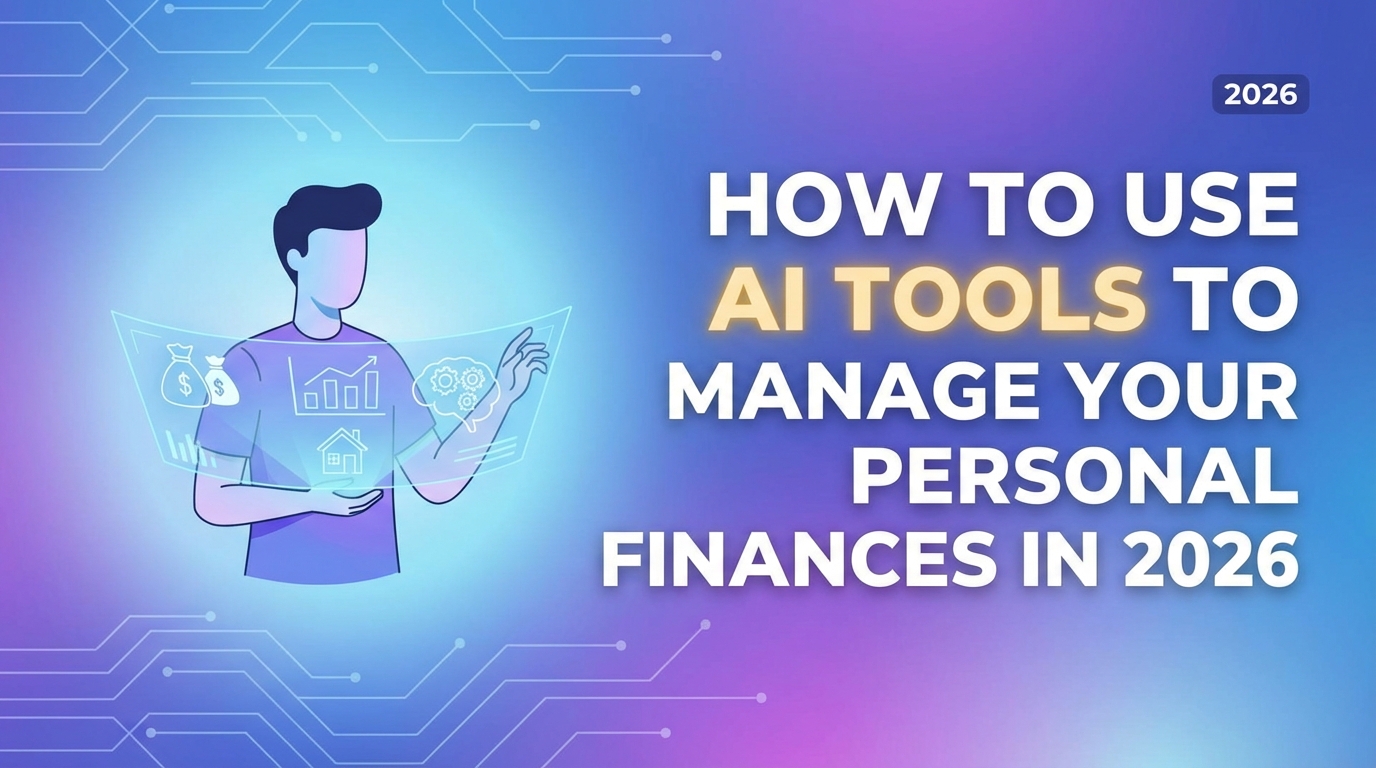
Money apps in 2026 don’t just record what happened; they interpret it. Budgets update as you spend, and portfolios rebalance in the background. Chat-style helpers can explain everything from ETFs to tax brackets in plain language.
The real shift is learning how to use AI personal finance tools in 2026 without handing over control, privacy, or decision quality.
This guide is built for adoption. It shows what to compare, what to trust, what to avoid, and how to choose a setup that still works as your income, goals, or markets change.
What Changed in 2026: From Tracking Money to Predicting It
In 2026, personal finance stopped being a record-keeping problem and became a real-time decision problem. The old routine exports transactions, categorizes them, then reacts; breaks because it runs on a delay. Spreadsheets can be precise, but they don’t stay current unless you feed them constantly. By the time you update the sheet, your spending has already moved, bills have posted, and small leaks have compounded.
AI tools shift the focus from “what happened” to “what’s about to happen.”Instead of end-of-month surprises, you get rolling cash-flow forecasts that update as you spend. You also get month-end projections based on spending pace and risk alerts before you cross a threshold or miss a payment.
The biggest upgrade is context. Modern systems recognize seasonality, like summer utility spikes, and routine behavior, like your usual grocery range. They also flag anomalies, such as a charge that doesn’t match your patterns.
The new baseline is simple: automation handles tracking, and prediction protects outcomes.
Why Compare AI Finance Tools: The Capabilities That Actually Matter
AI adoption has moved from optional to default, but most people still run money across multiple apps. That fragmentation creates blind spots, especially when a tool can’t see the full picture or explain how it reached a recommendation. Comparison matters in 2026 because accuracy, privacy, and decision quality vary sharply across platforms.
A reliable 2026 tool should prove four capabilities:
- Predictive budgeting & cash-flow forecasting: projects month-end outcomes, flags bill spikes, tracks spending velocity.
- Behavioral spending intelligence: spots triggers, lifestyle creep, and opportunity cost, not just categories.
- Automated investment optimization: supports disciplined rebalancing, tax-aware moves, and goal-based allocation.
- Real-time fraud detection & security: flags pattern breaks early, before damage spreads.
What Are AI-Powered Personal Finance Tools in 2026
Most tools fall into five groups. Match the tool to the job, not the interface.
-
Budgeting + Cash Flow Apps
These tools handle daily visibility. They auto-sort spending, surface trends, and send real-time alerts. They flag low balances, odd charges, due dates, and overspending. They also catch subscription leaks and price hikes.
Many offer simple forecasts like, “You’ll land at X by month-end.” They break down on long-horizon planning. Goals become buckets, not tradeoffs. Tax and retirement modeling is usually thin. Use them for guardrails and early warnings.
Strengths
- Great for spending clarity and habit correction
- Alerts, subscription cleanup, category trends
- Easy entry point for most users
Limitations
- Limited investing and tax depth
- Often struggles with long-range planning beyond basic goals
-
Investing Assistants
These tools are built for research and monitoring. They summarize companies and ETFs, highlight risks, and track portfolio drift. They help screen ideas using plain language queries. They fail when cash flow matters.
They don’t feel debt pressure or upcoming bills. They can nudge action without full constraints. Use them for faster analysis, not life planning.
Strengths
- Research support for stocks/ETFs
- Portfolio monitoring and watchlists
- Useful for active investors
Limitations
- Typically blind to cash flow, debt, and real-life constraints
- Can push signals without full context
-
Advisor-Grade Planning Platforms
These systems aim for full-context reasoning. They connect spending, saving, investing, and net worth. They model scenarios like job change or early retirement. They add guardrails through stronger calculation logic.
They can still depend on clean integrations. They won’t replace tax or legal specialists. Use them for multi-goal planning and decision fatigue.
Strengths
- Cross-account reasoning (spend + save + invest + plan)
- Better guardrails for accuracy and consistency
- Built for continuity, not one-off answers
Limitations
- Value depends on integration quality
- Still not a replacement for specialist tax/legal decisions
-
Standalone LLMs (ChatGPT/Gemini)
These are best for learning and decision prep. They explain concepts clearly and build checklists. They draft scripts for fees, loans, and negotiations. They cannot see your accounts. Outputs depend on your inputs. Math can drift without structure. Share only sanitized numbers, never identifiers.
Strengths
- Explains concepts quickly
- Helps you draft questions for banks/advisors
- Useful for comparing options in plain language
Limitations
- No live account context
- Can be overconfident with incomplete inputs
- Calculation slips are possible without verification
-
Human Financial Advisors
Humans win on judgment and nuance. They handle taxes, inheritance, business income, and complex debt. They help with values-based tradeoffs and accountability. Their weakness is frequency. Advice is episodic and can be expensive. Use them for high-stakes choices and major life transitions.
Strengths
- Judgment for complex, nuanced decisions
- Helps align strategy with values and life changes
- Strong for long-term planning and accountability
Limitations
- Not always available in real time
- Cost can be high
- Advice quality depends on how complete your shared data is
Use AI personal finance tools in 2026 to manage money with the right tool class for each job. Don’t choose based on design; choose based on what the tool can actually handle.
Comparison Table (2026 Edition)
| Feature | Standalone LLMs | Budgeting Apps | Investing Tools | Advisor-Grade Platforms | Human Advisors |
| Expense tracking | No native tracking | Strong | Minimal | Strong (if integrated) | Periodic review |
| Investment guidance | General info | Limited | Medium (portfolio-focused) | Strong (full-profile) | Strong (personalized) |
| Cross-account visibility | No | Sometimes partial | Investment-only | Yes (holistic) | Depends on what you share |
| Real-time context | No | Spend-focused | Portfolio-focused | Full financial context | Meeting-based updates |
| Math reliability | Can be inconsistent | Reliable | Reliable | High (rules + engines) | High |
| Ongoing guidance | Reactive | Alerts | Alerts/signals | Continuous monitoring | Episodic |
| Privacy/compliance controls | Varies; often not finance-native | Varies | Varies | Strongest focus | Regulated |
| Cost accessibility | Low/free | Low–medium | Medium | Medium | Highest |
AI Tools vs Human Financial Advisors: Pros and Cons
-
Where AI is stronger in 2026
AI wins on coverage and timing. It monitors spending in real time and flags drift early. It catches missed bills, duplicate charges, and unusual transactions fast. It also runs quick scenarios without scheduling delays. You can test goal changes instantly and see the knock-on effects. The biggest edge is consistency. Guidance shows up between decisions, not after damage.
-
Where humans still outperform
Humans win when the stakes and nuance rise. Tax strategy, estate planning, and business income need context that AI often lacks. Advisors also handle value-based tradeoffs. They can balance risk comfort, family priorities, and major timing choices. They add accountability when behavior becomes the real blocker. That matters during market stress and life disruption.
-
The future-proof blend
Use AI for continuous visibility and guardrails. Use humans for complex calls and major transitions. AI keeps you aligned week to week. Advisors keep you aligned decade to decade.
Final Verdict
In 2026, the best setup isn’t one app. It’s a stack with clear jobs. Use budgeting tools for spend control and alerts. Use investing assistants for research and portfolio monitoring, and advisor-grade platforms for cross-account planning.
Treat standalone LLMs as a learning layer, not an execution layer. Bring in a human advisor for taxes, estate planning, business income, and major life transitions.
AI personal finance tools 2026 work best when they handle monitoring, while big decisions stay anchored in context, privacy, and judgment.
Disclaimer: This content is for informational purposes only and should not be considered financial or investment advice. Always do your own research before trading or investing in cryptocurrencies.
Post Disclaimer
The information provided on Financepdia.com is for educational and informational purposes only and should not be considered financial, investment, or trading advice. Cryptocurrency and financial markets are highly volatile and involve significant risk. Readers should conduct their own research (DYOR) and consult with a qualified financial advisor before making any investment decisions. Financepdia.com and its authors are not responsible for any financial losses resulting from actions taken based on the information provided on this website.