



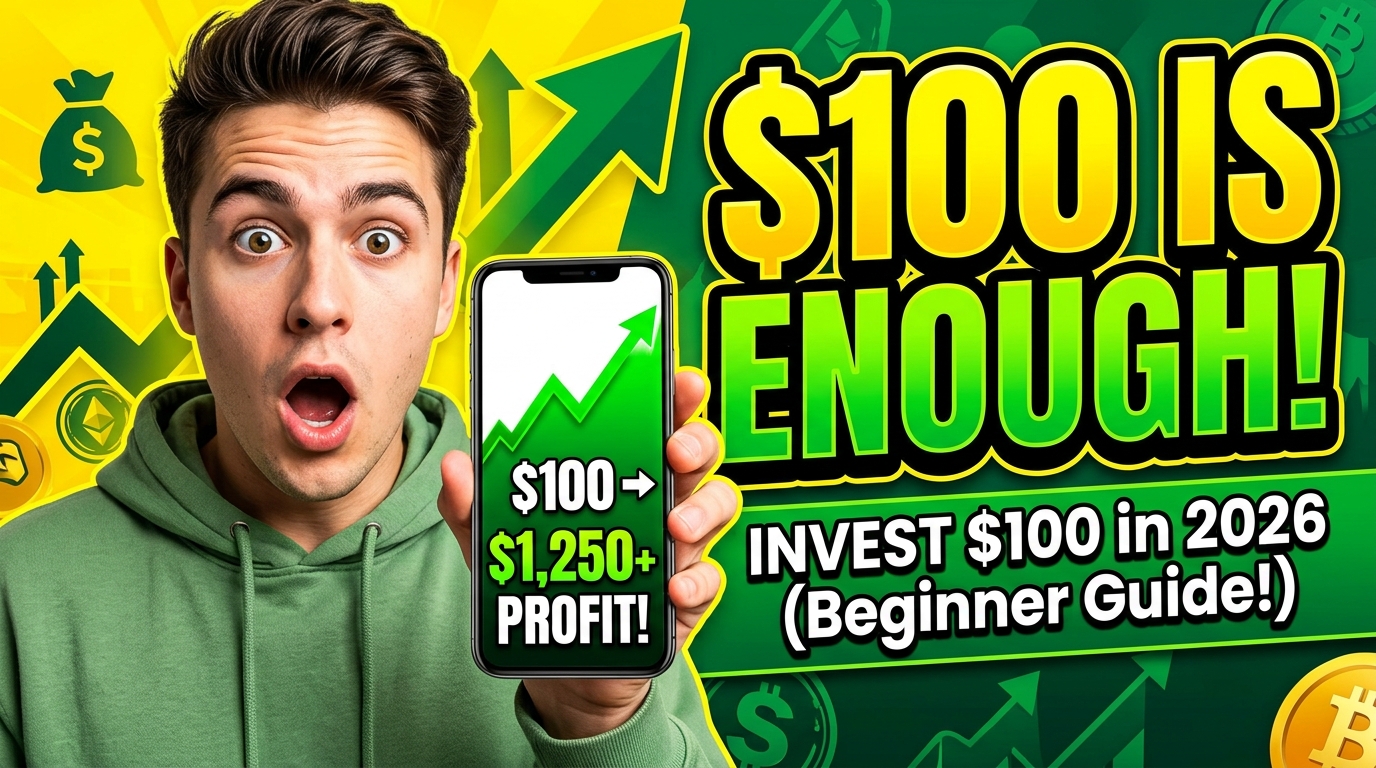
Can $100 really grow into real wealth? Yes. And 2026 is the best time to prove it.
Not long ago, you needed thousands just to open a brokerage account. Big firms had steep minimums. Stock prices locked out small investors. If one share of a top company cost $500, your $100 was useless.
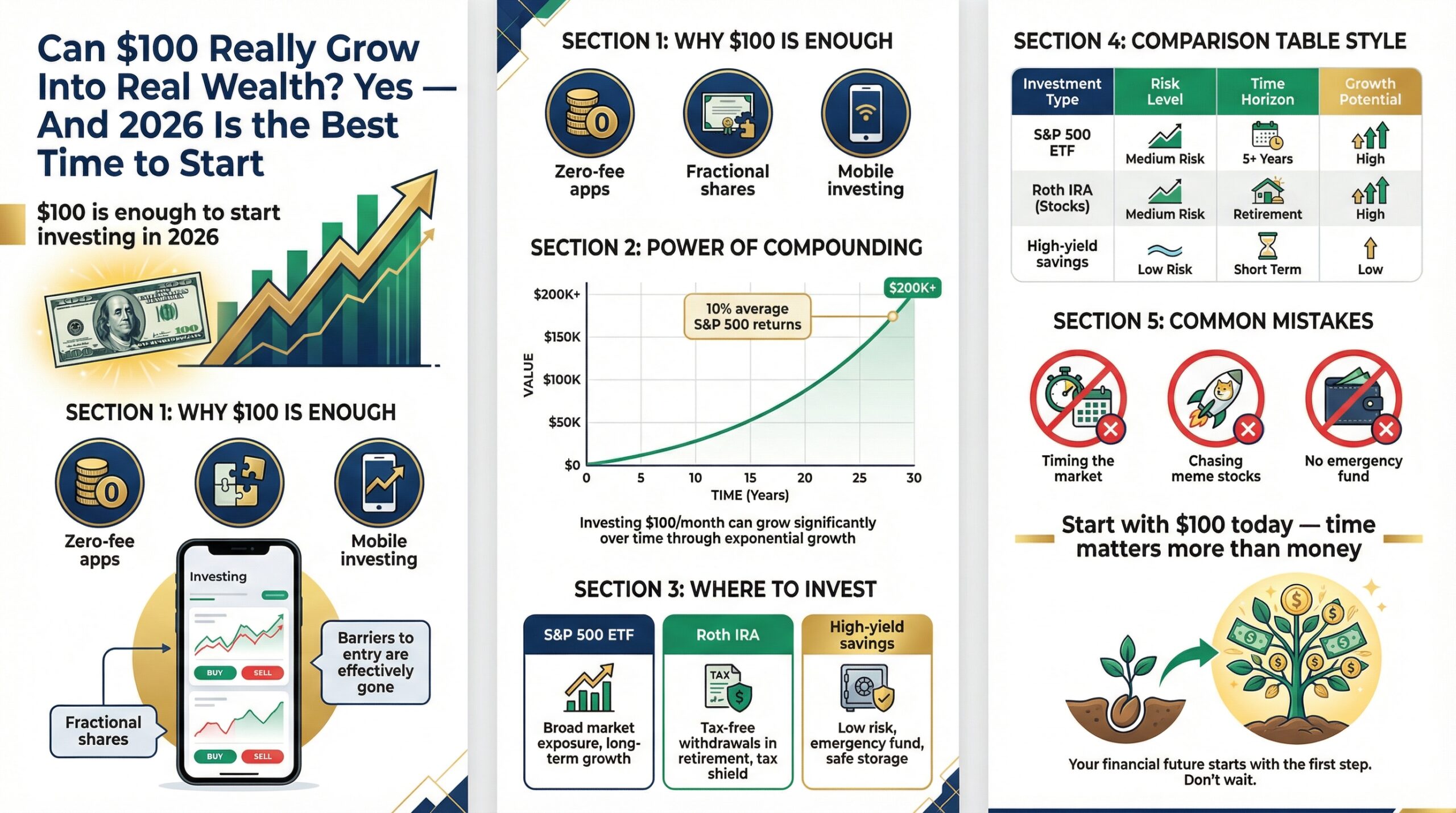
That wall is gone. Zero-fee trading apps now let anyone invest. Fractional shares let you buy a slice of any stock. No minimum balance. No broker fees. Your $100 works from day one.
Yet most people still wait. They think $100 is too small. But math says the opposite. At $100 a month and 10% returns, you could top $200,000 in 30 years. The S&P 500 has returned about 10% per year on average since 1957. Time beats timing. The key is to start now.
Key Takeaways
- $100 is enough to start. Many apps have zero minimums and free trades.
- Fractional shares changed the game. You can own a piece of any stock for as little as $1.
- Index funds are the easiest first step. One fund gives you hundreds of stocks at once.
- Tax-smart accounts save you money. The 2026 IRA limit rose to $7,500 per year.
- Starting small builds habits that stick. The goal is not the amount. It is the routine.
Why $100 Is Enough in 2026
A decade ago, $100 would barely cover account fees. Today, the barriers are almost gone.
Most major platforms charge zero trade fees. Names like Fidelity, Schwab, and Vanguard need no minimum to open. Apps like Acorns let you invest spare change from daily buys.
Fractional shares are the real game changer. Say a stock costs $400. You can buy one-quarter of that share for $100. You earn the same gains, just scaled to your size. If the stock doubles, your $100 becomes $200.
This access did not exist for regular people a short time ago. Now it does. That alone makes 2026 a great year to begin.
Where to Put Your First $100
The best choice depends on your goal and time frame. Here are the main options for a $100 budget.
Index funds and ETFs are the top pick for most new investors. One S&P 500 ETF gives you a slice of 500 companies. Buffett has called this fund type the best pick for most people (Motley Fool). Fees are tiny. Returns have been strong for decades.
A Roth IRA is a smart home for your $100 for long-term growth. You pay taxes now, but future gains grow tax-free. In 2026, the IRA limit is $7,500 per year, up from $7,000 in 2025. Most brokers let you open one with no minimum.
A high-yield savings account works if you lack an emergency fund. As of early 2026, some accounts pay 3% or more. Build a small safety net first. Then invest with peace of mind.
Comparing Your $100 Options
| Option | Risk Level | Best For | Min. to Start | Tax Benefit |
| S&P 500 ETF | Medium | Long-term growth | $1 (fractional) | None in taxable account |
| Roth IRA + ETF | Medium | Retirement savings | $0 at most brokers | Tax-free growth |
| High-yield savings | Low | Emergency fund | $0 to $1 | Interest is taxable |
| 401(k) with match | Medium | Workers with employer plan | Varies | Pre-tax or Roth option |
| Robo-advisor | Medium | Hands-off beginners | $0 to $10 | Depends on account type |
How to Pick a Platform
Not all apps are equal. Here is what matters most for a first-time investor.
- Zero fees. Avoid any app that charges to buy or sell.
- Fractional shares. This lets your $100 reach more stocks and funds.
- Easy to use. A clean, simple screen helps you learn faster.
- SIPC coverage. This insures your account up to $500,000 if the broker fails.
- Proper licensing. Stick with names regulated by the SEC or FINRA.
The Power of Starting Early
Time is your biggest asset. Not money. Not skill. Time.
The S&P 500 has returned about 10.33% per year since 1957. Some years are bad. Some are great. But over decades, the trend is up.
Here is a simple example. You invest $100 per month. You earn 10% per year on average. After 10 years, you have about $20,500. After 20 years, about $72,000. After 30 years, over $200,000. You only put in $36,000 of your own cash. The rest is growth.
That growth is called compound interest. Your gains earn more gains. The sooner you start, the more time your money has to grow.
Three Mistakes New Investors Make
Learning from others saves you pain and money.
First, many people wait for the “right time” to invest. This almost never works. A JPMorgan study found that most people earn just 2.9% per year. That is far below the market average. Why? They buy and sell at the wrong times.
Second, some chase penny stocks or meme trades. Stocks under $5 often carry huge risk. Social media hype is not sound investing.
Third, skipping the safety fund is a trap. A surprise bill could force you to sell at a loss. Build a small cash buffer first.
Frequently Asked Questions
Can I lose all my money in an index fund?
It is very unlikely. An S&P 500 fund holds 500 companies. For you to lose it all, every single one would have to fail. That has never happened. You can still lose money in a bad year. But over long stretches, broad funds have always bounced back.
Should I pay off debt before I invest?
It depends on the rate. Credit card debt often costs 20% or more per year. That is higher than any likely stock market gain. Pay off high-rate debt first. Low-rate loans, like a mortgage, can sit next to your investing plan.
Is a robo-advisor better than picking my own ETF?
Robo-advisors are great for hands-off beginners. They build and manage a mix of funds for you. The trade-off is a small fee, often 0.25% per year. For low cost and full control, a single S&P 500 ETF wins.
Disclaimer: This article is for informational purposes only. It is not financial advice. Always do your own research.
Post Disclaimer
The information provided on Financepdia.com is for educational and informational purposes only and should not be considered financial, investment, or trading advice. Cryptocurrency and financial markets are highly volatile and involve significant risk. Readers should conduct their own research (DYOR) and consult with a qualified financial advisor before making any investment decisions. Financepdia.com and its authors are not responsible for any financial losses resulting from actions taken based on the information provided on this website.