


When spot Bitcoin ETFs launched in January 2024, something historic happened. For the first time, regular people could buy Bitcoin through a normal brokerage account. No crypto wallet. No private keys. No confusing exchanges. Just a simple ticker symbol, like buying shares of Apple.
Before that, crypto investing felt like a private club. Hedge funds and wealthy investors had the tools and access. Retail investors had fear and confusion. That gap has been closing fast. In 2026, crypto ETFs hold over $90 billion in total net assets. BlackRock, Fidelity, and Grayscale lead the pack. ETFs now exist for Bitcoin, Ethereum, Solana, XRP, and more. But should you, as a regular investor, actually care? Let us walk through it together.
Key Takeaways
- Crypto ETFs let you invest in Bitcoin or Ethereum through a regular brokerage.
- No crypto wallet or exchange account needed.
- Spot Bitcoin ETFs charge between 0.20% and 0.25% in annual fees.
- BlackRock’s IBIT alone has pulled in over $62 billion since launch.
- Crypto ETFs are available inside IRAs and some 401(k) plans.
- They carry real risks including volatility, tracking error, and no staking rewards.
- Less than 0.5% of US advised wealth is in crypto so far. The space is still early.
What Is a Crypto ETF and How Does It Work
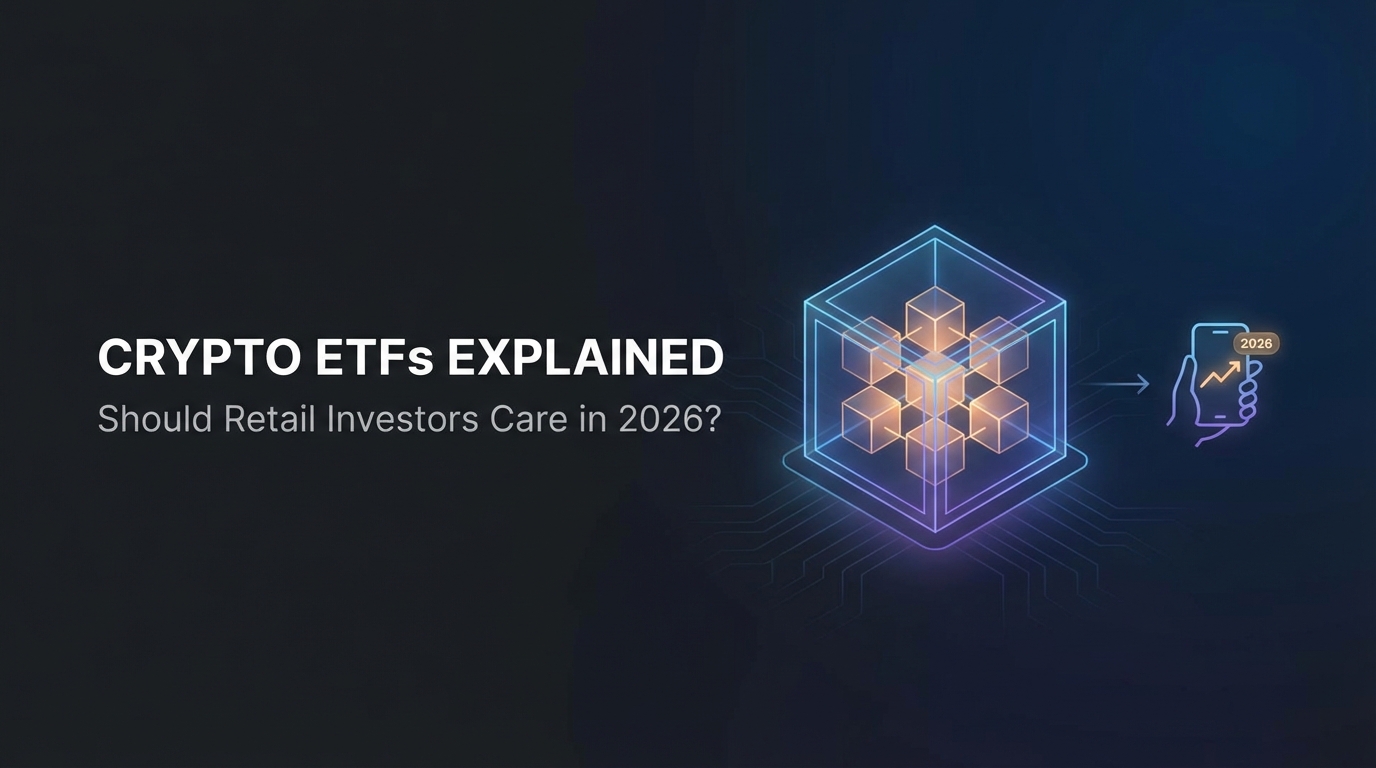
An ETF is an exchange-traded fund. It trades on the stock market like a regular stock. A crypto ETF holds cryptocurrency for you. You buy shares. The fund holds the actual Bitcoin or Ethereum behind those shares.
There are two main types. Spot ETFs hold real crypto. Futures ETFs hold contracts that bet on future prices. Spot ETFs track prices more closely. They also charge lower fees. Most experts recommend spot over futures for long-term holding.
When you buy a share of BlackRock’s IBIT, for example, you are buying a tiny piece of all the Bitcoin that fund holds. Your brokerage handles everything. You see it in your portfolio like any other stock.
Which Crypto ETFs Exist in 2026
The market has expanded fast since 2024. Here is what is available now.
| ETF Name | Ticker | Asset | Expense Ratio | Provider |
| iShares Bitcoin Trust | IBIT | Bitcoin | 0.25% | BlackRock |
| Wise Origin Bitcoin Fund | FBTC | Bitcoin | 0.25% | Fidelity |
| Bitwise Bitcoin ETF | BITB | Bitcoin | 0.20% | Bitwise |
| Grayscale Bitcoin Mini Trust | BTC | Bitcoin | 0.15% | Grayscale |
| iShares Ethereum Trust | ETHA | Ethereum | 0.25% | BlackRock |
| Fidelity Ethereum Fund | FETH | Ethereum | 0.25% | Fidelity |
Beyond these, ETFs for Solana, XRP, and even Dogecoin now exist. On the first trading day of 2026, crypto ETFs pulled in a combined $670 million. Bitcoin products led with $471 million. Ethereum added $174 million.
(Source: BeInCrypto)
Why Retail Investors Should Pay Attention
Crypto ETFs solve the biggest barriers that kept everyday people out.
- No technical knowledge needed. You do not need a wallet, seed phrase, or exchange account. Your existing brokerage handles it.
- Tax reporting is simpler. ETFs issue standard 1099 forms. Direct crypto ownership creates complex tax events.
- Available in retirement accounts. You can hold crypto ETFs inside an IRA or 401(k). That was not possible with direct crypto.
- Regulated and insured. ETFs trade on regulated stock exchanges. Your brokerage likely carries SIPC protection.
- Low minimum investment. Buy one share for under $50 in many cases. No minimum balance required.
BlackRock’s Jay Jacobs said it best in January 2026. He noted that many investors are just starting their learning journey around Bitcoin and how it fits a portfolio.
(Source: CNBC)
Grayscale estimates that less than 0.5% of US advised wealth is allocated to crypto. That number is expected to grow as more platforms add crypto to their model portfolios.
(Source: Grayscale 2026 Outlook)
The Risks You Need to Understand
Crypto ETFs are easier to access. But they still carry real risks. Do not skip this section.
Volatility is extreme. Bitcoin fell roughly 44% from its October 2025 high. Five straight red months followed. ETF holders felt every bit of that drop. Your shares go down when Bitcoin goes down.
You do not own actual crypto. ETF shares are not Bitcoin. You cannot send them, stake them, or use them in DeFi. You own a piece of a fund, not the asset itself.
No staking rewards. If you hold Ethereum directly, you can earn 3% to 5% through staking. ETF holders do not get that yield. You miss out on extra income.
Tracking error exists. Futures-based ETFs like BITO can diverge from Bitcoin’s price by 5% to 12% per year. Spot ETFs are much tighter, usually within 1.5%.
Fees compound over time. A 0.25% annual fee sounds small. Over 10 years on a $10,000 investment, it adds up. Compare that to holding crypto directly with zero ongoing fees.
February 2026 saw $3.8 billion in ETF outflows. That was the worst month since launch. Markets can turn fast. Be prepared for drawdowns.
(Source: Blockhead)
Should You Invest? A Simple Framework
There is no one right answer. But here is a way to think about it.
A crypto ETF might suit you if you want simple, regulated crypto exposure. It fits best for buy-and-hold investors. It works well inside retirement accounts. It is ideal if you do not want to manage wallets or keys.
Direct crypto ownership might suit you better if you want staking rewards. It works if you plan to use DeFi. It is cheaper long-term with no annual fees. It gives full control over your assets.
Wealth managers at major banks now suggest 1% to 5% crypto allocation. That is a small, manageable position. It gives exposure without betting the farm.
The Bottom Line for Retail Investors
Crypto ETFs have removed the biggest friction points. Access, complexity, and regulation are no longer excuses. The tools are here. The question is whether crypto fits your goals and risk tolerance.
Start small if you are curious. Learn as you go. Use the ETF wrapper if you want simplicity. Go direct if you want full control. Either way, understand what you own and why.
This is still early. That means opportunity. It also means risk. Both are real.
This article is for informational purposes only. It is not financial advice. Crypto markets are highly volatile. Always do your own research. Never invest more than you can afford to lose.
Frequently Asked Questions
Can I lose all my money in a crypto ETF?
In theory, if Bitcoin’s price went to zero, your ETF shares would be worthless. In practice, a total loss is extremely unlikely for an established asset like Bitcoin. However, losses of 30% to 50% have happened in past cycles. Only invest what you can afford to lose.
Are crypto ETFs safer than buying Bitcoin on an exchange?
They reduce certain risks like exchange hacks and lost passwords. But they do not reduce price risk. If Bitcoin drops 40%, your ETF drops 40% too. The safety is in custody and regulation, not in price protection.
Will crypto ETFs eventually include more coins beyond Bitcoin and Ethereum?
They already do. As of early 2026, ETFs for Solana, XRP, and Dogecoin have launched with initial inflows. The trend is toward broader crypto access through regulated products. Expect more variety as the market matures.
Disclaimer: This article is for informational and educational purposes only and should not be considered financial or investment advice. Cryptocurrency markets are volatile and involve risk.
Post Disclaimer
The information provided on Financepdia.com is for educational and informational purposes only and should not be considered financial, investment, or trading advice. Cryptocurrency and financial markets are highly volatile and involve significant risk. Readers should conduct their own research (DYOR) and consult with a qualified financial advisor before making any investment decisions. Financepdia.com and its authors are not responsible for any financial losses resulting from actions taken based on the information provided on this website.