






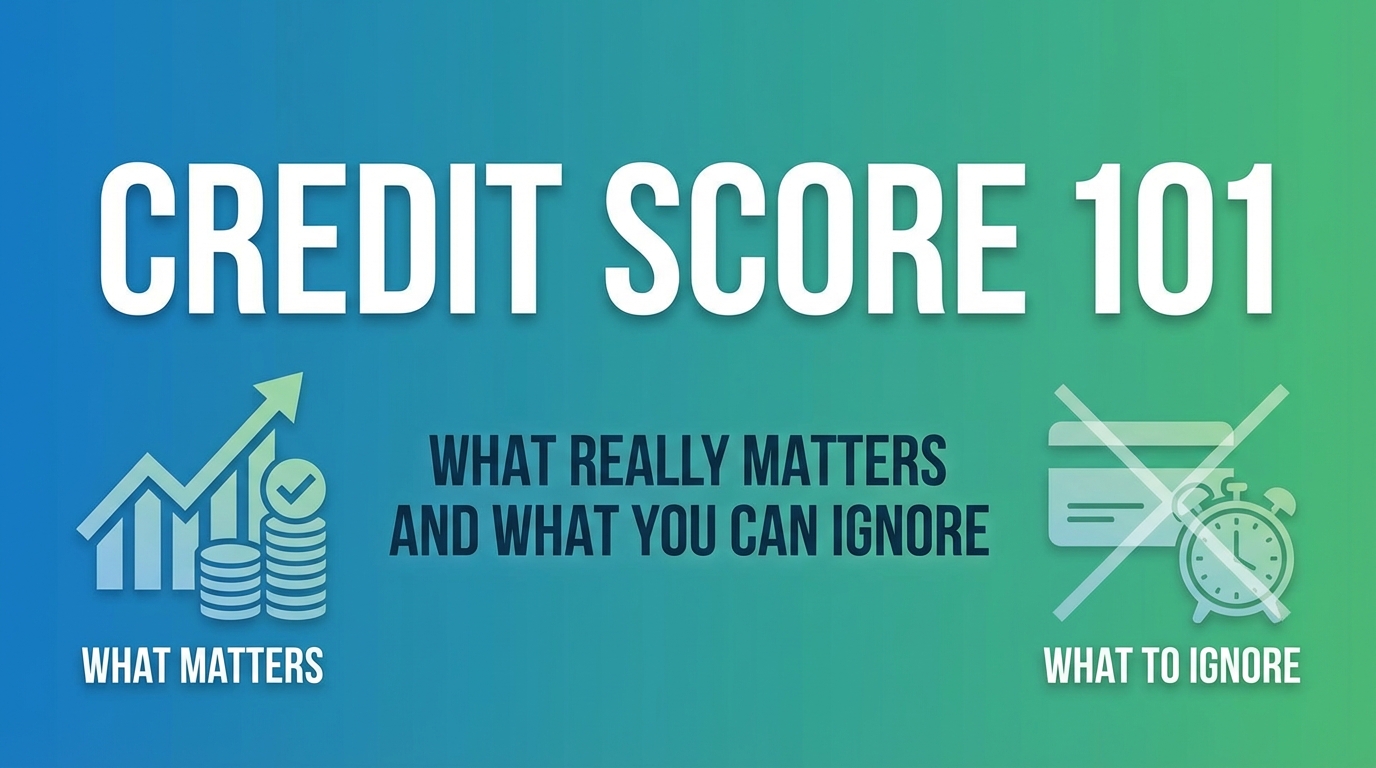
Credit Score 101: What Really Matters And What You Can Ignore

Credit Score 101: What Really Matters And What You Can Ignore

Why does one person get approved for a low-interest loan in minutes, while another gets rejected without a clear reason? In most cases, the difference is their credit score. Your credit score is a three-digit number that shows how responsibly you handle borrowed money. Lenders use it to judge risk before approving loans or credit cards. It reflects your payment history, how much of your available credit you use, and how steadily you manage debt. 

It does not measure your income, job title, or savings. It focuses only on your credit behavior, which is summarized in your credit report and evaluated using a credit scoring model such as FICO Score or VantageScore

Scores usually range from 300 to 850. Higher scores signal lower risk and often unlock better rates and approvals. Your score changes with your habits. Paying on time helps. High balances and missed payments hurt. What matters most is consistent behavior over time. Now that you understand what a credit score actually is, let’s look at what truly makes it rise or fall.

How Credit Scores Are Calculated (The 5 Core Factors)

Your credit score is not pulled out of thin air. It is calculated using five specific factors, and each one plays a clear role in shaping your number.

  1. Payment history carries the most weight. Lenders look at whether you pay your bills on time. Late payments, collections, and defaults can lower your score quickly because they signal higher risk.
  2. Credit utilization is the second major factor. This is the percentage of your available credit that you are using. If you have a $10,000 limit and carry a $5,000 balance, you are using 50%. Lower usage generally helps your score.
  3. Length of credit history shows stability. Older accounts with steady activity build trust.
  4. Credit mix considers the types of credit you manage, such as credit cards, auto loans, or mortgages.
  5. New credit and hard inquiries reflect recent applications. Multiple applications in a short period can signal risk.

Lenders rely on this score to decide loan approvals, interest rates, credit limits, rental approvals, and even certain background checks. A stronger score gives you leverage and better financial terms.

What Really Matters

Payment History: The Single Most Important Factor

If there is one area you cannot afford to ignore, it is payment history. This factor carries the most weight in your credit score calculation. Lenders review whether you paid at least the minimum amount by the due date. A payment that is 30 days late or more can be reported as a delinquency, which can lower your score. 

More severe delays, such as 60 or 90 days late, cause greater damage and may lead to default status. Negative marks can remain on your credit report for up to seven years under the Fair Credit Reporting Act (FCRA). The impact fades over time, but the record stays. Consistent, on-time payments build long-term credibility.

Credit Utilization: The Second Biggest Lever

Credit utilization measures how much of your available credit you are using. It is calculated as a percentage. If your total credit limit is $5,000 and your balance is $1,500, your utilization is 30%. Staying below 30% is important for maintaining a healthy score. 

Staying closer to 10% shows stronger control. High balances, even when paid on time, can lower your score because they signal higher risk.

Length Of Credit History: Why Time Works In Your Favor

Your score considers the age of your oldest account and the average age of all accounts. Older accounts demonstrate stability. Closing a long-standing credit card can reduce your average account age and lower your score. Time and steady management strengthen your profile.

Stability And Consistency Over Short-Term Moves

Credit scoring models reward steady behavior. Frequent account openings, balance spikes, or sudden closures can create instability. Reliable patterns carry more weight than temporary strategies. Building credit is a long-term process.

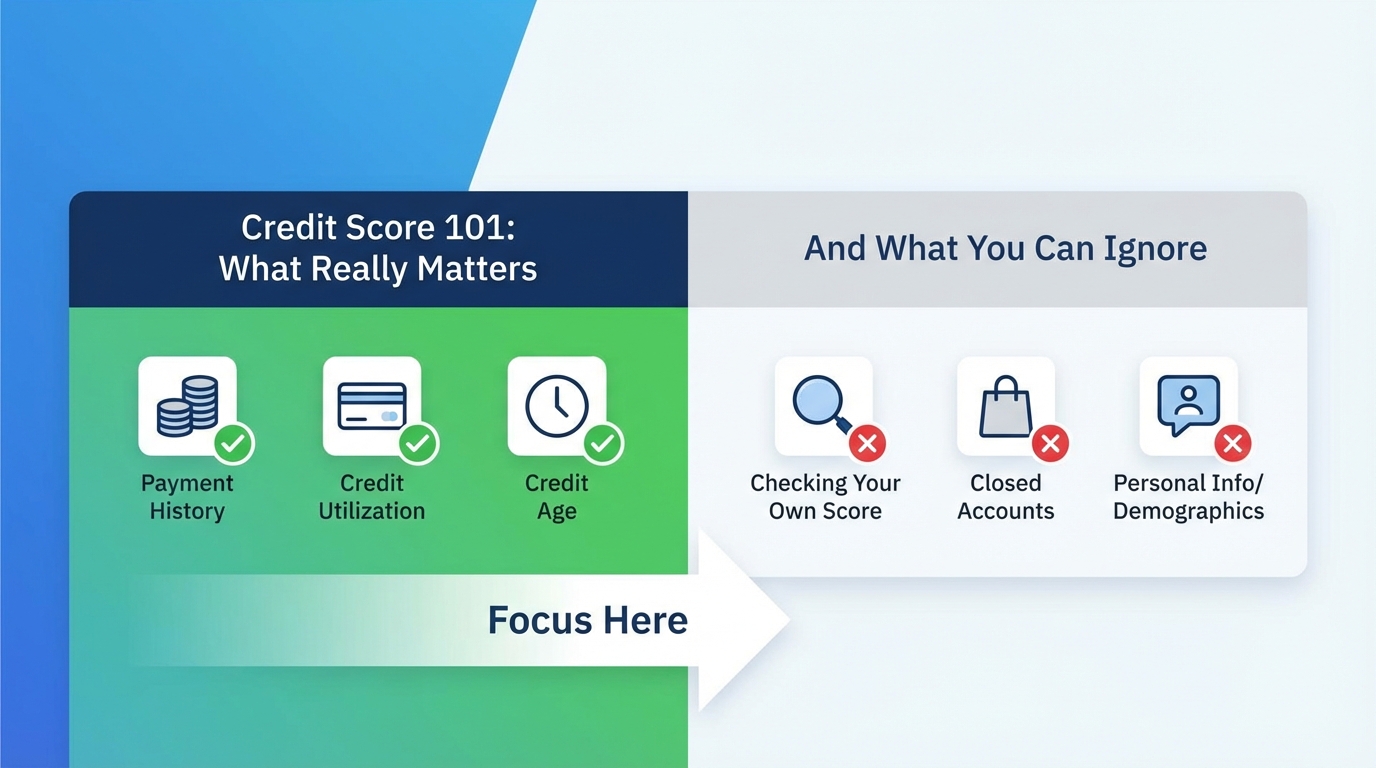
If You Only Focus On Three Things

To simplify your approach, prioritize these habits:

  • Never miss a payment.
  • Keep your credit utilization low.
  • Maintain older accounts whenever possible.

These actions drive most of your score and remove unnecessary guesswork.

What You Can Ignore

Many people lose points in their own mind before they ever lose them on paper. Credit advice online often sounds urgent, but not every warning deserves your attention. Knowing what to ignore protects your focus and reduces unnecessary stress.

Checking Your Own Credit Score

Reviewing your own credit report creates a soft inquiry. Soft inquiries do not affect your score. You can check your score as often as you like without damage. In fact, regular monitoring helps you catch errors early.

Carrying A Balance To “Build Credit”

You do not need to carry a balance to improve your score. Paying your statement in full still counts as positive activity in your payment history record. Interest charges do not strengthen your credit profile. Responsible use matters more than revolving debt.

Income Level

Your salary is not included in credit score calculations. Credit scoring models evaluate behavioral data, not income verification. A higher income may influence debt-to-income ratio (DTI) during loan underwriting, but it does not directly raise your score.

Small Score Fluctuations

Changes of 5 to 10 points are normal. Balances update monthly, and minor shifts reflect normal activity. Focus on trends, not small swings.

Occasional Hard Inquiries

A single hard inquiry may lower your score slightly, often by only a few points. The effect is usually temporary. Multiple applications in a short period matter more than one.

Credit Mix Obsession

You do not need every type of loan to build strong credit. Opening unnecessary accounts adds risk without real benefit. Solid payment history and low balances carry far more weight.

A Simple Framework to Evaluate Your Own Credit Health

If you want clarity about your credit, you do not need advanced tools. You need a focused checklist. Most strong credit profiles share three clear traits. When these areas are healthy, your score usually reflects it. When one area weakens, your score responds. This framework keeps your attention on the factors that carry real weight.

1) Payment Discipline

  • Are you 100% on time with every payment?
  • Have you avoided any 30-day late reports?
  • Are automatic payments set up for key accounts?

Payment history is the largest scoring factor. A single reported late payment can remain on your record for up to seven years. Consistent, on-time payments build measurable trust.

2) Utilization Control

  • Is your total credit usage below 30% of your limits?
  • Are you closer to 10% or lower for stronger positioning?

Utilization is calculated as a percentage of your available credit. Lower balances show financial control and reduce perceived risk.

3) Stability

  • Are your oldest accounts still open and active?
  • Is your average account age increasing over time?

Long-standing accounts signal reliability. Stability strengthens your profile and supports long-term growth.
Credit Score 101: What Really Matters And What You Can Ignore

How To Improve Your Credit Score Step By Step 

Improving your credit score is not about luck. It is about following clear steps in the right order. When you focus on actions that directly affect scoring factors, results become easier to track. This plan is practical and direct. Each step targets a specific part of your credit profile. Follow it consistently, and you create steady improvement instead of short-term spikes.

Step 1: Pull Your Credit Report

  • Request your report from the three major credit bureaus: Experian, Equifax, and TransUnion.
  • Review every account, balance, and payment record carefully.
  • Check for errors, duplicate accounts, or unfamiliar activity.

Accurate information is the foundation of a strong score.

Step 2: Identify Late Payments

  • Look for any 30, 60, or 90-day late payments.
  • Confirm whether each mark is correct.
  • Dispute inaccuracies promptly through the reporting bureau.

Payment history carries the most weight, so accuracy is critical.

Step 3: Reduce High Balances

  • Focus on accounts above 30% utilization.
  • Prioritize paying balances down toward 10% or lower.
  • Consider mid-cycle payments to lower reported balances.

Lower utilization can lead to noticeable improvement within a few months.

Step 4: Set Autopay

  • Enable automatic payments for at least the minimum due.
  • Choose a payment date before the deadline for safety.

This protects your payment history from avoidable mistakes.

Step 5: Monitor Monthly

  • Review balances and payment activity each month.
  • Track utilization levels and new inquiries.
  • Adjust spending if balances begin to rise.

Consistent monitoring keeps progress steady and prevents setbacks.

Why Understanding What To Ignore Reduces Financial Stress

Worry often comes from misunderstanding how credit scoring works. When you know what truly matters, you stop reacting to every small change and start focusing on steady progress. That shift alone reduces financial pressure and builds control.

Score fluctuations are normal. Changes of 5–10 points can happen when balances update each month. Small dips do not signal long-term damage.

You do not need a perfect 850. Scores in the upper 700s already qualify for competitive rates in most lending decisions.

Lenders review ranges, not exact numbers. Moving into a stronger bracket matters more than minor point increases.

Consistency beats quick fixes. On-time payments and low balances drive lasting results.

When you focus on patterns instead of perfection, your confidence grows and stress decreases.

How Credit Scores Impact Loans, Credit Cards, And Rates

Your credit score directly affects what lenders offer you. It influences approvals, interest rates, and credit limits. Even a small move between score ranges can change the cost of borrowing.

  • Score ranges drive decisions. Scores above 760 often qualify for the lowest rates, while scores below 650 face higher interest and tighter approval standards.
  • Higher scores reduce total loan costs. A lower rate can save thousands over the life of a mortgage or auto loan.
  • Strong credit increases flexibility. It improves approval odds, raises borrowing limits, and gives you better negotiating power with lenders.

Summing Up 

Why does one person get approved for a low-interest loan in minutes, while another gets rejected without a clear reason? The answer is rarely income or luck. It is usually a stronger credit profile built over time.

Your credit score rewards measurable behavior. On-time payments carry the most weight. Low credit utilization strengthens your position. Older accounts add stability. These are not theories. They are the core drivers behind lending decisions.

You need consistent habits. Small fluctuations are normal. What lenders watch is your long-term pattern. When you focus on what truly matters and ignore distractions, your progress becomes steady and predictable. Strong credit is built through discipline, and discipline creates financial opportunity.

Disclaimer: This content is for educational and informational purposes only and does not constitute financial advice. Always consult a qualified financial professional before making credit decisions.

Post Disclaimer

The information provided on Financepdia.com is for educational and informational purposes only and should not be considered financial, investment, or trading advice. Cryptocurrency and financial markets are highly volatile and involve significant risk. Readers should conduct their own research (DYOR) and consult with a qualified financial advisor before making any investment decisions. Financepdia.com and its authors are not responsible for any financial losses resulting from actions taken based on the information provided on this website.

US Crypto Tax Rules 2026: Track Your IPO Genie Gains Properly

Learn the US crypto tax rules for 2026 and how to track IPO Genie gains correctly. Understand taxable events, cost basis, and new IRS reporting rules.

The win feels great until tax season shows up

You made solid gains on IPO Genie. Watching the numbers go up feels great. But then tax season arrives, and suddenly the questions start piling up.

Where did you buy the tokens?
How much did you pay for them?
Did you swap them anywhere before selling?

Many crypto investors discover too late that profit alone is not enough. The IRS wants proof of how that profit happened. If your trades sit across exchanges, wallets, and token swaps, missing records can turn a clean gain into a stressful filing situation. So here’s the real question: can you clearly show how much you earned and how you calculated that number?

Understanding the U.S. crypto tax rules for 2026 helps you avoid surprises and track your IPO Genie gains the right way.

What Changed In 2026 For U.S. Crypto Taxes?

Crypto taxes did not suddenly appear in 2026. The IRS has already taxed digital assets for years. What changed now is how closely transactions get tracked and reported. Several reporting updates and compliance rules now push investors toward better record-keeping.

Here are the changes that matter most.

1. Exchanges Now Report Crypto Activity Through Form 1099-Da

The biggest shift comes from Form 1099-DA, a new reporting form created specifically for digital asset transactions.

  • Crypto exchanges and brokers must send this form to both you and the IRS.
  • It reports sales and exchanges of digital assets made on the platform.
  • The rule applies to transactions starting January 1, 2025, which means investors begin seeing these forms when filing in 2026

This move gives the IRS clearer visibility into crypto trading activity. The IRS now receives more direct information about your transactions. If the numbers on your tax return do not match exchange reports, questions may follow.

2. Cost Basis Reporting Becomes More Important

Early versions of the reporting system focus mainly on gross proceeds, meaning the amount you received when selling crypto.  But starting with 2026 transactions, brokers will begin including cost basis details, the price you originally paid for the asset. 

That number determines the real taxable gain.

For example:

  • Buy IPO Genie tokens for $4,000
  • Sell them later for $10,000

Your taxable gain = $6,000, not $10,000.

Without proper basis records, the IRS could assume the entire sale amount counts as profit. This is why tracking purchase price matters more than ever.

3. Crypto Still Counts As Property, Not Currency

One rule has not changed:

The IRS treats cryptocurrency as property. That means crypto transactions follow the same general tax rules as other investment assets.

Several common actions can trigger taxes:

  • Selling crypto for cash
  • Swapping one crypto for another
  • Using crypto to buy goods or services

Each of these events can create capital gains or losses. Many investors assume taxes only apply when money hits their bank account. In reality, tax events can happen long before that.

4. The IRS Now Asks Every Taxpayer About Digital Assets

Another important compliance step sits right on the tax return itself.

Every taxpayer must answer a question on their federal return asking whether they received, sold, or exchanged digital assets during the year. That simple yes-or-no question forces investors to acknowledge crypto activity during filing.

Skipping it or answering incorrectly can create problems later if the IRS already has transaction data from exchanges.

5. Broker Reports Do Not Show Everything

Even with improved reporting, exchange forms still miss some information.

For example, a broker may not see:

  • Transfers between wallets
  • Transactions on foreign exchanges
  • DeFi activity without intermediaries 

So even with Form 1099-DA, your own records still matter. Think of exchange reports as a starting point, not the full picture.

Crypto tax rules did not suddenly change overnight. What changed is visibility. More reporting forms, clearer IRS oversight, and stronger documentation requirements mean casual record-keeping no longer works.

If you want to keep your IPO Genie gains clean and easy to report, tracking your transactions carefully is no longer optional.

What Counts As A Taxable IPO Genie Gain?

Many investors believe taxes only apply when they convert crypto into cash. That assumption creates confusion for many traders. In reality, several common crypto activities can trigger a taxable event under U.S. tax rules.

1. Selling IPO Genie Tokens For Dollars

Selling IPO Genie tokens for U.S. dollars or converting them into stablecoins that are later turned into cash usually creates a capital gain or capital loss.

The IRS calculates this gain using a simple formula. It compares:

  • Your purchase price (cost basis)
  • The amount you receive when selling

For example, if you bought IPO Genie tokens for $3,000 and later sold them for $7,000, the taxable gain would be $4,000. That difference becomes the amount used when calculating your crypto tax obligation.

2. Swapping IPO Genie For Another Cryptocurrency

Many investors trade one token for another instead of selling directly for cash. However, this type of transaction can still trigger taxes.

When you swap IPO Genie tokens for another cryptocurrency, the IRS generally treats the transaction as if you sold the first asset and then purchased the second one.

Even though no cash changes hands, the value of the tokens at the time of the swap determines whether you made a gain or a loss.

3. Using Crypto To Pay For Goods Or Services

Crypto payments can also trigger taxes. When you use IPO Genie tokens to buy a product or pay for a service, the IRS treats that transaction as disposing of the asset.

This means the token’s market value at the time of payment gets compared to the price you originally paid for it. If the value increased, the difference becomes a taxable gain. If the value dropped, you may record a loss.

These rules often surprise new investors. Many people assume taxes only start when crypto turns into cash. In practice, the IRS treats digital assets like property. Because of that classification, many types of transactions can create taxable events, not just withdrawals to a bank account.

The One Number That Matters: Your Cost Basis

When it comes to crypto taxes, one number drives the entire calculation: your cost basis. Many investors focus only on the selling price of a token, but the IRS looks at something different. It wants to know how much you originally paid for the asset before deciding how much of your profit is taxable.

Your cost basis represents the total value you spent to acquire the cryptocurrency. This amount forms the starting point for calculating gains or losses when you sell, swap, or use that asset.

In simple terms, cost basis answers one question: What did this investment actually cost you?

What Cost Basis Includes

Cost basis usually includes more than just the price of the token. It can also include certain costs related to the transaction.

Typical components may include:

  • The purchase price of the token
  • Exchange or trading fees
  • Transaction or network fees tied to the purchase
  • Broker or platform charges

For example, if you buy IPO Genie tokens worth $2,500 and the exchange charges a $100 transaction fee, your actual investment becomes $2,600, not $2,500. That full amount becomes your cost basis.

Understanding this detail matters because fees can slightly reduce your taxable gain later.

How Cost Basis Determines Your Crypto Gain

Whenever you sell, exchange, or spend crypto, the IRS calculates whether the asset increased or decreased in value during the time you held it.

The formula remains straightforward:

Capital Gain or Loss = Sale Value – Cost Basis

If the sale value is higher than your cost basis, you record a capital gain.
If the sale value is lower than your cost basis, you record a capital loss.

This simple comparison determines the amount that appears on your tax return.

A Simple IPO Genie Example

Imagine you purchased IPO Genie tokens early and decided to sell later.

  • You bought IPO Genie tokens for $2,500
  • You paid $100 in exchange fees
  • Your total cost basis becomes $2,600

Later, you sell the tokens for $6,500.

Your taxable gain would be calculated like this:

$6,500 – $2,600 = $3,900

That $3,900 becomes the capital gain reported on your tax return.

If the token value had dropped and you sold the tokens for $2,000 instead, the calculation would look like this:

$2,000 – $2,600 = $600 capital loss

Losses can sometimes offset gains, which is why accurate basis tracking works in your favor.

Why Cost Basis Tracking Gets Complicated In Crypto

Tracking cost basis becomes more difficult in crypto compared to traditional investments. Many investors buy tokens in one place, move them somewhere else, and eventually sell them on a different platform.

For example:

  1. You purchase IPO Genie tokens on Exchange A
  2. You transfer them to a personal wallet
  3. Later, you move them to Exchange B
  4. You sell them there

Exchange B may know how much you sold the tokens for, but it may not know how much you originally paid for them.

Because of that gap, exchange reports may only show the sale proceeds, not the full gain calculation. That leaves the responsibility on you to track the missing information.

Multiple Purchases Create Multiple Cost Bases

Another layer of complexity appears when investors buy the same token multiple times.

Let’s say you buy IPO Genie tokens in three separate transactions:

  • First purchase: $1,000
  • Second purchase: $1,500
  • Third purchase: $2,000

Each purchase creates a separate cost basis because the tokens were acquired at different prices.

When you later sell part of your holdings, tax rules determine which purchase price applies to the sale. This process affects how much gain or loss you report. Without organized records, these calculations quickly become confusing.

Why Missing Cost Basis Can Create Tax Problems

Failing to track cost basis can create several problems during tax filing.

First, exchange reports may not match your tax return if important details are missing. That mismatch can lead to questions or corrections during filing.

Second, missing basis information can make your gains look larger than they actually are.

For instance, if the IRS only sees a sale worth $6,500 but does not see the original $2,600 purchase, it might assume the entire amount represents profit. That situation could inflate the reported taxable gain.

Proper records prevent this kind of confusion.

A Simple Tracking Checklist For IPO Genie Investors

Staying organized does not require complex spreadsheets. You only need to capture the right details.

Track these basics for every transaction:

  • Date you bought the token
  • Amount purchased
  • Price paid in USD
  • Fees or gas costs
  • Wallet or exchange used
  • Transfer records between wallets
  • Date sold or swapped
  • Value received at the time of disposal

Keeping these details organized ensures that when you eventually sell the tokens, your gain calculation stays accurate and easy to verify. In the world of crypto taxes, price movements grab attention. But when filing season arrives, cost basis becomes the number that matters most. 

Final Thoughts

Crypto profits feel exciting. But tax season quickly exposes weak record-keeping. In 2026, stronger reporting rules mean the IRS sees far more digital asset activity than before. Exchanges send transaction summaries. Tax returns ask direct questions about crypto activity.

That does not mean crypto taxes need to become complicated. Track your IPO Genie purchases. Record transfers between wallets. Keep your cost basis clear.

Do that consistently, and tax filing becomes a simple calculation instead of a stressful reconstruction of your trading history.

Frequently Asked Questions

Will Crypto Be Taxed In 2026?

Yes. Crypto remains taxable in the U.S. because the IRS treats digital assets as property, meaning gains from selling, swapping, or using crypto can create capital gains taxes.

What Is The New Rule In 2026 For Crypto?

The IRS introduced Form 1099-DA, requiring crypto exchanges and brokers to report digital-asset sales and transactions to both taxpayers and the IRS. This increases reporting transparency and helps the IRS match exchange data with your tax return.

Will Crypto Be Tax Free In The USA?

No. Crypto is not tax-free in the U.S.; profits from selling or trading cryptocurrency are generally subject to capital gains tax.

Is The IRS Delaying Crypto Tax Reporting Until 2026?

Not exactly. Reporting begins for transactions from 2025, with exchanges sending the first Form 1099-DA statements to taxpayers in early 2026


Post Disclaimer

The information provided on Financepdia.com is for educational and informational purposes only and should not be considered financial, investment, or trading advice. Cryptocurrency and financial markets are highly volatile and involve significant risk. Readers should conduct their own research (DYOR) and consult with a qualified financial advisor before making any investment decisions. Financepdia.com and its authors are not responsible for any financial losses resulting from actions taken based on the information provided on this website.